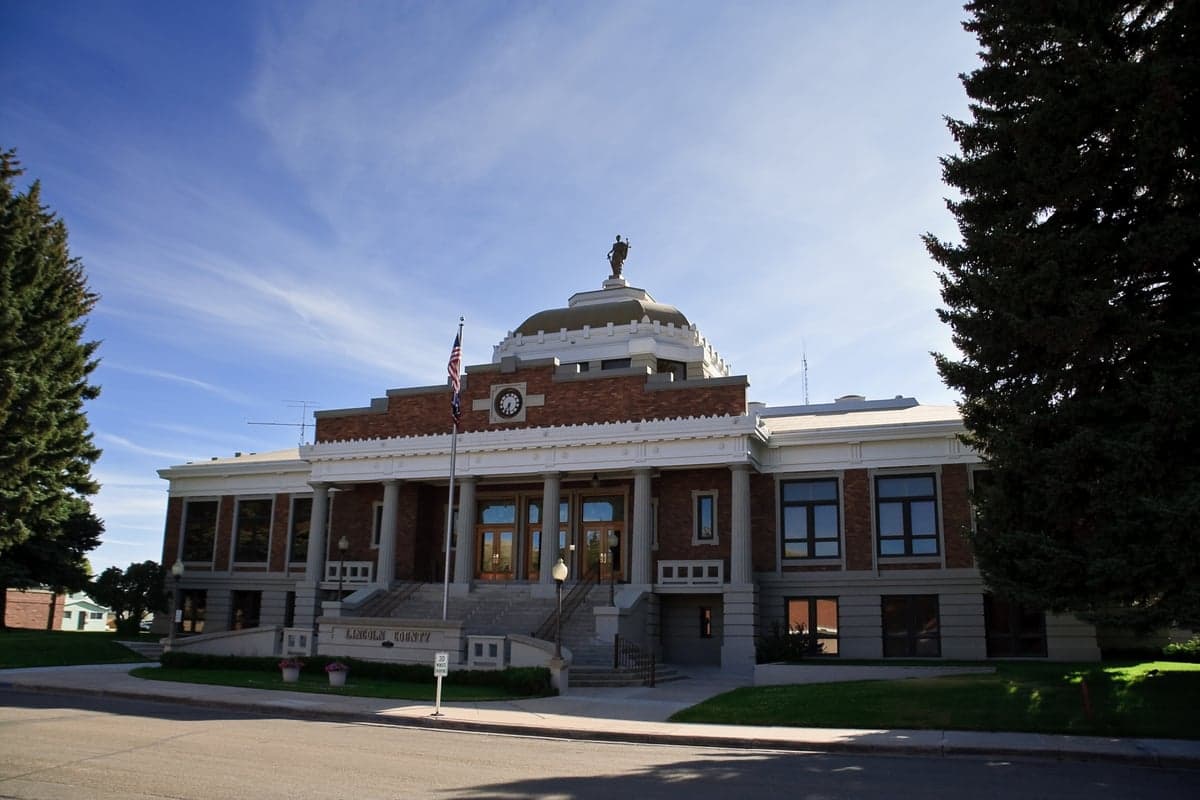
Photo: Wikipedia
Demographics of Lincoln County
Affluence Level in Lincoln County
An upper-middle-class area. Household wealth, education levels, and homeownership run ahead of national benchmarks.
People of Lincoln County
Lincoln County, Wyoming, is home to roughly 20,158 residents, a population that is 91.2% white and 5.2% Hispanic, with a foreign-born share of just 1.8%. This is a deeply rural, culturally homogeneous county shaped by successive waves of Anglo-American settlement, Mormon colonization, and resource extraction booms. Its people are characterized by a strong ranching and mining heritage, a conservative political culture, and a low population density of about 2.5 people per square mile, concentrated in small towns like Kemmerer, Afton, and Alpine.
Settlement & growth (pre-1960)
Before American settlement, the region now known as Lincoln County was part of the traditional territory of the Shoshone and Bannock peoples, who followed seasonal game and fish migrations through the Green River and Salt River valleys. The area saw sparse use by fur trappers in the early 1800s, but no permanent non-Native settlements existed until after the 1868 Fort Bridger Treaty confined the Shoshone to the Wind River Reservation far to the east.
The first permanent American settlers were Mormon pioneers dispatched from Salt Lake City in the 1870s and 1880s. The Church of Jesus Christ of Latter-day Saints (LDS) organized colonization of the Star Valley region, founding Afton (1885), Thayne (1889), and Bedford (1890) as agricultural communities focused on dairy farming and hay production. These settlers were predominantly of English, Welsh, and Scandinavian descent, and their descendants still form the demographic core of the county's western half. The LDS cultural influence remains strong: Afton hosts the world's largest elk horn arch, and the county's social calendar still revolves around church activities and family reunions.
A second wave arrived with the railroad and coal mining booms of the late 19th and early 20th centuries. The Union Pacific Railroad pushed through the southern part of the county, establishing Kemmerer (1897) and Diamondville (1898) as coal-mining towns. This drew a more ethnically diverse workforce: Irish, Italian, and Eastern European immigrants came to work the underground mines, along with a small number of Chinese laborers who built railroad grades. By 1910, Kemmerer had a population of over 2,000, making it the county's largest town, and it remained a rough-edged mining hub through the 1950s. The coal industry also created the now-ghost town of Cumberland, which boomed from 1900 to 1930 before the mines closed.
A third, smaller wave came during the Dust Bowl era of the 1930s, when a few dozen families from Oklahoma and the Texas Panhandle moved into the county's eastern ranchlands, drawn by available grazing land and the promise of work on the newly constructed Fontenelle Dam. These "Okie" settlers largely assimilated into the existing ranching culture and left little distinct trace.
By 1960, Lincoln County's population stood at about 9,000, with the economy split between agriculture (cattle, hay, dairy) in the Star Valley and mining in the Kemmerer area. The county was overwhelmingly white, native-born, and either LDS or mainline Protestant, with a small Catholic minority in the mining towns.
Modern era (post-1965)
The 1965 Hart-Cellar Act had minimal direct effect on Lincoln County, as the foreign-born population remains just 1.8% today. However, the county experienced significant domestic migration shifts after 1970, driven by energy booms and recreational development. The construction of the Jim Bridger Power Plant (1974) and the opening of the Kemmerer coal mine expansions brought a wave of workers from other parts of Wyoming and the Rocky Mountain region, many of whom were young families seeking stable blue-collar employment. This influx temporarily increased the county's population to over 14,000 by 1980.
The most transformative modern development has been the growth of Alpine and the Snake River corridor as a bedroom community for Jackson Hole. Starting in the 1990s, rising housing costs in Teton County pushed service workers, construction trades, and second-home caretakers south into Lincoln County. Alpine's population grew from 550 in 1990 to over 1,200 by 2020, with many residents commuting 30-45 minutes north to jobs in Jackson. This has introduced a small but noticeable contingent of out-of-state transplants, many from California and Colorado, who bring more liberal political views than the native population. However, they remain a minority: the county voted 78% for Donald Trump in 2020.
Hispanic population growth has been modest but steady, rising from 2.1% in 2000 to 5.2% in 2024. This growth is concentrated in Kemmerer and Diamondville, where a small number of Mexican-heritage families work in the coal mines, construction, and service industries. There is no distinct Hispanic enclave; rather, these families are dispersed through existing neighborhoods and have largely assimilated into the local culture. The East/Southeast Asian population is negligible at 0.3%, and the Indian-subcontinent population is effectively zero.
Suburbanization has been limited to the Alpine area, where subdivisions of single-family homes on 1-5 acre lots have replaced former ranchland. Elsewhere, the county remains dominated by open range, with the largest town (Kemmerer) having just 2,400 residents. The county's college-educated share is 24.1%, below the national average, reflecting the dominance of blue-collar and agricultural employment.
The future
Lincoln County's population is projected to grow slowly, reaching roughly 22,000 by 2040, driven primarily by continued spillover from Jackson Hole and by the development of the proposed Kemmerer nuclear power plant (a Natrium reactor, expected to begin construction in 2026). This project will likely bring a few hundred skilled trades workers and engineers, many of whom will be temporary, but some may settle permanently.
The county is not tribalizing into distinct enclaves; rather, it is slowly homogenizing as the small Hispanic population assimilates and the Jackson Hole transplants are absorbed into the dominant ranching and mining culture. The LDS influence, while still strong in Star Valley, is gradually weakening as younger generations move to Salt Lake City or Denver for education and employment. The county's cultural identity remains rooted in self-reliance, outdoor recreation, and conservative politics, and in-migration is unlikely to change this significantly given the small numbers involved.
For someone moving in now, Lincoln County offers a stable, safe, and culturally predictable environment. The population is aging (median age 41.5) but not declining, and the economy is diversifying beyond coal into nuclear energy and tourism. The key challenge for newcomers will be the lack of ethnic diversity and the social insularity of small-town life, particularly in Star Valley, where family connections dating back to the 1880s still matter. For those seeking a quiet, conservative, and nature-oriented lifestyle, the county remains one of the most intact examples of traditional Western rural culture in the United States.

* Values derived from national, state, county, city and local statistics and may differ in a specific area. Last updated: 2026-05-12T14:18:43.000Z
Narrative content on this page is AI-generated and may contain mistakes. Verify any details that matter before acting on them.
ReloMaps may earn a commission from affiliate links at no extra cost to you.

