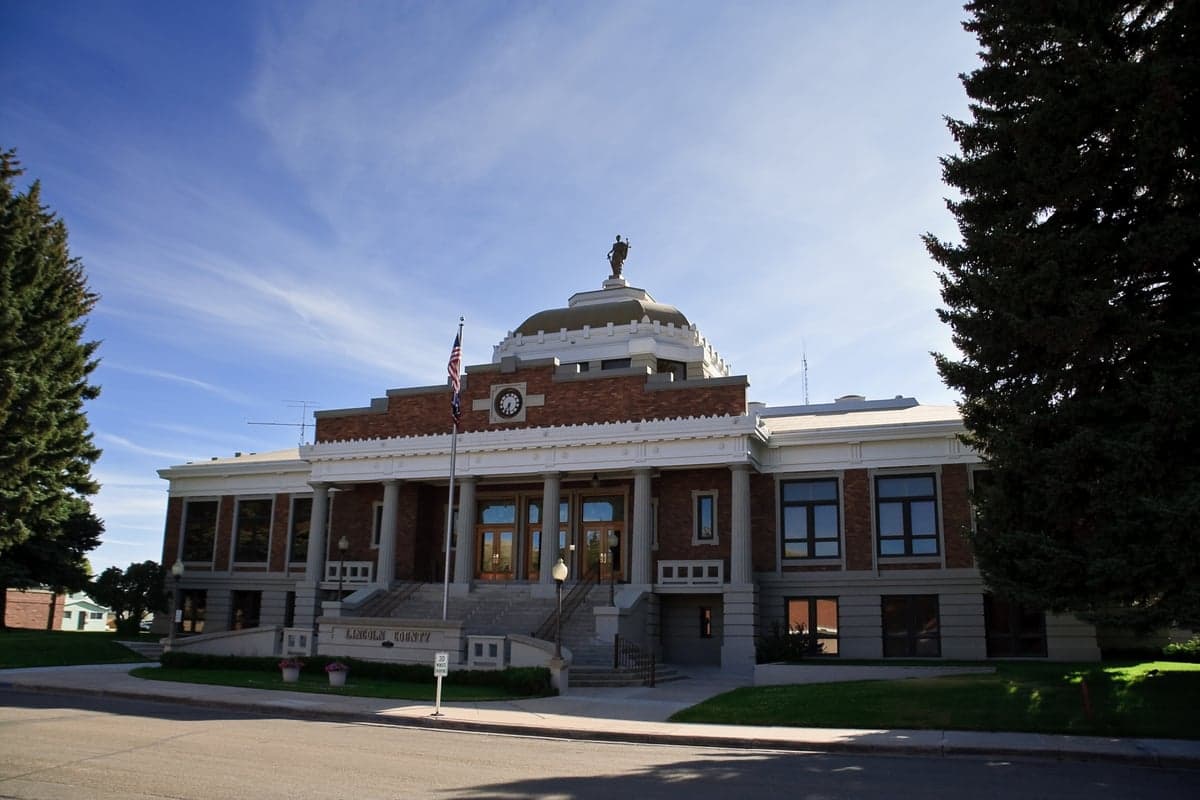
Photo: Wikipedia
Personal Sovereignty in Lincoln County
Viable for self-reliance. Generally workable, though some barriers may limit total independence.
What does Personal Sovereignty tell us?
Personal Sovereignty measures your capacity for self-reliance and independence with minimal government friction. Higher scores mean fewer barriers between you and the way you want to live... but it assumes you have the space you need and good neighbors.
What does this tell us?
Personal Sovereignty measures your capacity for self-reliance and independence with minimal government friction. Higher scores mean fewer barriers between you and the way you want to live... but it assumes you have the space you need and good neighbors.
State Policy
Energy independence: Net exporter (800% of energy produced in-state)
Personal Liberty
Homesteading

Personal Liberty Analysis
Lincoln County, Wyoming offers one of the most robust environments for personal sovereignty in the Intermountain West, where state-level protections for gun rights, property autonomy, and low taxation create a buffer against federal overreach that many conservative families and preppers find increasingly rare. The county’s roughly 20,000 residents benefit from Wyoming’s constitutional ethos—enshrined in Article 1, Section 1 of the state constitution, which declares that “the right of the people to be secure in their persons, houses, papers and effects against unreasonable searches and seizures shall not be violated.” This isn’t just rhetoric; it translates into tangible legal protections that limit government intrusion into daily life, from self-defense to medical choice. For those eyeing a relocation where the state stays out of your business, Lincoln County stands as a practical stronghold, though the degree of autonomy varies between its communities—from the more developed Kemmerer and Afton to the remote stretches of Cokeville and Alpine.
Tax burden and regulatory posture: How Lincoln County compares to surrounding areas
Wyoming’s absence of a state income tax is the headline, but Lincoln County’s regulatory posture goes deeper. Property taxes here are among the lowest in the nation, with the county’s mill levy averaging around 70 mills—meaning a $300,000 home carries roughly $2,100 in annual property tax. There is no state-level sales tax on groceries or prescription drugs, and the county’s 4% sales tax (with local option additions up to 6%) is applied narrowly. Critically, Wyoming has no estate or inheritance tax, which matters for families passing land or assets to the next generation. The regulatory environment is equally lean: the county has no building codes in unincorporated areas, and zoning is minimal outside of towns like Kemmerer and Afton, which have basic land-use ordinances. For preppers, this means you can build a steel-reinforced bunker or a pole barn on your own land without county inspectors demanding permits—a stark contrast to states like Colorado or Washington. The state’s “Right to Farm” law (W.S. 11-44-101) further shields agricultural operations from nuisance lawsuits, protecting homesteaders who run livestock or grow food. Compared to Teton County to the north, where strict environmental regulations and high property taxes dominate, Lincoln County is a libertarian-leaning haven for those seeking to minimize government entanglement.
Self-defense and gun law specifics: What the Second Sanctuary status means for residents
Lincoln County is a Second Amendment Sanctuary, a designation the county commission reaffirmed in 2021, resolving that no county resources will be used to enforce federal gun laws deemed unconstitutional. This aligns with Wyoming’s constitutional carry law, which has been in effect since 2011—no permit is needed to carry a concealed firearm for anyone 21 or older legally allowed to possess a gun. Open carry is unrestricted, and the state preempts all local firearm ordinances, meaning towns like Kemmerer, Afton, and Cokeville cannot impose their own bans or waiting periods. For preppers, the practical implications are significant: you can keep firearms in your vehicle, on your person, or in your home without registration or storage mandates. Stand-your-ground laws (W.S. 6-2-602) apply with no duty to retreat in any place you are lawfully present, and castle doctrine protections extend to occupied vehicles and workplaces. The state also prohibits red flag laws (W.S. 7-1-101), so no court can seize your firearms based on a third-party complaint without a criminal conviction. For those concerned about federal overreach, Lincoln County’s sanctuary status provides a local shield—sheriff’s deputies are instructed not to participate in federal firearm confiscation efforts. The nearest gun ranges and training facilities are in Kemmerer and Afton, with the Bridger-Teton National Forest offering unlimited backcountry shooting areas for those who prefer privacy.
Self-reliance and homesteading viability: Lot sizes, zoning, and off-grid feasibility
Lincoln County’s vast geography—over 4,000 square miles—makes self-reliant living highly feasible, but the specifics depend on where you land. In unincorporated areas like the Star Valley region around Afton and Thayne, minimum lot sizes for rural residential parcels are typically 1 to 5 acres, though larger tracts of 20 to 160 acres are common through BLM and state land leases. Off-grid living is legal countywide: there are no mandates to connect to municipal water or sewer, and solar panels, wind turbines, and propane systems are standard. The county does require a septic system permit (around $500) and a well permit (around $300) from the Wyoming State Engineer’s Office, but these are straightforward filings, not discretionary approvals. In Kemmerer, the county seat, zoning is more structured—residential lots are often 0.25 to 1 acre, and the town enforces basic setbacks—but outside city limits, you can build a yurt, a shipping container home, or a traditional log cabin without plan review. Cokeville, near the Idaho border, offers some of the cheapest raw land in the county, with 5-acre parcels starting around $15,000, though water access can require deep drilling (200-400 feet). Alpine, closer to Jackson Hole, has higher land prices and more restrictive subdivision regulations due to tourism pressure, but still allows off-grid setups on larger parcels. For preppers, the key advantage is the lack of a county-wide building code: you can construct a reinforced safe room or a root cellar without inspections, as long as you meet basic electrical code for insurance purposes. The growing season is short (90-110 days), but cold-hardy crops like potatoes, kale, and root vegetables thrive, and the area’s abundant surface water from the Salt River and Greys River supports irrigation.
Personal liberties: Parental rights, medical autonomy, speech, and property protections
Wyoming’s legal framework strongly favors parental rights and medical autonomy, which matters for families concerned about government overreach in healthcare and education. The state has no vaccine mandate for school attendance—parents can claim a philosophical exemption (W.S. 21-4-309)—and Lincoln County School District #2 (Afton) and #1 (Kemmerer) have not imposed mask or testing requirements beyond state guidance. Parental rights in education are protected under state law, allowing parents to opt their children out of any curriculum they find objectionable without penalty. Medical autonomy is similarly broad: Wyoming does not have a state-level health insurance exchange mandate, and there are no laws restricting the purchase of ivermectin, hydroxychloroquine, or other off-label medications by prescription. The state’s “Right to Try” law (W.S. 35-22-101) allows terminally ill patients access to experimental treatments without FDA interference. Property rights are reinforced by Wyoming’s “Private Property Protection Act,” which requires the government to compensate landowners for any regulatory taking that reduces property value by more than 50%. Free speech is protected by the state constitution’s broad language, and Lincoln County has no local ordinances restricting political signage, leafleting, or public assembly. For those who value the Second Amendment alongside the First, the county’s culture of non-interference means you can fly a Gadsden flag on your front porch, post a “No Trespassing” sign with legal teeth (Wyoming’s trespass law requires explicit permission to enter private land), and speak your mind at county commission meetings without fear of censorship.
Overall, Lincoln County ranks among the top 10% of U.S. counties for personal sovereignty, combining Wyoming’s low-tax, low-regulation state framework with a local culture that actively resists federal encroachment. Compared to neighboring Teton County, where land-use restrictions and high costs stifle autonomy, or to states like Oregon and Colorado where red flag laws and vaccine mandates are tightening, Lincoln County offers a rare combination of legal protections and practical feasibility for self-reliant living. The trade-offs are real—harsh winters, limited healthcare infrastructure (the nearest Level 1 trauma center is in Idaho Falls, 90 minutes from Afton), and a sparse job market—but for those prioritizing freedom over convenience, the county’s communities from Kemmerer to Cokeville provide a defensible base for a sovereign life.

* Values derived from national, state, county, city and local statistics and may differ in a specific area. Last updated: 2026-05-12T14:18:43.000Z
Narrative content on this page is AI-generated and may contain mistakes. Verify any details that matter before acting on them.
ReloMaps may earn a commission from affiliate links at no extra cost to you.

