Photo: Wikipedia
Demographics of Yankton, SD
Affluence Level in Yankton, SD
A middle-class area roughly in line with national averages across income, home values, education, and employment.
People of Yankton, SD
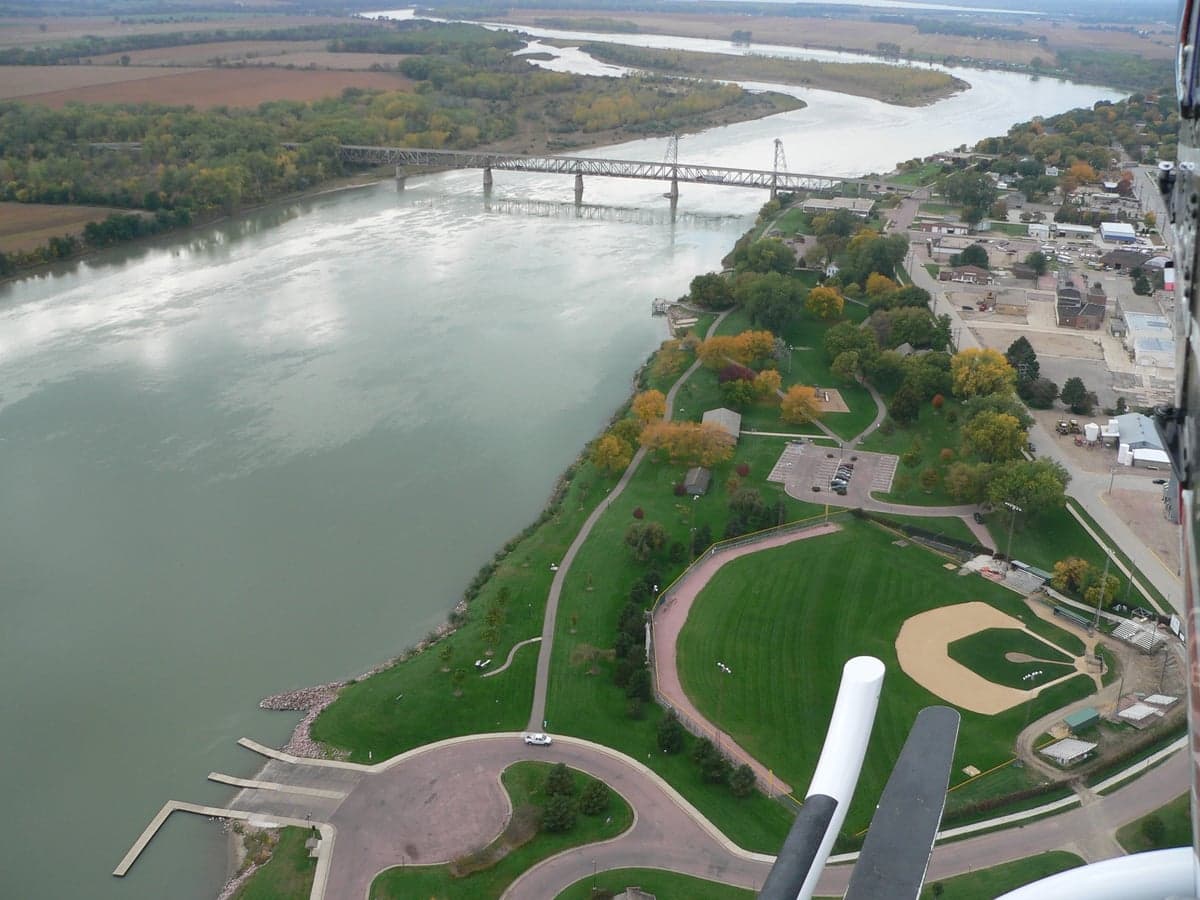
Yankton, South Dakota, is a compact Missouri River city of 15,501 residents that retains a distinctly Midwestern, family-oriented character. Its population is predominantly white (85.3%) with a notable Hispanic minority (6.0%) and small Black (2.1%) and East/Southeast Asian (0.3%) communities, while the foreign-born share sits at a modest 3.1%. The city’s identity is shaped by its river-town history, a strong German and Scandinavian heritage, and a stable, slow-growth trajectory that appeals to those seeking a predictable, community-focused lifestyle.
How the city was settled and grew
Yankton’s founding in the 1850s was driven by its strategic location on the Missouri River, making it a natural hub for steamboat traffic and trade. The original wave of settlers were primarily Yankee and German immigrants drawn by the promise of fertile farmland and the 1862 Homestead Act. These early residents built the core of the city in what is now the Historic District, a neighborhood of Victorian homes and brick storefronts along Douglas Avenue and Third Street. A second major wave arrived in the 1870s and 1880s, composed of Scandinavian immigrants (Norwegians and Swedes) who worked the river trade and established farms to the north and west. They concentrated in the West Side neighborhood, where many built modest frame houses and founded Lutheran churches that still anchor the area. The city’s role as the first territorial capital (1861–1883) briefly boosted its population, but the capital’s move to Bismarck and the decline of steamboat traffic slowed growth. By 1900, Yankton had settled into its role as a regional agricultural and manufacturing center, with a population that was overwhelmingly white, Protestant, and of Northern European descent.
Modern era (post-1965)
After the 1965 Immigration Act, Yankton saw only modest demographic change compared to larger cities. The most significant shift was the arrival of Hispanic workers, primarily of Mexican descent, beginning in the 1980s. They were drawn by jobs in meatpacking and food processing at plants like the Smithfield Foods facility (now part of WH Group) on the city’s south edge. These families settled in the South Side neighborhood, near the industrial corridor along Highway 81, where a small but stable Hispanic community has formed. The city’s Black population (2.1%) is largely composed of families with roots in the military or regional manufacturing, and they are dispersed across the East Side and central neighborhoods rather than forming a distinct enclave. The East/Southeast Asian community (0.3%) is tiny and consists mostly of professionals employed at Avera Sacred Heart Hospital or the University of South Dakota’s Yankton campus, living in the North End near the college. Suburbanization in Yankton has been limited; the Fox Run subdivision, developed in the 1990s and 2000s, attracted white middle-class families moving from older central neighborhoods, but the city’s overall footprint has expanded slowly. The Indian-subcontinent population is effectively zero, and the Arab population is negligible, reflecting Yankton’s distance from major immigration gateways.
The future
Yankton’s population is projected to remain stable or grow very slowly, with the white share likely declining slightly as the Hispanic community continues to grow through both births and limited new arrivals. The Hispanic population, currently 6.0%, is expected to reach 8–10% by 2040, driven by family reunification and continued demand for labor in food processing and light manufacturing. This growth is concentrated in the South Side, which is becoming a more distinct Hispanic enclave, though it remains integrated with white working-class households. The Black and East/Southeast Asian communities are likely to remain small, as Yankton lacks the economic pull or chain-migration networks to attract larger numbers. The city is not tribalizing into sharply divided enclaves; rather, it is experiencing a slow, organic diversification that is most visible in the South Side and among younger families in the Fox Run area. The college-educated share (30.2%) is below the national average, but the presence of the university and hospital anchors a modest professional class that is overwhelmingly white.
For someone moving to Yankton today, the city offers a stable, low-crime environment with a strong sense of community, but with limited ethnic diversity and a demographic trajectory that will remain predominantly white and Midwestern for the foreseeable future. The Hispanic community is growing but assimilating into the local culture, while other minority groups remain small and dispersed. Yankton is becoming slightly more diverse, but it is not a place of rapid demographic change—it is a place where tradition and continuity still define daily life.

* Values derived from national, state, county, city and local statistics and may differ in a specific area. Last updated: 2026-05-02T05:35:42.000Z
Narrative content on this page is AI-generated and may contain mistakes. Verify any details that matter before acting on them.
ReloMaps may earn a commission from affiliate links at no extra cost to you.

