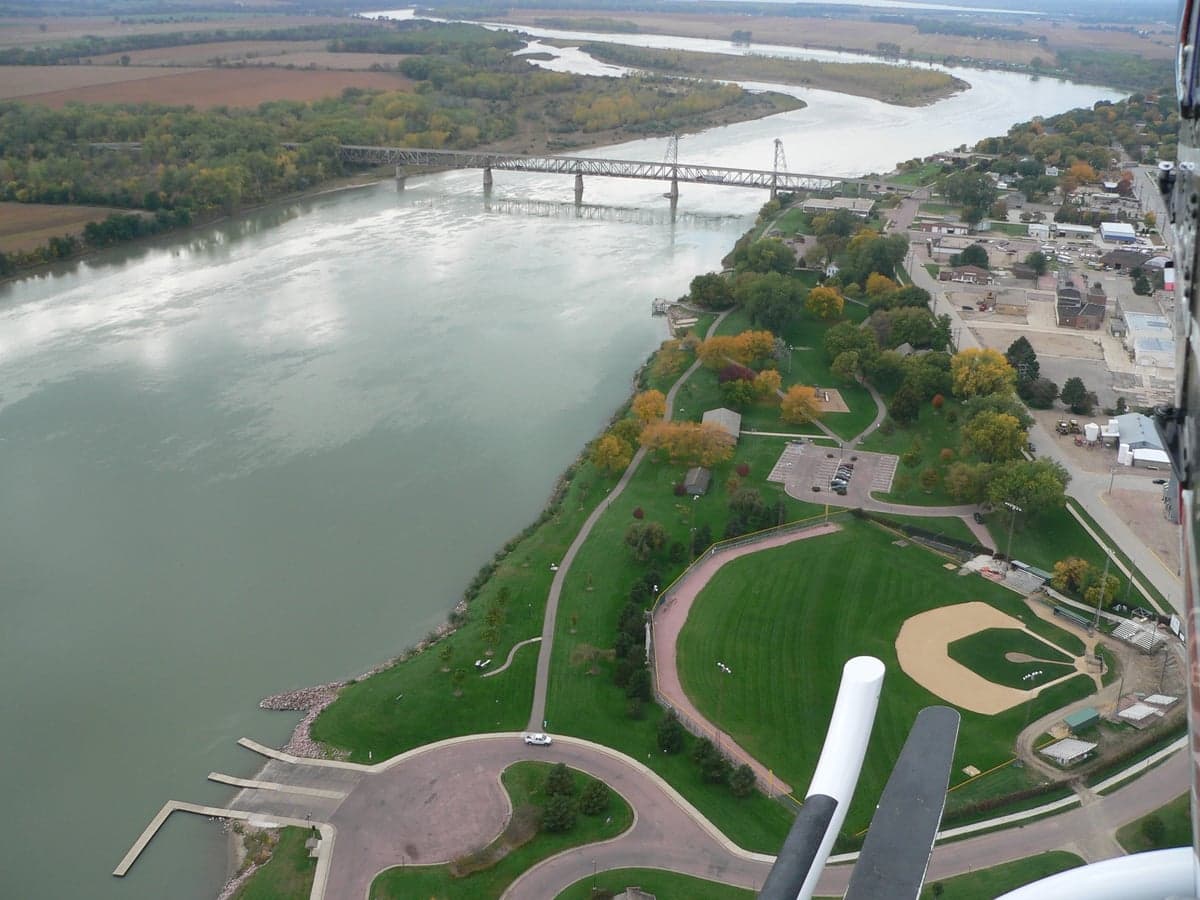
Photo: Wikipedia
Political ClimatePolitical Climate in Yankton, SD
District shown is the primary district for this city’s centroid. Cities may span multiple districts.
Inherited from parent state — no local data available.
Local Political AnalysisPolitical Analysis of Yankton, SD
Yankton, South Dakota, sits comfortably in a deep-red political landscape, with a Cook PVI of R+15 that reflects the area’s long-standing conservative values. For generations, this town along the Missouri River has leaned reliably Republican, and while the national winds have shifted leftward in many places, Yankton has held its ground. The 2024 presidential election saw the county vote for Donald Trump by a margin of roughly 68% to 30%, a pattern that has held steady for decades. That said, there’s been a subtle but noticeable creep of progressive influence in local school board races and city council discussions over the past five years, mostly driven by newcomers from places like Sioux Falls or out-of-state transplants. It’s not a sea change yet, but it’s something longtime residents keep an eye on.
How it compares
Yankton’s politics are more conservative than the state’s largest city, Sioux Falls, which has trended slightly more moderate in recent years—especially on social issues. Drive 30 miles north to Mitchell, and you’ll find a similar Republican stronghold, though with a stronger agricultural bent. The real contrast is just across the Missouri River in Nebraska, where towns like Crofton and Hartington lean even further right, but with a more libertarian streak on property rights and gun laws. Yankton sits in a sweet spot: conservative enough to feel safe, but not so isolated that you lose access to amenities. The surrounding Yankton County has voted Republican in every presidential election since 1968, and local officials tend to run unopposed or face only token opposition. That stability is a double-edged sword—it keeps taxes low and regulations light, but it also means the political establishment can get a little too cozy with itself.
What this means for residents
For the average Yankton resident, the conservative tilt translates into a government that mostly stays out of your business. Property taxes are among the lowest in the state, and there’s no state income tax on wages—a big draw for families and retirees alike. The city council has resisted zoning overhauls that would limit single-family home construction, and the school board has kept curriculum focused on traditional academics rather than the social-justice trends popping up in larger districts. Gun rights are respected, with concealed carry permits issued without excessive red tape. The downside? If you’re hoping for rapid infrastructure upgrades or progressive social programs, you’ll be disappointed. The local government moves slow, and there’s a strong preference for keeping things as they are. That’s fine for most folks here, but it can feel stifling if you’re used to a more dynamic political environment.
One cultural distinction worth noting: Yankton has a strong sense of community self-reliance that predates modern political labels. The annual Riverboat Days festival and the local farmers’ market are run by volunteers, not city mandates. There’s a healthy skepticism of federal programs—many residents remember the 2019 Missouri River flooding and the slow FEMA response, which reinforced the belief that local solutions work best. The biggest policy debate in recent years has been over a proposed wind farm south of town, which pitted property rights against renewable energy goals. The project was ultimately approved, but only after a long fight that highlighted the community’s wariness of outside corporate influence. Looking ahead, Yankton will likely stay red, but the real test will be whether it can resist the cultural drift that’s softened conservative values in other small cities. For now, it’s a place where you can still raise a family without worrying about government overreach—and that’s worth holding onto.

State Political ClimatePolitical Climate in South Dakota
State Political AnalysisPolitical Environment in the State
South Dakota has long been a reliably conservative state, with a Republican lean that has only deepened over the past two decades. The state hasn't voted for a Democratic presidential candidate since Lyndon B. Johnson in 1964, and in 2024, Donald Trump carried it by over 30 points. The dominant coalition is a mix of rural agricultural interests, small business owners, and a growing number of out-of-state transplants seeking lower taxes and fewer restrictions. Over the last 10-20 years, the state has shifted further right, driven by an influx of people from blue states and a Republican supermajority in the legislature that has pushed a consistently pro-liberty agenda.
Urban vs. rural divide
The political map of South Dakota is a classic tale of two worlds. The eastern corridor, anchored by Sioux Falls and Brookings, is where most of the population lives and where the state's economic engine hums. Sioux Falls, the largest city, is a mix of conservative business owners and a growing number of younger professionals who lean slightly more moderate, but it still votes reliably Republican in statewide races. Brookings, home to South Dakota State University, has a more academic tilt but remains a conservative stronghold compared to college towns in other states. The western half, including Rapid City and the Black Hills region, is deeply conservative, with a strong libertarian streak—think gun rights, land use freedom, and a general distrust of federal authority. The rural counties in between, like Harding County and Jones County, often vote 80-90% Republican. The only real blue dots are the tribal lands, like Pine Ridge and Rosebud, where Democratic margins can be high, but those populations are small and geographically isolated. The urban-rural divide here isn't about ideology—it's about intensity. Even the "liberal" parts of Sioux Falls are still more conservative than most of the country.
Policy environment
South Dakota's policy environment is a dream for conservatives who value limited government. There is no state income tax, no personal or corporate income tax, and the sales tax is a modest 4.2% (with local options adding a bit more). Property taxes are reasonable, especially compared to the coasts. The regulatory posture is light—permitting for new businesses is fast, and there are no onerous environmental or labor regulations that strangle growth. Education policy is a mixed bag: the state has a robust school choice movement, with a new Education Savings Account (ESA) program passed in 2024 that lets parents use public funds for private or homeschool expenses. However, the state's rural schools are struggling with consolidation and teacher shortages. Healthcare is a point of tension—the state expanded Medicaid in 2023 via a ballot initiative, which many conservatives opposed as a federal overreach, but the legislature has since added work requirements. Election laws are strong: voter ID is required, no-excuse absentee voting is limited, and the state has a clean voter roll system. There is no ballot harvesting, and drop boxes are restricted. Overall, the policy environment is designed to keep government small and personal freedom large.
Trajectory & freedom
South Dakota is becoming more free in many respects, but not without some concerning backsliding. On the positive side, the state has been a national leader in gun rights: permitless carry has been law since 2019, and in 2024 the legislature passed a law prohibiting state enforcement of any future federal gun bans. Parental rights were strengthened with a 2023 law requiring schools to notify parents of any curriculum involving sexuality or gender identity, and a 2025 law gave parents the right to opt their kids out of any lesson they find objectionable. Medical autonomy saw a win with the 2024 passage of a law protecting doctors who refuse to perform procedures that violate their conscience. However, there are red flags. The state's property rights have been tested by the ongoing fight over the Dakota Access Pipeline—while the state government sided with the pipeline, the federal government's involvement has been a constant source of friction. On taxation, the state has held the line, but there is growing pressure from local governments to raise property taxes to fund infrastructure in growing areas like Sioux Falls and Rapid City. The biggest concern for liberty-minded residents is the COVID-era overreach that still lingers—while the state never had a mask mandate, some local health orders were heavy-handed, and the memory of that power grab has not faded.
Civil unrest & political movements
South Dakota is not a hotbed of civil unrest, but there have been flashpoints. The Standing Rock protests in 2016-2017, centered near the Standing Rock Reservation in the north-central part of the state, drew thousands of activists from across the country and resulted in clashes with law enforcement. That event still resonates, and the area remains a symbol of the tension between tribal sovereignty and state/federal authority. More recently, there have been small but vocal pro-choice protests in Sioux Falls after the Dobbs decision, but they have been dwarfed by the annual March for Life events that draw thousands. On the right, the South Dakota Freedom Caucus has become a powerful force in the legislature, pushing for stricter immigration enforcement (the state has a law requiring local law enforcement to cooperate with ICE) and opposing any form of sanctuary policies. There is no serious secession or nullification movement, but the state's Second Amendment Sanctuary status is a point of pride. Election integrity controversies are minimal—the state uses paper ballots and has a strong track record of clean elections, though some activists remain wary of the growing use of electronic voting machines in a few counties. A new resident would notice that political activism here is generally polite and low-key, but the underlying tensions over federal overreach and cultural change are real.
Projection
Over the next 5-10 years, South Dakota is likely to become even more conservative, but with a libertarian flavor. The in-migration from states like California, Minnesota, and Illinois is accelerating, and these new residents are not fleeing to change the state—they're fleeing to preserve their freedoms. This will likely push the legislature to further cut taxes, expand school choice, and strengthen gun rights. However, the growth of Sioux Falls and Rapid City will bring urban challenges—traffic, housing costs, and pressure for more government services—that could create a tension between the rural libertarian base and the suburban pragmatists. The biggest wild card is the federal government: if a future administration tries to impose national gun control or environmental regulations on the state's agriculture and energy sectors, expect a fierce pushback. The tribal lands will remain a source of friction, but their political influence is limited. For someone moving in now, expect to find a state that is doubling down on its conservative identity, but with a growing awareness that freedom requires constant vigilance.
For a new resident, the bottom line is this: South Dakota offers one of the most pro-liberty environments in the country, with low taxes, strong gun rights, and a government that generally stays out of your life. The trade-offs are real—harsh winters, limited cultural amenities, and a growing population that is testing the infrastructure. But if you value personal freedom and want to live in a place where your vote actually matters, this is one of the best bets in the nation. Just keep an eye on the local elections in Sioux Falls and Rapid City—that's where the future battles over freedom will be fought.
* Values derived from national, state, county, city and local statistics and may differ in a specific area. Last updated: 2026-05-02T05:35:42.000Z
Narrative content on this page is AI-generated and may contain mistakes. Verify any details that matter before acting on them.
ReloMaps may earn a commission from affiliate links at no extra cost to you.

