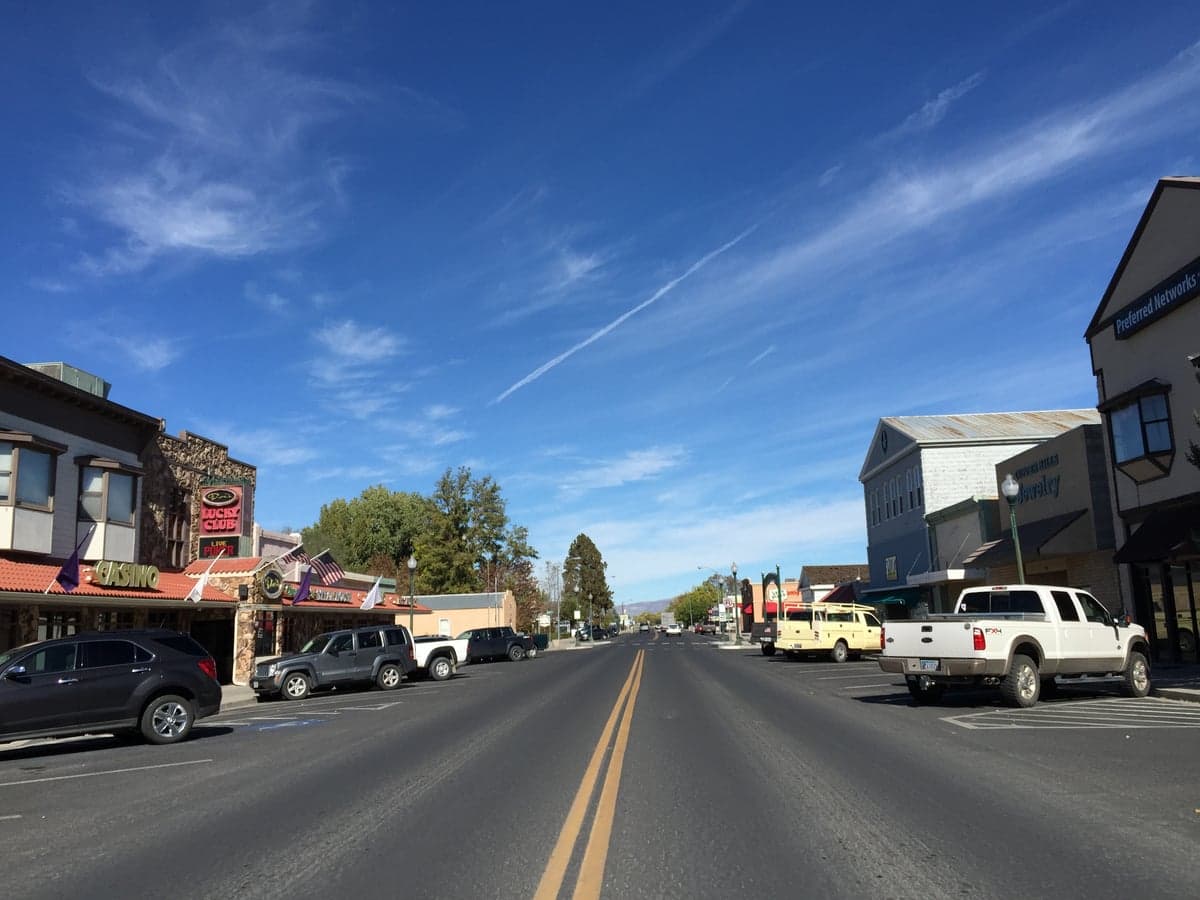
Photo: Wikipedia
Demographics of Yerington, NV
Affluence Level in Yerington, NV
A middle-class area roughly in line with national averages across income, home values, education, and employment.
People of Yerington, NV
Yerington, Nevada, is a small, predominantly White and Hispanic community of 3,139 residents, characterized by a rural, working-class identity rooted in agriculture and mining. The city’s population is notably less diverse than Nevada as a whole, with a 73.1% White share and a 20.0% Hispanic population, while Black (0.2%), East/Southeast Asian (0.0%), and Indian subcontinent (0.0%) residents are virtually absent. With only 17.0% of adults holding a college degree, Yerington’s demographic profile reflects a blue-collar, family-oriented town where generational ties to the land and local industry remain strong.
How the city was settled and grew
Yerington’s human history begins with the indigenous Paiute and Shoshone peoples, who inhabited the Walker River Valley for centuries before Euro-American contact. The city itself was founded in the 1870s as a railroad stop on the Virginia and Truckee Railroad, originally named “Pizen Switch” before being renamed after Henry M. Yerington, a railroad executive. The first major wave of settlers were Anglo-American ranchers and farmers drawn by the fertile soil of the Walker River Valley and the promise of irrigated agriculture. These early families established homesteads in what is now the Downtown Yerington area and along Main Street, building a commercial core around the railroad depot. A second wave arrived in the early 1900s with the expansion of copper mining at the nearby Yerington Mine (Anaconda Copper), bringing a mix of European immigrants—primarily Irish, Italian, and Basque—who settled in the Mine Camp District south of town. The Basque community, in particular, left a lasting mark, with many families transitioning from mining to sheepherding and ranching, and their descendants still live in the West Side neighborhoods near the old railroad yards. By the mid-20th century, Yerington’s population had stabilized around 1,500, with a nearly all-White demographic base and a Hispanic presence limited to seasonal agricultural laborers.
Modern era (post-1965)
The post-1965 period brought gradual demographic change, driven primarily by domestic in-migration and the expansion of the Hispanic population. The 1965 Hart-Cellar Act did not directly trigger large-scale immigration to Yerington, as the city remained geographically isolated, but it did open the door for a steady stream of Mexican-American families who came for work in the region’s alfalfa, garlic, and onion fields. These families settled in the East Yerington area, near the industrial park and agricultural processing plants, creating a distinct Hispanic enclave that today accounts for the city’s 20.0% Hispanic share. Meanwhile, the White population remained stable, with many younger residents leaving for college or jobs in Reno (90 miles northwest) and being replaced by retirees and remote workers seeking affordable housing. The Mountain View Estates subdivision, developed in the 1990s, attracted a mix of White and Hispanic families, but the city’s overall racial segregation by neighborhood has persisted: Downtown and West Side remain predominantly White, while East Yerington is heavily Hispanic. The Asian and Indian populations have remained at zero, reflecting the city’s lack of high-skilled employment or university presence that typically draws these groups.
The future
Yerington’s population is projected to grow slowly, driven by two competing forces: an aging White cohort (many over 65) and a younger, higher-fertility Hispanic population. The city is not homogenizing; rather, it is becoming more ethnically segmented, with Hispanic families concentrated in East Yerington and White retirees in the Desert Hills and Pine Grove subdivisions. The Hispanic share is likely to rise to 25-30% by 2035, as younger Hispanic families have more children and some White residents move to larger cities. However, the foreign-born share (currently 3.7%) is low and will remain so, as most Hispanic growth comes from U.S.-born children of existing residents. The Black, Asian, and Indian populations are expected to stay near zero, as Yerington offers no economic pull for these groups. The city’s future is one of a stable, bicultural community—predominantly White and Hispanic—with little racial or ethnic diversification beyond that.
For a conservative-leaning individual or family considering relocation, Yerington offers a low-crime, rural environment where traditional values and community ties remain strong. The population is becoming slightly more Hispanic but remains overwhelmingly White and native-born, with no significant immigrant enclaves or cultural friction. The city is not diversifying in the way that larger Nevada cities are; instead, it is slowly evolving into a two-group community where White and Hispanic residents coexist with minimal integration but also minimal conflict. This is a place for those who value stability, affordability, and a slower pace of life, rather than demographic dynamism or urban amenities.

* Values derived from national, state, county, city and local statistics and may differ in a specific area. Last updated: 2026-04-29T19:29:05.000Z
Narrative content on this page is AI-generated and may contain mistakes. Verify any details that matter before acting on them.
ReloMaps may earn a commission from affiliate links at no extra cost to you.

