Photo: Wikipedia
Demographics of York, PA
Affluence Level in York, PA
A below-average socioeconomic profile. Incomes, home values, and educational attainment trail the U.S., with higher poverty and unemployment.
People of York, PA
The people of York, Pennsylvania today form a densely packed, majority-minority city of 44,830 residents, characterized by a distinctive three-way balance between Hispanic (36.0%), Black (23.3%), and White (34.6%) populations. With only 17.1% holding a bachelor’s degree and a foreign-born share of 6.3%, the city is working-class, family-oriented, and increasingly Latino, while the surrounding York County remains predominantly White and more affluent. The city’s identity is shaped by its industrial past, its role as a regional hub for manufacturing and logistics, and a growing sense of cultural vibrancy in its historic core.
How the city was settled and grew
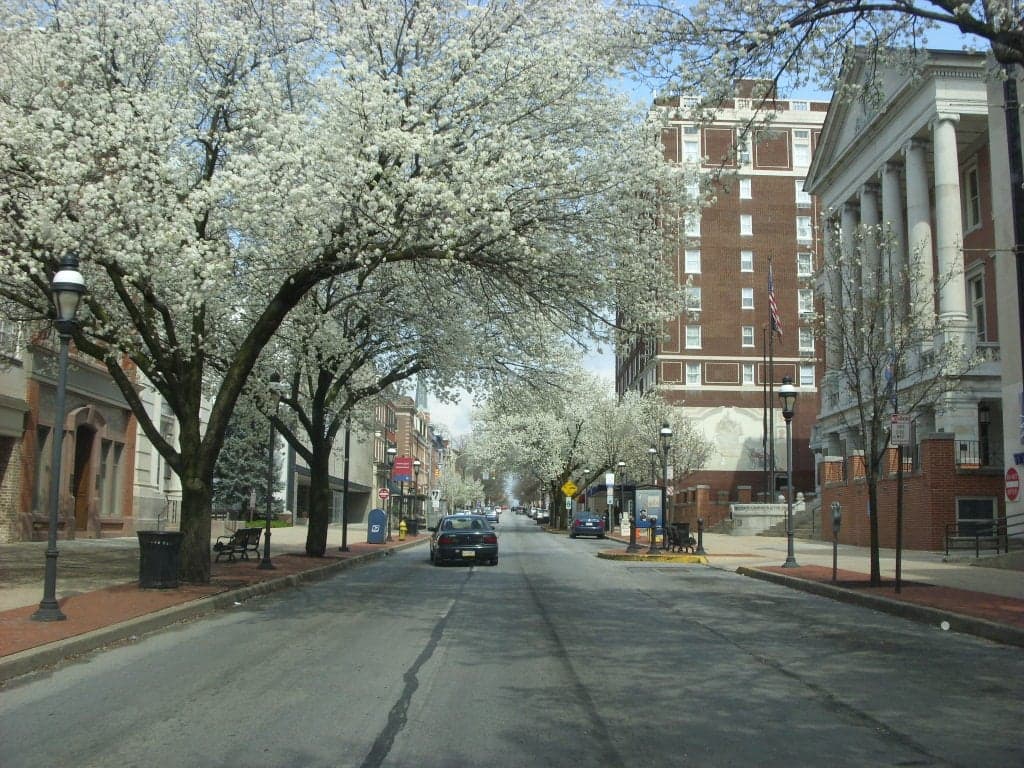
York was founded in 1741 by German and Scots-Irish settlers, drawn by the fertile farmland of the Susquehanna Valley and land grants from the Penn family. The city’s original core, now known as the Historic District around Continental Square, was built by these early German craftsmen and merchants, who established a grid of streets and sturdy brick homes. The arrival of the railroad in the 1830s and the rise of manufacturing—particularly in farm equipment, textiles, and later, the York Peppermint Pattie factory—drew successive waves of immigrants. Irish laborers arrived in the 1840s and 1850s, settling in the West York area near the rail yards. Eastern European Jews, primarily from Poland and Russia, came in the 1880s-1910s, establishing a tight-knit community around Penn Street and the former Jewish Market. Italian immigrants followed in the early 1900s, clustering in East York near the industrial plants. By 1950, York was a thriving, heavily White industrial city of roughly 60,000, with distinct ethnic neighborhoods that still bear their marks today.
Modern era (post-1965)
The post-1965 era brought profound demographic change. The Immigration and Nationality Act of 1965 opened the door to new arrivals, but York’s modern transformation was driven more by domestic migration. The Great Migration brought Black families from the rural South to York’s industrial jobs, settling primarily in the South Side and West End neighborhoods, where they built churches, community organizations, and a resilient cultural presence. By 1990, the Black population had risen to roughly 20%. Simultaneously, the city’s White population began a steep decline, falling from over 80% in 1970 to 34.6% today, as families moved to suburban townships like Springettsbury and Manchester. The most dramatic shift has been the rise of the Hispanic population, which grew from under 5% in 1990 to 36.0% by 2020. This wave, primarily of Puerto Rican and Mexican origin, concentrated in the Northwest Triangle and Parkway neighborhoods, drawn by low housing costs, warehouse and food-processing jobs, and established family networks. The Asian population remains very small (0.9% East/Southeast Asian, 0.2% Indian), with a modest cluster of Vietnamese families near the East Market Street corridor. The city’s foreign-born share of 6.3% is below the national average, indicating that most of York’s diversity comes from domestic migration and natural increase.
The future
York’s population is heading toward a continued Hispanic majority, with the White and Black shares likely to decline gradually as younger, more diverse cohorts age in. The Hispanic population is young (median age around 26) and has a higher birth rate, so natural increase will drive growth even if migration slows. The city is not homogenizing; rather, it is tribalizing into distinct enclaves—the Northwest Triangle is heavily Hispanic, the South Side remains predominantly Black, and the Historic District and Frogtown (a small, revitalizing area near the Codorus Creek) are attracting a mix of White professionals and artists. Immigrant communities are growing slowly, with a small but steady influx of Central American families, but the city remains primarily a destination for domestic movers from within Pennsylvania and the Mid-Atlantic. The next 10-20 years will likely see York become a majority-Hispanic city of 45,000-50,000, with a stable Black minority and a shrinking White population, while the surrounding county continues to diversify at a slower pace.
For someone moving in now, York is becoming a younger, more Latino, and more working-class city, with a strong sense of neighborhood identity and a growing cultural scene anchored by its historic architecture and the York Revolution baseball stadium. The city offers affordable housing and a central location, but the low college attainment rate and high poverty rate (roughly 30%) mean that economic opportunity remains a challenge. It is a place of distinct, self-reinforcing communities rather than a melting pot, and newcomers should expect to find their footing within one of these established enclaves.

* Values derived from national, state, county, city and local statistics and may differ in a specific area. Last updated: 2026-05-01T22:23:31.000Z
Narrative content on this page is AI-generated and may contain mistakes. Verify any details that matter before acting on them.
ReloMaps may earn a commission from affiliate links at no extra cost to you.

