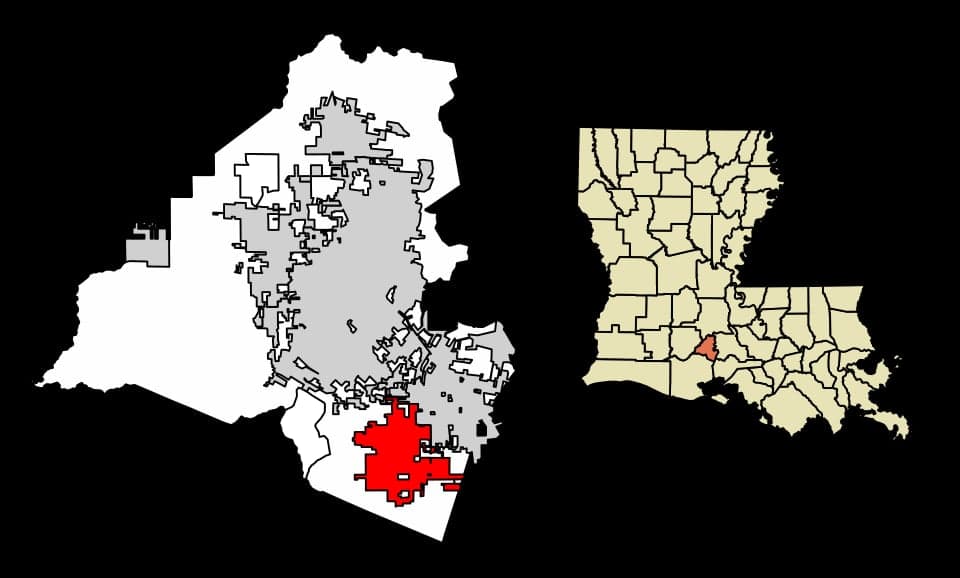
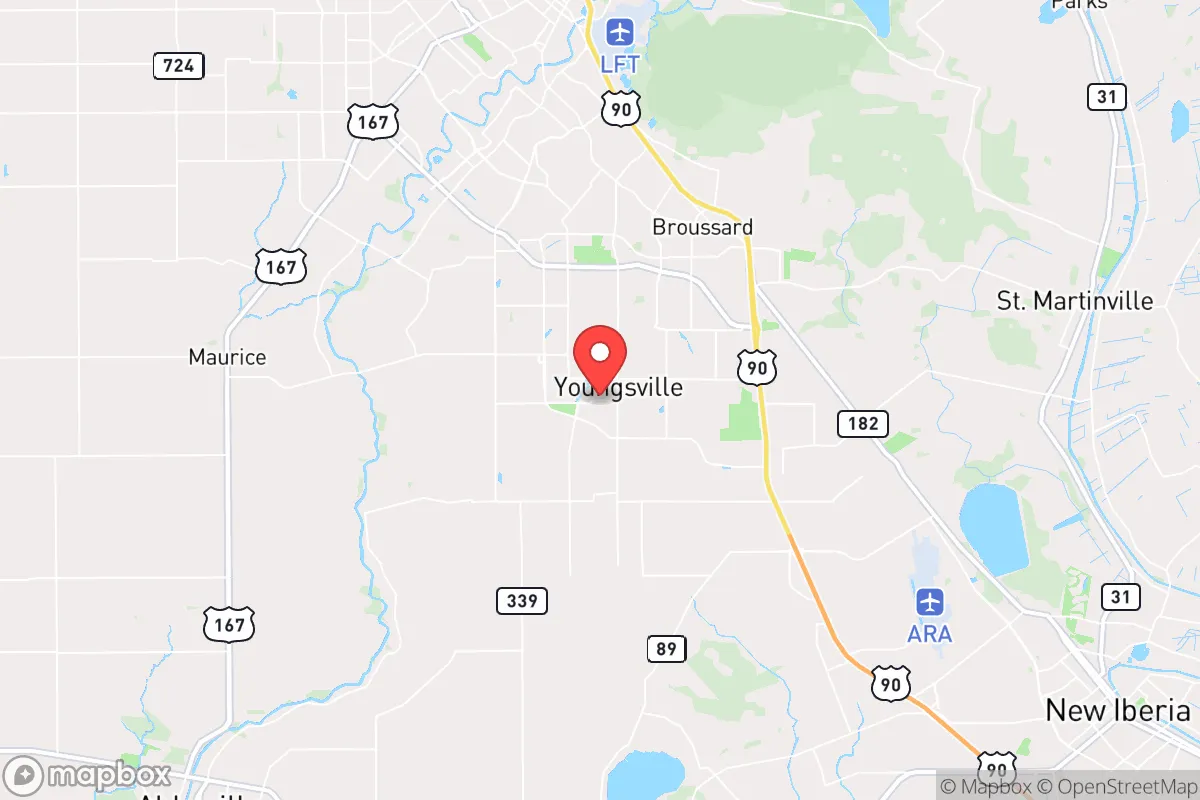
Photo: Wikipedia
Political ClimatePolitical Climate in Youngsville, LA
District shown is the primary district for this city’s centroid. Cities may span multiple districts.
Local Political AnalysisPolitical Analysis of Youngsville, LA
Youngsville, Louisiana, sits solidly in the red, with a Cook PVI of R+22 that reflects a deep-rooted conservative tradition. This isn’t a place that’s suddenly flipped—it’s been reliably Republican for decades, and the 2024 election only reinforced that, with Lafayette Parish voting about 65% for the GOP ticket. The real story here is how the town’s political lean has actually hardened over the past ten years, as newcomers from more liberal areas like Baton Rouge or Houston have moved in but quickly adapted to the local culture rather than shifting it. If you’re worried about government overreach or progressive creep, Youngsville remains a stronghold where personal freedoms and limited government are still the default.
How it compares
Drive ten miles north to Lafayette, and you’ll see a different picture—Lafayette Parish overall leans red, but the city itself has a more mixed voting record, with precincts near UL Lafayette and downtown trending blue in recent cycles. Youngsville, by contrast, is a suburb that’s avoided that drift. Compare it to Broussard just to the west, which is similarly conservative but slightly less intense, or to New Iberia to the south, where the political climate is more moderate and occasionally split on local issues. The biggest contrast is with Baton Rouge, about an hour east, where the state capital’s politics are a constant tug-of-war between conservative and progressive factions. Youngsville residents I know see that as a cautionary tale—proof that when you let government get too big, it starts meddling in things like school curricula, property rights, and even how you run your small business. The town’s leadership has kept that at bay, but there’s a quiet concern that if the state or federal government pushes harder on mandates or zoning overrides, Youngsville’s independence could erode.
What this means for residents
For folks living here, the political climate translates into a daily life that’s low on bureaucracy and high on personal responsibility. You won’t find heavy-handed HOA rules or city ordinances that dictate what color you can paint your fence—Youngsville’s government is lean, with a city council that mostly focuses on infrastructure and public safety. Property taxes are among the lowest in the region, and there’s no city income tax, which is a big draw for families and retirees. The school system, part of Lafayette Parish, has avoided the kind of curriculum battles you see in more progressive districts, though there’s always a watchful eye on state-level mandates. The downside? If you’re hoping for a lot of public transit or bike lanes, you’ll be disappointed—this is a car-centric place where the government’s role is to keep roads paved and crime low, not to engineer social change. That suits most residents fine, but it means anyone moving here should expect a hands-off approach that can feel isolating if you’re used to more municipal services.
Culturally, Youngsville is still very much a Cajun and Catholic community, which shapes its politics in subtle ways. The annual Boucherie Festival and the strong presence of local churches reinforce a social fabric that’s resistant to outside ideological shifts. There’s a palpable skepticism of national trends—like the push for diversity, equity, and inclusion mandates in schools or corporate ESG policies—that locals see as unnecessary government overreach. The long-term trajectory, as I see it, is that Youngsville will stay conservative as long as its economy remains tied to oil, gas, and agriculture, and as long as the state legislature keeps its hands off local control. But there’s a nagging worry that if Louisiana’s population continues to grow in the suburbs, some of that progressive influence from bigger cities could trickle down. For now, though, this is still a place where you can live your life without a lot of interference, and that’s exactly how most folks want it.

State Political ClimatePolitical Climate in Louisiana
State Political AnalysisPolitical Environment in the State
Louisiana has long been a reliably red state in federal elections, but its political climate is far more complex than a simple partisan label suggests. The state leans Republican at the presidential level — Donald Trump won it by nearly 20 points in 2020 and by a similar margin in 2024 — but Democrats still hold significant power in local and state offices, particularly in the New Orleans area and along the Mississippi River. Over the past 20 years, the state has shifted from a Deep South Democratic stronghold to a solidly Republican one, driven largely by white suburban and rural voters abandoning the national Democratic Party. However, the state’s unique blend of Cajun culture, Catholic social conservatism, and a strong independent streak means Louisiana politics often defy easy categorization.
Urban vs. rural divide
The political map of Louisiana is a textbook study in the urban-rural split. New Orleans and its surrounding Jefferson Parish are the state’s Democratic strongholds, with Orleans Parish consistently voting 70-80% Democratic in recent presidential elections. Baton Rouge is more of a battleground — East Baton Rouge Parish has trended blue in recent cycles, but the city’s suburbs, like Prairieville and Denham Springs, are deeply red. Lafayette, the heart of Cajun country, has shifted rightward over the past decade, with the city itself becoming more competitive while the surrounding Lafayette Parish remains reliably Republican. The rural parishes — Allen, Beauregard, Vernon, and Washington — vote 75-80% Republican, driven by strong gun culture, evangelical Christianity, and opposition to coastal restoration regulations that threaten oil and gas jobs. The Florida Parishes (north of Lake Pontchartrain) have become a Republican stronghold, with St. Tammany Parish voting 65% Republican in 2024, making it one of the most conservative suburban areas in the South.
Policy environment
Louisiana’s policy environment is a mixed bag for conservatives. The state has no state income tax on corporate income, but it does have a progressive personal income tax with rates up to 4.25% — a point of contention for fiscal conservatives. Sales taxes are high, often exceeding 10% in some parishes, which hits lower-income residents hardest. The state’s regulatory posture is generally business-friendly, especially for oil and gas, but the coastal erosion crisis has led to expensive mitigation mandates that some conservatives view as government overreach. Education policy is a bright spot: Louisiana has one of the strongest school choice programs in the nation, with the Louisiana Scholarship Program and a robust charter school sector, particularly in New Orleans, where nearly all public schools are charters. However, the state’s public school system ranks near the bottom nationally, and teacher unions remain politically active. On healthcare, Louisiana expanded Medicaid under the Affordable Care Act in 2016, a decision that remains controversial among conservatives who see it as federal overreach. Election laws are relatively strict: voter ID is required, early voting is limited to 7 days, and absentee voting is restricted to specific categories — a system that most conservatives view as secure.
Trajectory & freedom
Louisiana has moved decisively toward expanding personal freedom in several key areas over the past five years. In 2021, the state passed a constitutional carry law (Act 22), allowing permitless concealed carry for anyone 21 or older — a major win for gun rights advocates. In 2024, the legislature passed a near-total abortion ban with no exceptions for rape or incest, reflecting the state’s strong pro-life stance. On parental rights, Louisiana passed the “Parents’ Bill of Rights” (Act 468) in 2023, requiring schools to notify parents of any changes to a student’s mental or physical health and prohibiting instruction on sexual orientation or gender identity in grades K-12. The state has also resisted federal vaccine mandates, with Governor Jeff Landry (a Republican) signing an executive order in 2024 barring state agencies from requiring COVID-19 vaccines. However, the state’s high incarceration rate — the highest in the nation — remains a concern for liberty-minded conservatives, as does the state’s heavy reliance on civil asset forfeiture, which critics say violates property rights. On the taxation front, the state has not moved toward eliminating the income tax, but a 2024 commission recommended phasing it out over a decade — a proposal that has strong support among Republican legislators.
Civil unrest & political movements
Louisiana has seen its share of political flashpoints, but they tend to be localized rather than statewide. The most visible recent unrest occurred in 2020 following the death of George Floyd, when protests in New Orleans and Baton Rouge turned violent, with property damage and clashes with police. The state’s Confederate monument controversy — particularly the removal of monuments in New Orleans in 2017 — remains a cultural flashpoint, with some rural parishes erecting new monuments in defiance. Immigration politics are less intense here than in border states, but the state has taken a hard line: in 2024, Governor Landry signed a law requiring local law enforcement to cooperate with federal immigration authorities, and the state has sent National Guard troops to the Texas border. There is a small but vocal secessionist movement in the Acadiana region, driven by Cajun cultural preservation and frustration with coastal restoration regulations, but it has no serious political traction. Election integrity has been a topic of debate, with the state’s Republican-controlled legislature passing a 2022 law requiring signature verification for absentee ballots and banning ballot drop boxes — measures that Democrats criticized as voter suppression but that most conservatives view as common-sense security.
Projection
Over the next 5-10 years, Louisiana is likely to become more conservative, not less. The state’s population is aging and white, with little in-migration from blue states — unlike Texas or Florida. The Democratic base in New Orleans is shrinking as the city loses population, while the Republican suburbs of Baton Rouge and the Northshore continue to grow. The state’s strong pro-life and pro-gun laws are unlikely to be rolled back, and the push to eliminate the income tax will likely gain momentum. However, the state faces serious headwinds: coastal erosion is accelerating, and the federal government’s response — including potential relocation of entire communities — could create new political tensions. The oil and gas industry, which underpins the state’s economy and its conservative politics, is facing long-term decline as the world transitions to renewable energy. A new resident moving in now should expect a state that is culturally conservative, economically struggling, and politically stable — but one where the biggest threats to freedom are not progressive ideology but rather the state’s own inefficiency, corruption, and reliance on federal dollars.
For a conservative family or individual considering relocation, Louisiana offers a genuine red-state environment with strong protections for gun rights, parental authority, and religious liberty. The cost of living is low, the people are friendly, and the culture is distinct. But the trade-offs are real: poor public schools, high crime in the major cities, and a state government that, while conservative in rhetoric, often fails to deliver on basic services. If you value cultural conservatism and low taxes above all else, Louisiana can be a good fit — just know that the state’s problems are homegrown, not imported from the coasts.
* Values derived from national, state, county, city and local statistics and may differ in a specific area. Last updated: 2026-04-23T04:57:31.000Z
Narrative content on this page is AI-generated and may contain mistakes. Verify any details that matter before acting on them.
ReloMaps may earn a commission from affiliate links at no extra cost to you.

