Photo: Wikipedia
Demographics of Zachary, LA
Affluence Level in Zachary, LA
A middle-class area roughly in line with national averages across income, home values, education, and employment.
People of Zachary, LA
The people of Zachary, Louisiana, today form a nearly evenly split Black and White community of 19,637 residents, a demographic profile that sets it apart from most Baton Rouge suburbs. With a foreign-born population of just 2.1% and a college attainment rate of 38.5%, the city is characterized by a stable, largely native-born population with a strong professional and middle-class identity. Distinctive markers include a high rate of homeownership and a reputation as a family-oriented, politically conservative enclave that has maintained its small-town feel despite proximity to the state capital.
How the city was settled and grew
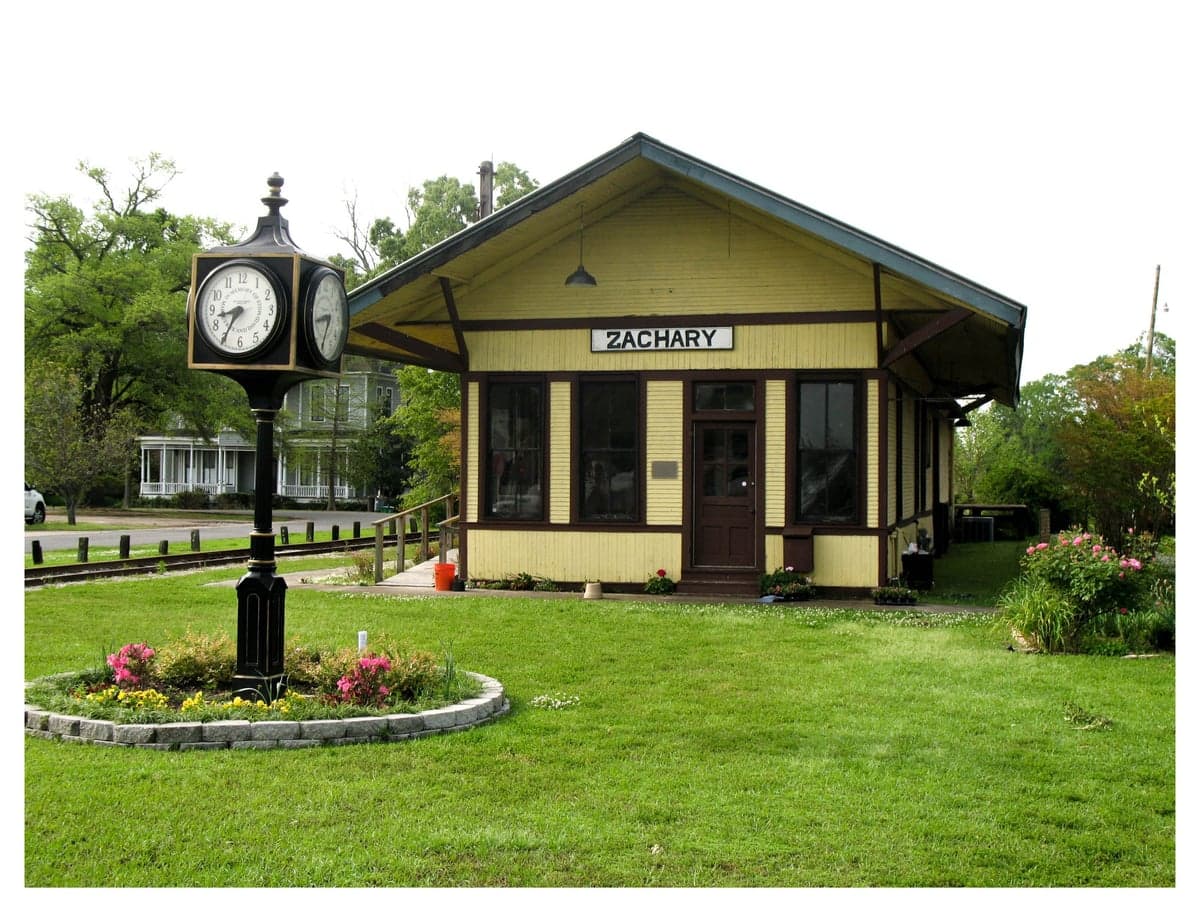
Zachary was not a colonial-era settlement but a post-Civil War railroad town, founded in the 1880s when the Illinois Central Railroad extended a line through East Baton Rouge Parish. The original population was drawn by timber and agriculture, particularly cotton and strawberry farming, with the first wave of White settlers arriving from the rural Deep South. The historic Old Zachary district, centered on Main Street and the railroad depot, was built by these early families, who established the town's first churches, schools, and mercantile businesses. A second wave of Black families moved into the area during the early 1900s, working as sharecroppers and farm laborers; they settled in what is now the Mount Pleasant neighborhood, named after the historic Mount Pleasant Baptist Church founded in 1892. By 1950, Zachary remained a small, segregated farming community of roughly 1,500 residents, with White families concentrated in Old Zachary and Black families in Mount Pleasant and the Plank Road corridor.
Modern era (post-1965)
The post-1965 period transformed Zachary from a rural hamlet into a suburban bedroom community. The Immigration and Nationality Act of 1965 had minimal direct effect here—the foreign-born share remains under 2.5%—but domestic migration reshaped the city. The 1970s and 1980s saw an influx of White professionals from Baton Rouge, drawn by new subdivisions and the reputation of Zachary High School. The Rolling Hills subdivision, developed in the 1970s, became the primary landing point for these families, offering larger lots and newer homes. Simultaneously, upwardly mobile Black families began moving out of the historic Mount Pleasant and Plank Road areas into newer developments like Lakewood Estates and Sherwood Forest, creating a more integrated suburban landscape. By the 2000 census, Zachary's population had grown to over 10,000, with the Black share rising from roughly 25% in 1990 to 47% today. This shift reflects a broader pattern of Black middle-class flight from Baton Rouge's inner-city neighborhoods, seeking better schools and lower crime rates. The small East/Southeast Asian community (1.3%) and Indian-subcontinent community (1.1%) are largely professionals employed at nearby ExxonMobil's Baton Rouge refinery or at Our Lady of the Lake Regional Medical Center, and they tend to settle in newer subdivisions like The Bluffs and Summer Grove.
The future
Zachary's population is likely to continue its gradual homogenization into a stable, middle-class, Black-White community with minimal ethnic diversity. The foreign-born population shows no signs of significant growth, as the city lacks the rental housing stock and entry-level jobs that attract immigrant gateways. The Hispanic share (1.1%) is plateauing, and both the East/Southeast Asian and Indian-subcontinent communities are small enough that they are more likely to assimilate into the broader professional class than form distinct ethnic enclaves. The most notable trend is the continued in-migration of Black families from Baton Rouge, which could push the Black share past 50% within the next decade, making Zachary one of the few majority-Black suburbs in Louisiana with a White population still above 40%. This is not tribalization into separate enclaves but rather a gradual blending, as newer subdivisions like Oak Hills and Village at Stone Creek attract both Black and White buyers. The city's population is projected to reach 22,000–23,000 by 2035, driven by new single-family construction and the annexation of adjacent unincorporated areas.
For someone moving in now, Zachary is becoming a more racially balanced, family-focused suburb where the primary dividing line is not ethnicity but income and educational attainment. The city offers a stable, low-crime environment with strong public schools, but those seeking significant ethnic diversity or a large immigrant community will not find it here. The bottom line: Zachary is a solid, middle-American suburb that is quietly integrating along class lines, and its future looks much like its present—steady, conservative, and predominantly Black and White.

* Values derived from national, state, county, city and local statistics and may differ in a specific area. Last updated: 2026-05-01T18:28:45.000Z
Narrative content on this page is AI-generated and may contain mistakes. Verify any details that matter before acting on them.
ReloMaps may earn a commission from affiliate links at no extra cost to you.

