 Popular
Photo: Wikipedia
Demographics of Afton, WY
Affluence Level in Afton, WY
A middle-class area roughly in line with national averages across income, home values, education, and employment.
People of Afton, WY
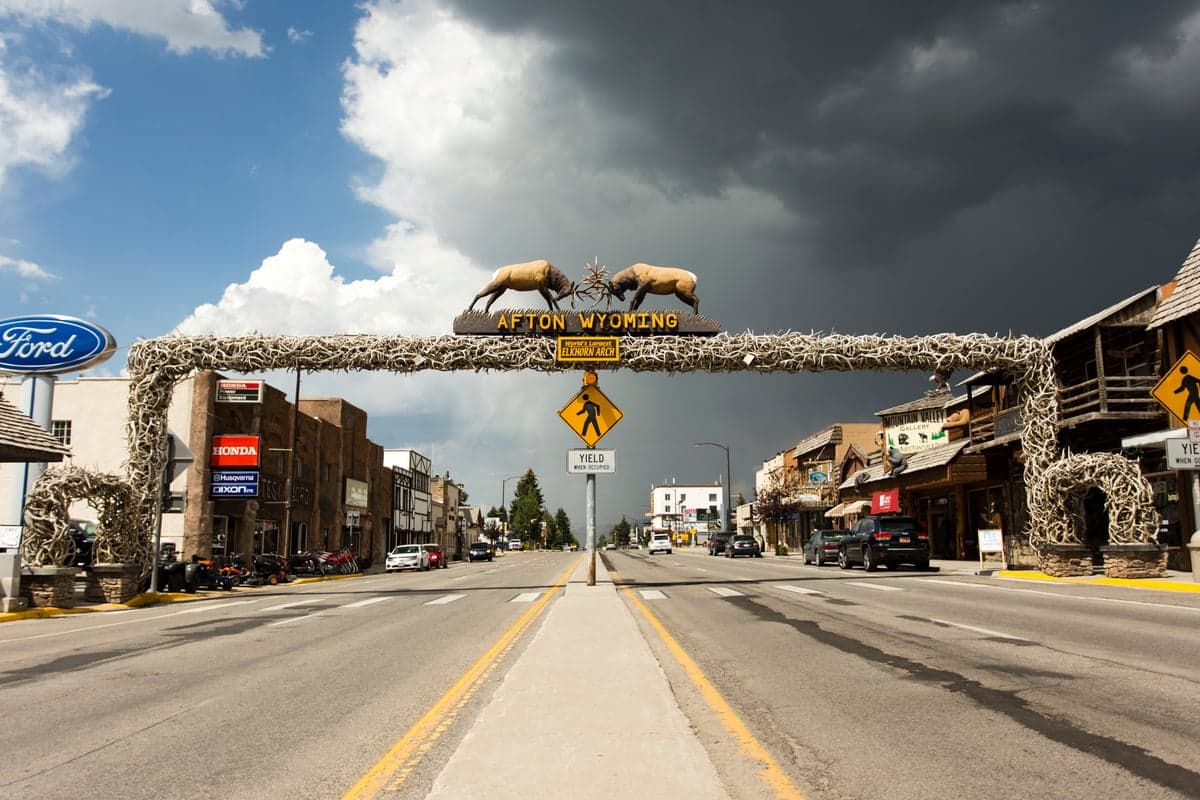
The people of Afton, Wyoming today form a tight-knit, predominantly white community of 1,982 residents, characterized by a strong Latter-day Saint (Mormon) cultural influence and a rural, family-oriented lifestyle. The population is notably homogenous, with 87.0% identifying as white and a small Hispanic minority of 7.3%, while the foreign-born share sits at just 0.9%. With a college attainment rate of 25.8%, the workforce is heavily tied to agriculture, small business, and regional services, creating a stable but slowly aging demographic base. This is a place where generational roots run deep, and newcomers are often drawn by the promise of quiet, safe living in the Star Valley.
How the city was settled and grew
Afton’s settlement history is rooted in the Mormon pioneer expansion of the late 19th century. The first permanent settlers, primarily Latter-day Saint families from Utah and Idaho, arrived in the 1880s, drawn by the fertile bottomlands of the Salt River and the promise of irrigated farming. The town was formally platted in 1899, and its growth was driven by the construction of the Star Valley Tabernacle in 1908, which became the social and religious anchor. The original homesteaders clustered in what is now the Historic Downtown Afton district, building simple frame homes and log cabins along what would become Washington Street. A second wave of Mormon settlers arrived in the 1910s and 1920s, pushing into the North Afton area, where larger farm plots were established. The community remained almost entirely white and LDS through the mid-20th century, with the local economy revolving around dairy farming, hay production, and the Afton Mercantile. No significant non-white or immigrant population settled here during this period, as the area’s isolation and cultural homogeneity discouraged outside migration.
Modern era (post-1965)
After the 1965 Hart-Cellar Act, Afton saw virtually no change in its ethnic composition, as the town’s remote location and lack of industrial jobs offered little draw for new immigrant groups. The foreign-born share remains negligible at 0.9%, and the Asian (East/Southeast Asian) population is a mere 0.3%, with no Indian-subcontinent residents recorded. The most notable demographic shift has been a modest increase in Hispanic residents, now at 7.3%, many of whom work in agricultural support roles and seasonal construction. These families have settled primarily in the South Afton area, near the highway corridor, where rental housing and mobile home parks are more available. Meanwhile, the white population has remained stable, with younger families often moving into the Fairview Addition subdivision, a newer development of single-family homes built in the 1990s and 2000s. The town has also seen a small influx of retirees from other parts of Wyoming and Idaho, drawn by the low crime rate and scenic setting, with many choosing homes in the Riverbend neighborhood along the Salt River. Overall, the modern era has reinforced Afton’s homogeneity rather than diversifying it, with the Hispanic community remaining the only notable minority group.
The future
Looking ahead, Afton’s population is likely to remain stable or grow very slowly, with projections suggesting a slight increase to around 2,100 by 2040. The Hispanic share may edge upward to 9-10% as agricultural labor needs persist, but the community shows no signs of rapid diversification. The white population is aging, with a median age around 40, and younger adults often leave for college or jobs in larger cities like Logan or Salt Lake City. The Elk Run subdivision, planned for development on the town’s western edge, may attract some new families, but the overall trend is toward homogenization rather than tribalization into distinct enclaves. The LDS cultural influence will likely remain dominant, and the town’s appeal to conservative-leaning families seeking a safe, rural environment will continue to drive what little in-migration occurs. For a newcomer, Afton offers a stable, predictable community where the population is not growing or changing rapidly, but where fitting in requires an appreciation for its tight-knit, faith-based social fabric.
In summary, Afton is becoming a slightly older, still overwhelmingly white community with a small but stable Hispanic presence, where the pace of demographic change is glacial. For someone moving in now, the key takeaway is that this is a place where cultural continuity is prized over diversity, and where the population’s future looks much like its past—quiet, homogeneous, and deeply rooted in the Star Valley landscape.

* Values derived from national, state, county, city and local statistics and may differ in a specific area. Last updated: 2026-04-21T11:29:27.000Z
Narrative content on this page is AI-generated and may contain mistakes. Verify any details that matter before acting on them.
ReloMaps may earn a commission from affiliate links at no extra cost to you.

