 Popular
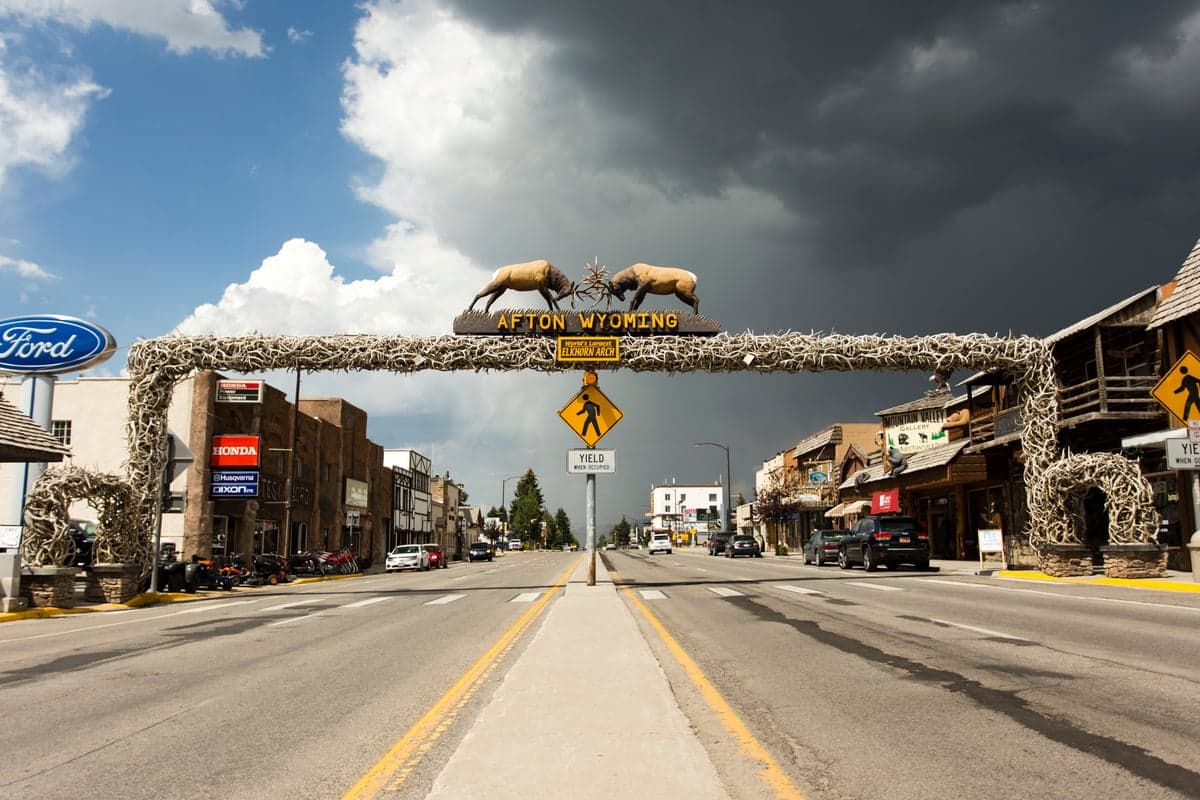
Photo: Wikipedia
Personal Sovereignty in Afton, WY
Viable for self-reliance. Generally workable, though some barriers may limit total independence.
What does Personal Sovereignty tell us?
Personal Sovereignty measures your capacity for self-reliance and independence with minimal government friction. Higher scores mean fewer barriers between you and the way you want to live... but it assumes you have the space you need and good neighbors.
What does this tell us?
Personal Sovereignty measures your capacity for self-reliance and independence with minimal government friction. Higher scores mean fewer barriers between you and the way you want to live... but it assumes you have the space you need and good neighbors.
State Policy
Energy independence: Net exporter (800% of energy produced in-state)
Personal Liberty
Homesteading

Personal Liberty Analysis
Afton, Wyoming, offers a level of personal sovereignty that is increasingly rare in the Lower 48, functioning as a practical stronghold for those prioritizing autonomy over convenience. Nestled in Star Valley, this community of roughly 2,200 residents operates under Wyoming’s famously libertarian-leaning state framework, which consistently ranks among the most freedom-respecting in the nation. For the survivalist or prepper, Afton represents a place where government overreach is still the exception, not the rule, and where the legal and cultural environment actively supports self-reliance. The key trade-off is geographic isolation—you are trading access to urban amenities for a buffer zone against federal and state intrusion, a calculation that many conservative-leaning individuals and families find increasingly worthwhile.
Tax burden and regulatory posture in Star Valley
Wyoming’s tax structure is a primary draw for those seeking to minimize government entanglement in their finances. There is no state income tax, no corporate income tax, and no personal property tax on vehicles or household goods. The state sales tax in Lincoln County is a modest 5%, with no local add-ons, meaning your daily purchases are taxed at a rate far below the national average. Property taxes are among the lowest in the country, with effective rates around 0.6% of assessed value—a fraction of what you’d pay in neighboring Idaho or Utah. Regulatory posture here is equally favorable. Wyoming operates under a “right to farm” law that protects agricultural operations from nuisance lawsuits, and the state has actively pushed back against federal land-use mandates. For the prepper, this means fewer zoning hurdles for building a root cellar, installing a backup generator, or keeping livestock on your property. The county government in Afton is small and accessible; most permitting decisions are handled by local officials who understand the value of self-sufficiency. There is no state-level building code in unincorporated areas, though Afton town limits do enforce basic codes—a detail worth noting if you plan to build from scratch.
Self-defense and gun law specifics in Wyoming
Wyoming is a constitutional carry state, meaning no permit is required to carry a concealed firearm for anyone legally allowed to possess one. This applies to both residents and non-residents, a significant advantage for those relocating from restrictive states. The state preempts all local firearm ordinances, so Afton cannot impose its own bans or waiting periods—your Second Amendment rights are uniform across the state. Stand-your-ground laws are in full effect, with no duty to retreat in any place you are lawfully present. Castle doctrine protections extend to your vehicle and place of business, not just your home. For the survivalist, this legal framework removes bureaucratic friction: you can carry, store, and train with firearms without navigating a permit maze. Magazine capacity limits, assault weapon bans, and red-flag laws are nonexistent. The nearest gun ranges are in Thayne (15 minutes north) or Alpine (30 minutes south), and the local sheriff’s office is known for being pro-2A in practice. If self-defense is a priority, Afton’s legal environment is as close to unencumbered as you will find outside of Alaska.
Self-reliance and homesteading viability in Afton
The physical landscape around Afton supports a serious homesteading lifestyle. Residential lots within town limits typically range from a quarter-acre to half-acre, but the real opportunity lies in the surrounding unincorporated areas of Star Valley, where parcels of 5 to 40 acres are common and affordable—often under $10,000 per acre. Zoning is minimal: Lincoln County has no county-wide zoning ordinance for agricultural or rural residential use, meaning you can keep chickens, goats, or a milk cow without seeking a variance. Off-grid feasibility is high. The area receives over 60 inches of annual snowfall, providing ample water for catchment systems, and the Salt River runs through the valley, offering surface water rights for irrigation (subject to state permitting, which is straightforward for domestic use). Solar potential is moderate due to the valley’s mountain shadows, but micro-hydro from seasonal creeks is a viable alternative for many properties. Internet access is improving with Starlink coverage, but cellular service remains spotty in the deeper draws—a feature, not a bug, for those seeking digital privacy. The local hardware store, Ace Hardware in Afton, stocks generators, water storage tanks, and basic off-grid supplies, and the Amish community in nearby Freedom, Idaho, is a resource for hand tools and alternative energy equipment. For the prepper, Afton offers the rare combination of affordable land, lenient zoning, and a climate that forces you to develop real survival skills—heating with wood, storing food, and managing snow removal are not hobbies here; they are necessities.
Personal liberties: parental rights, medical autonomy, speech, and property
Wyoming’s legal culture strongly favors individual liberty across multiple domains. Parental rights are robust: the state has a “Parents’ Bill of Rights” statute that affirms the fundamental right of parents to direct the upbringing, education, and healthcare of their children. School choice is available through open enrollment within the district, and homeschooling is lightly regulated—no notification requirements, no standardized testing mandates, and no curriculum approval. Medical autonomy is similarly respected. Wyoming has no state-level vaccine mandate for adults or children, and the state legislature has passed laws prohibiting discrimination against unvaccinated individuals in employment and public accommodations. The “Right to Try” law allows terminally ill patients access to experimental treatments without FDA interference, and there is no state-run prescription drug monitoring program that tracks your purchases. Free speech protections are strong, with no hate speech laws or social media censorship mandates at the state level. Property rights are protected by Wyoming’s Private Property Protection Act, which requires the government to compensate landowners for any regulatory taking that reduces property value by more than 50%. Eminent domain for private economic development is prohibited. For the conservative individual or family, these laws create a buffer against the kind of top-down mandates that have become common in coastal states. You can raise your children, manage your health, and speak your mind without fear of government reprisal—a baseline that is increasingly rare in 2026.
In the broader context of the Mountain West, Afton stands out not for being extreme, but for being consistent. Idaho’s panhandle offers similar gun laws and tax advantages but is seeing rapid population growth and the accompanying regulatory creep. Utah’s Wasatch Front is denser and more expensive, with a state government that has shown willingness to impose health mandates. Wyoming, by contrast, has maintained a stable, low-intervention governance model for decades. For the survivalist or prepper evaluating relocation options, Afton provides a proven template: low taxes, minimal zoning, strong self-defense laws, and a community that values self-reliance over government dependency. The isolation is real—two hours to Idaho Falls, four to Salt Lake City—but for those who see that isolation as a feature rather than a bug, Afton represents one of the last affordable bastions of personal sovereignty in the contiguous United States.

* Values derived from national, state, county, city and local statistics and may differ in a specific area. Last updated: 2026-04-21T11:29:27.000Z
Narrative content on this page is AI-generated and may contain mistakes. Verify any details that matter before acting on them.
ReloMaps may earn a commission from affiliate links at no extra cost to you.

