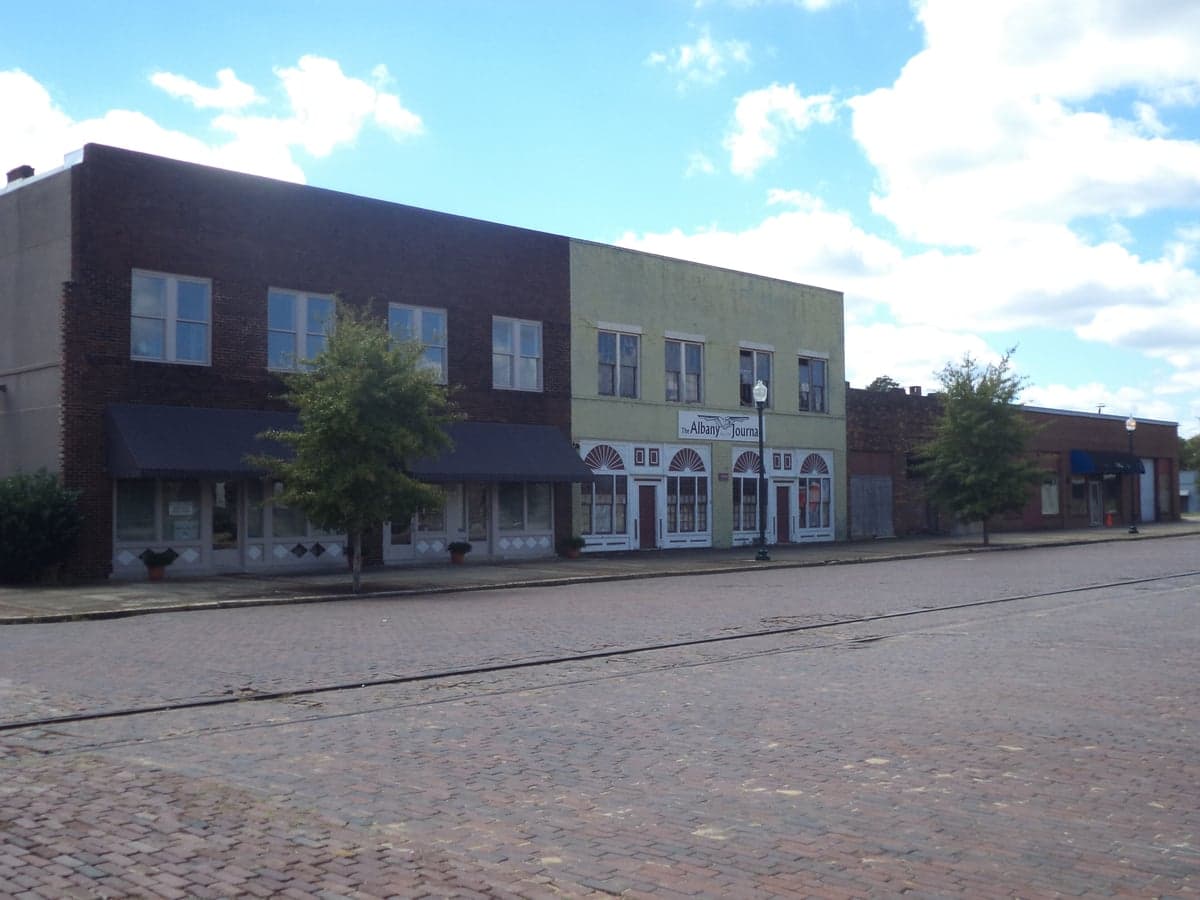
Photo: Wikipedia
Demographics of Albany, GA
Affluence Level in Albany, GA
A low-income area with significant economic hardship. Household wealth and educational attainment are well below national averages.
People of Albany, GA
The people of Albany, Georgia, today form a predominantly Black, deeply rooted community shaped by generations of agricultural labor, civil rights struggle, and economic adaptation. With a population of 67,939, the city is 75.8% Black, 18.5% White, 2.5% Hispanic, and 0.6% East/Southeast Asian, while only 1.1% of residents are foreign-born — making it one of the least immigrant-diverse cities in Georgia. The city’s identity is marked by a strong sense of place, a legacy of activism, and a population that is notably less college-educated (21.5%) than state averages, reflecting the economic challenges that have shaped its modern character.
How the city was settled and grew
Albany was founded in 1836 as a river port on the Flint River, designed to ship cotton from the surrounding plantation economy. The original White settlers were planters and merchants from the coastal South, who brought enslaved Black laborers to work the cotton fields. By the 1840s, the city’s economy depended entirely on enslaved African Americans, who made up the majority of the labor force. After the Civil War, freedmen and women remained in the area, forming the foundation of Albany’s Black community in neighborhoods like East Albany and Southside, where they built churches, schools, and small businesses. The arrival of the railroad in the 1850s and the establishment of peanut and pecan processing plants in the early 1900s drew additional Black workers from rural Southwest Georgia, as well as a small number of White laborers from the Appalachian region. By 1920, Albany’s population had grown to roughly 12,000, with Black residents concentrated in the Harlem district (named after New York’s Harlem) and along the Oglethorpe Boulevard corridor, while White residents dominated the Dawson Road and North Albany areas.
Modern era (post-1965)
The post-1965 period brought profound demographic change to Albany, driven by the collapse of the agricultural economy and the rise of manufacturing. The Civil Rights Movement, which saw Albany as a major battleground in 1961-62, accelerated White flight to suburbs like Lee County and Dougherty County’s unincorporated areas, while Black residents remained in the urban core. By 1980, Albany’s population had peaked at nearly 100,000, but deindustrialization — particularly the closure of textile mills and the decline of the Marine Corps Logistics Base’s workforce — triggered a steady population decline. The city’s White share dropped from roughly 45% in 1970 to 18.5% today, as middle-class White families moved to surrounding counties. Meanwhile, Black residents consolidated in neighborhoods like East Albany and Southside, while a small Hispanic population (2.5%) began arriving in the 1990s, primarily working in poultry processing and construction, settling in the Westover area near the industrial parks. The East/Southeast Asian community (0.6%) is tiny and largely consists of Vietnamese and Filipino families connected to the medical and military sectors, concentrated near Phoebe Putney Memorial Hospital.
The future
Albany’s population is projected to continue its slow decline, with the city losing roughly 1,000 residents per year since 2010. The Black population share is stabilizing near 76%, while the White share is likely to shrink further as older White residents age out and younger families leave for larger metros. The Hispanic population is growing slowly but remains too small to reshape the city’s demographics significantly. The East/Southeast Asian and Indian (0.0%) communities are negligible and show no signs of expanding. The city is not tribalizing into distinct enclaves so much as becoming more uniformly Black and lower-income, with the remaining White and Hispanic populations scattered across the North Albany and Westover areas. The biggest demographic wildcard is whether the Marine Corps Logistics Base — the city’s largest employer — will expand or contract, as its workforce brings in a small but stable number of military families from outside the region.
For someone moving to Albany now, the city is becoming a place where the population is increasingly homogeneous by race and class, with limited in-migration from outside the region. The lack of foreign-born residents (1.1%) means little cultural or economic dynamism from immigration, while the low college attainment rate (21.5%) reflects a workforce that struggles to attract knowledge-economy jobs. Albany is not a growing or diversifying city — it is a stable, deeply Southern community where the population is slowly aging and shrinking, and where newcomers will find a tight-knit, historically grounded Black majority culture rather than a melting pot.

* Values derived from national, state, county, city and local statistics and may differ in a specific area. Last updated: 2026-04-30T00:52:30.000Z
Narrative content on this page is AI-generated and may contain mistakes. Verify any details that matter before acting on them.
ReloMaps may earn a commission from affiliate links at no extra cost to you.

