Photo: Wikipedia
Demographics of Alexandria, VA
Affluence Level in Alexandria, VA
An upper-middle-class area. Household wealth, education levels, and homeownership run ahead of national benchmarks.
People of Alexandria, VA
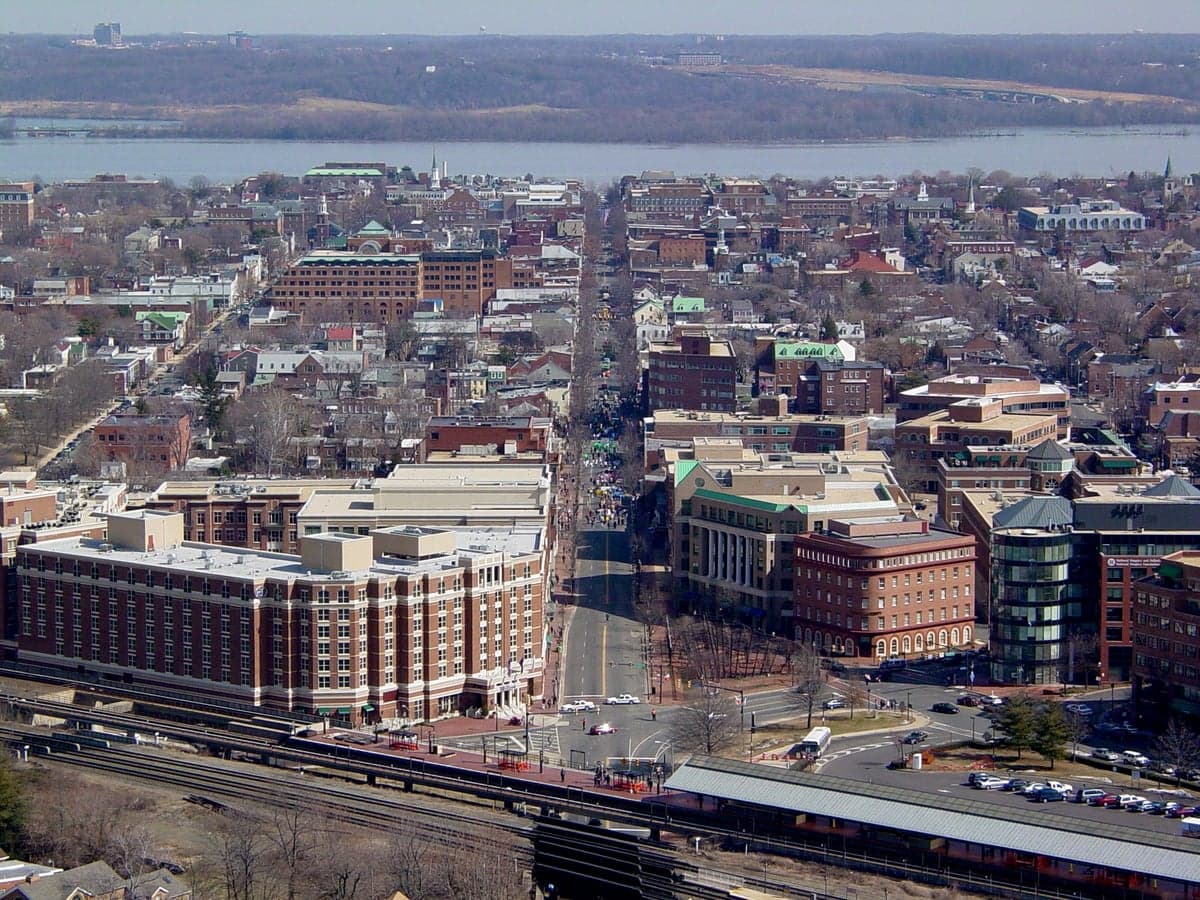
Alexandria, Virginia, is a densely populated, historically layered city of 156,788 residents where a highly educated workforce (65.8% college-educated) coexists with deep-rooted Black and immigrant communities. Its character is defined by a sharp contrast: affluent, white-majority Old Town and the West End sit alongside historically Black neighborhoods like Parker-Gray and the Arlandria corridor, which anchors a growing Hispanic population. The city’s identity is a blend of federal government professionals, military families tied to the Pentagon, and long-standing families who predate the region’s modern boom.
How the city was settled and grew
Founded in 1749 as a tobacco port on the Potomac River, Alexandria’s original population was a mix of English merchants, Scottish traders, and enslaved Africans who built the city’s wharves and warehouses. The 19th century brought a wave of Irish and German immigrants who worked on the railroad and in the shipyards, settling in the working-class Del Ray neighborhood. After the Civil War, freed Black families established the Parker-Gray district, which became the cultural and commercial heart of Alexandria’s African American community through the Jim Crow era. The 20th century saw a major influx of federal employees during World War II, drawn by the Pentagon’s 1943 opening, which spurred suburban growth in the West End and Beverley Hills neighborhoods. These mid-century arrivals were overwhelmingly white, middle-class, and government-oriented, setting the stage for the city’s modern professional character.
Modern era (post-1965)
The 1965 Hart-Cellar Act reshaped Alexandria’s population by opening immigration from Asia and Latin America. Today, the foreign-born share stands at 12.7%, with two distinct streams. East and Southeast Asian communities (4.6% of the population) began arriving in the 1970s and 1980s, many as Vietnamese refugees or Chinese professionals in tech and government, concentrating in the Landmark area and the West End. The Hispanic population (18.2%) grew rapidly from the 1990s onward, driven by Salvadoran, Guatemalan, and Mexican immigrants who found work in construction, hospitality, and landscaping. They anchor the Arlandria corridor (known locally as “Chirilagua” after a Salvadoran town) and parts of the West End. Meanwhile, domestic migration brought a wave of young professionals and families from across the U.S., drawn by the region’s strong job market. This group is predominantly white and college-educated, and they have gentrified Old Town and Del Ray, pushing up housing costs and shifting the city’s racial balance. The Black population, once a majority in the 1970s, has declined to 20.7% as many families moved to Prince George’s County or further south in Virginia, though Parker-Gray remains a symbolic and residential anchor. The Indian-subcontinent population (1.6%) is a smaller, newer group, largely professionals in tech and medicine, scattered across the West End rather than forming a single enclave.
The future
Alexandria’s population is heading toward greater economic stratification and ethnic balkanization rather than homogenization. The white, college-educated share is likely to grow further as high housing costs filter out lower-income families, especially in Old Town and Del Ray. The Hispanic population is plateauing, with second-generation families assimilating into the broader workforce and moving to outer suburbs like Woodbridge or Manassas for cheaper housing. The Black population is stabilizing after decades of decline, but remains concentrated in the West End and Parker-Gray, where legacy homeowners provide a buffer against displacement. East and Southeast Asian communities are slowly dispersing from Landmark into more affluent areas, while the Indian-subcontinent population is growing modestly but remains too small to create a distinct neighborhood. The next 10-20 years will likely see Alexandria become a city of two tiers: a wealthy, white-majority core along the Potomac and a more diverse, middle-income West End, with Arlandria remaining a Hispanic gateway. The city’s overall density will increase as new high-rise developments rise along the Route 1 corridor and near the Potomac Yard Metro station.
For someone moving in now, Alexandria offers a stable, well-educated community with strong public services and a deep sense of history. The trade-off is high cost of living and a demographic landscape where your experience will vary sharply by neighborhood—Old Town is a walkable, affluent enclave, while the West End provides more diversity and affordability. The city is not becoming a melting pot; it is becoming a collection of distinct, self-reinforcing enclaves, each with its own trajectory.

* Values derived from national, state, county, city and local statistics and may differ in a specific area. Last updated: 2026-05-02T01:19:06.000Z
Narrative content on this page is AI-generated and may contain mistakes. Verify any details that matter before acting on them.
ReloMaps may earn a commission from affiliate links at no extra cost to you.

