Photo: Wikipedia
Demographics of Allentown, PA
Affluence Level in Allentown, PA
A low-income area with significant economic hardship. Household wealth and educational attainment are well below national averages.
People of Allentown, PA
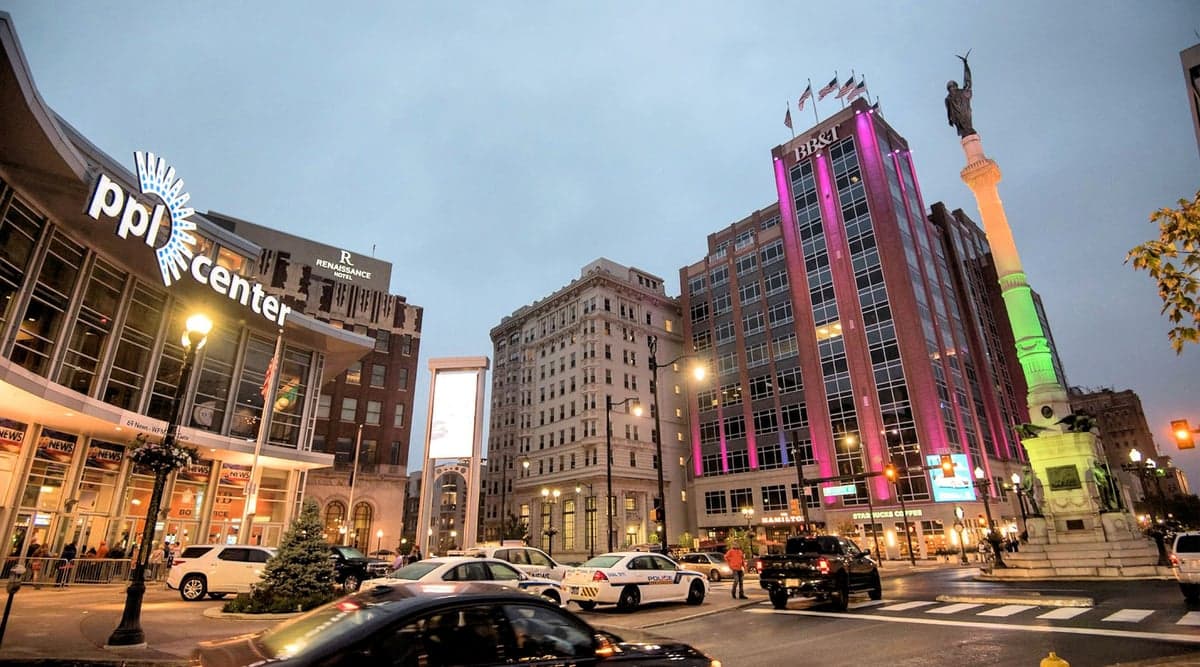
The people of Allentown, Pennsylvania today form a densely populated, majority-Hispanic city of 125,320 residents, a dramatic shift from its 20th-century identity as a predominantly white, industrial hub. The city is characterized by a young, working-class population with a median age of 32.5 and a notably low college attainment rate of 19.4%, reflecting its blue-collar roots and ongoing economic transition. Distinctive identity markers include a strong Puerto Rican and Dominican cultural presence, a shrinking but historically influential white ethnic population, and a small but growing East/Southeast Asian and Indian community. Allentown is a city in demographic flux, where the old ethnic neighborhoods of European immigrants are now largely Hispanic enclaves.
How the city was settled and grew
Allentown was founded in 1762 by William Allen, a wealthy Philadelphia merchant, on land purchased from the Lenape people. Its early growth was driven by its location along the Lehigh River and the arrival of German-speaking settlers, primarily Lutherans and Reformed Protestants, who established farms and small trades. The city’s industrial boom began in the mid-19th century with the discovery of iron ore and the construction of the Lehigh Canal and later railroads, making it a center for iron, steel, and manufacturing. This drew successive waves of immigrants: first the Irish and Germans in the 1840s–1880s, who built neighborhoods like Old Allentown and the First Ward near the canal and rail yards. Then, from the 1880s to the 1920s, large numbers of Eastern European Jews, Italians, Poles, Slovaks, and Hungarians arrived to work in the Bethlehem Steel and Mack Trucks plants. These groups settled in distinct enclaves: Italians concentrated in the 6th Ward (around St. Paul’s Catholic Church), Poles in the 5th Ward near St. Stanislaus Church, and Jews in the West End along Chew Street. By 1950, Allentown was over 98% white, with a strong German and Eastern European cultural character.
Modern era (post-1965)
The post-1965 era brought a fundamental demographic transformation. The Immigration and Nationality Act of 1965 opened doors to non-European immigration, but the most dramatic shift in Allentown was domestic: the Great Migration of Puerto Ricans to the mainland, which accelerated in the 1970s and 1980s as manufacturing jobs declined and the island’s economy faltered. Puerto Ricans initially settled in the Center City and Old Allentown neighborhoods, areas that had been vacated by white families moving to the suburbs. By 1990, the Hispanic share of the population had risen to roughly 20%, and by 2020 it had surged to over 50%. Today, the Hispanic population stands at 53.8%, with Puerto Ricans and Dominicans forming the largest subgroups. The 6th Ward, once Italian, is now overwhelmingly Hispanic. The white population, now 30.0%, has largely retreated to the West End and the South Side (the area south of the Little Lehigh Creek), though these neighborhoods are also seeing Hispanic in-migration. The Black population (11.0%) is concentrated in the East Side and parts of Center City, a legacy of later migration from other U.S. cities. East/Southeast Asian communities (1.5%) are small and dispersed, with a slight concentration near the Lehigh Valley Hospital campus. The Indian population (1.0%) is even smaller and more scattered, with no single dominant neighborhood.
The future
Allentown’s population is heading toward further Hispanicization, with the white share projected to continue declining as older residents age out and younger white families choose suburban municipalities like Emmaus or Macungie. The Hispanic population is young and has a higher birth rate, suggesting it will approach 60–65% of the city within 10–15 years. The city is not homogenizing, however; it is tribalizing into distinct enclaves based on national origin within the Hispanic community—Puerto Rican and Dominican neighborhoods remain somewhat separate, and newer arrivals from Central America (Guatemala, Honduras) are forming clusters in the 1st Ward. The Black population is stable but not growing rapidly, while the East/Southeast Asian and Indian communities are growing slowly from a small base, likely due to the city’s lack of high-skilled job opportunities. The college-educated share (19.4%) is low, and without a major anchor employer or university expansion, Allentown is unlikely to attract significant numbers of new immigrants from Asia or India. The city will remain a working-class, majority-Hispanic industrial city in transition, with pockets of white and Black residents in specific neighborhoods.
For someone moving in now, Allentown offers a dense, affordable urban environment with a strong Latino cultural identity, but it is not a place of rapid upward mobility or high educational attainment. The city is becoming more uniformly Hispanic, with less ethnic diversity than its 20th-century past. New residents should expect a community where Spanish is widely spoken, where the economy is still tied to logistics and light manufacturing, and where the most stable, family-oriented neighborhoods are in the West End and South Side, while Center City remains the most dynamic but also the most economically challenged area.

* Values derived from national, state, county, city and local statistics and may differ in a specific area. Last updated: 2026-05-02T01:09:54.000Z
Narrative content on this page is AI-generated and may contain mistakes. Verify any details that matter before acting on them.
ReloMaps may earn a commission from affiliate links at no extra cost to you.

