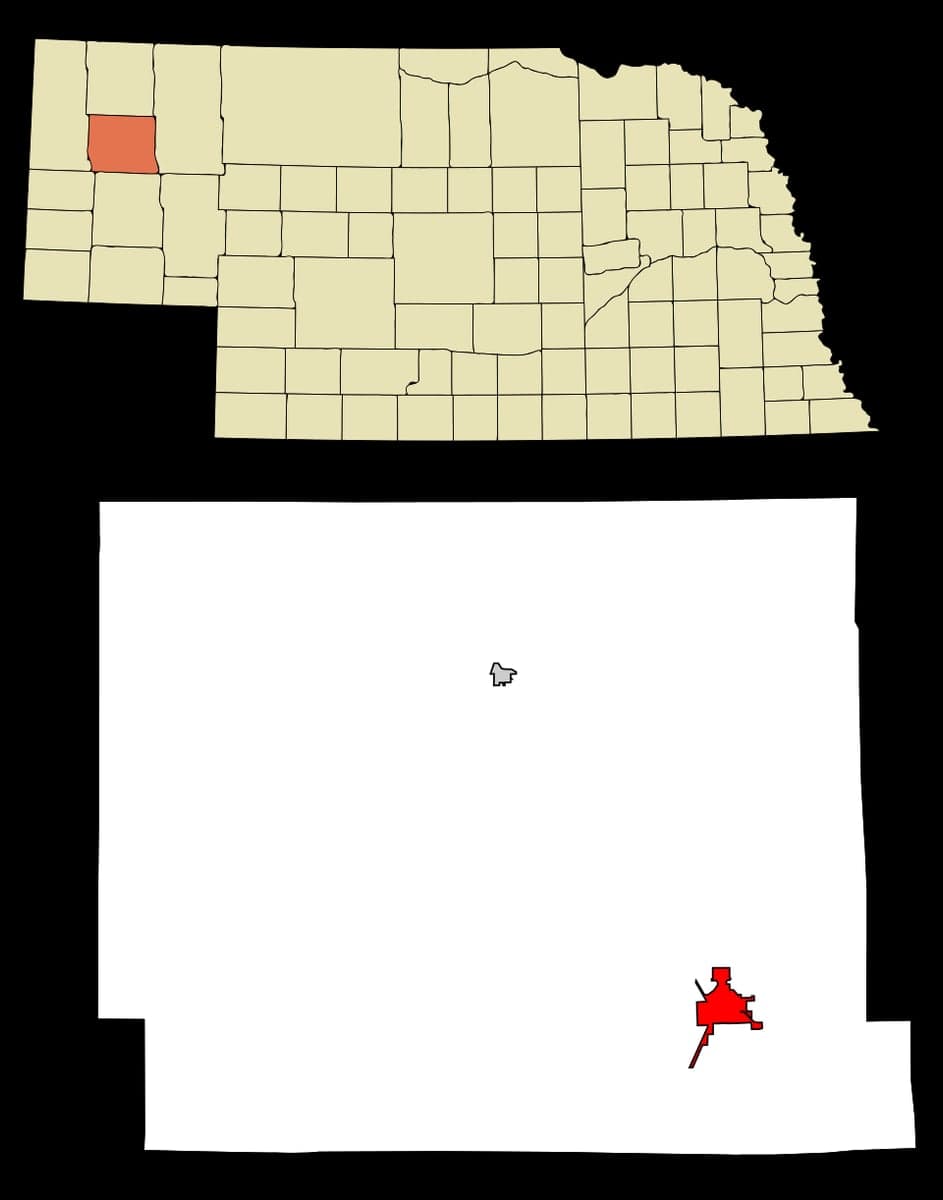
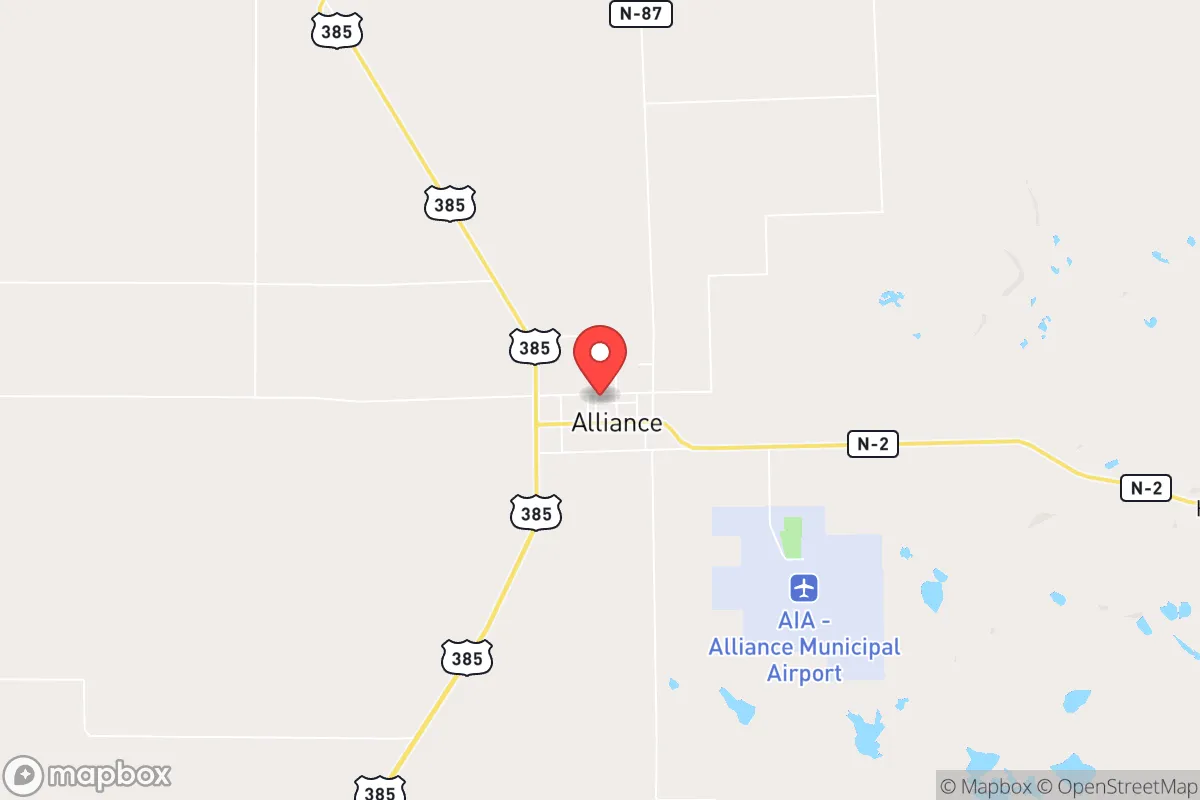
Photo: Wikipedia
Demographics of Alliance, NE
Affluence Level in Alliance, NE
A middle-class area roughly in line with national averages across income, home values, education, and employment.
People of Alliance, NE
The people of Alliance, Nebraska, today number 8,089, forming a tight-knit, predominantly white community with a growing Hispanic minority and small but established Black and East/Southeast Asian populations. The city’s character remains rooted in its railroad and agricultural heritage, with a population density of roughly 1,400 people per square mile that gives it a small-town, walkable feel. Distinctive markers include a strong sense of local pride centered on the historic Knight Museum and the annual Alliance Rodeo, alongside a practical, self-reliant ethos common to Nebraska Panhandle towns. The population is older than the national median (median age 41.2) and less college-educated (20.2%), reflecting a workforce oriented toward blue-collar and service-sector employment.
How the city was settled and grew
Alliance was founded in 1888 as a railroad town, born directly from the expansion of the Chicago, Burlington and Quincy Railroad. The original population was overwhelmingly white, drawn from Midwestern states like Iowa, Illinois, and Missouri, as well as German and Scandinavian immigrants who came to work the rails and farm the surrounding dryland wheat fields. The first major wave of settlement clustered around the original depot and the commercial corridor along Box Butte Avenue, an area still known as Downtown Alliance, where many of the original brick storefronts and railroad-era boarding houses remain. A second wave of homesteaders arrived during the early 1900s under the Kinkaid Act, which granted 640-acre parcels to settlers willing to prove up the land. These families built homes in what is now the West Side neighborhood, a grid of modest frame houses west of the tracks that remains a predominantly white, working-class area. By 1910, the population had reached 4,000, and the city became a regional trade hub for ranchers and farmers. A small but notable wave of Black railroad workers and their families settled in the South Side district near the rail yards during the 1920s and 1930s, forming the nucleus of the city’s Black community, which today stands at 4.5% of the population.
Modern era (post-1965)
After the 1965 Hart-Cellar Act, Alliance saw modest diversification. The most significant post-1965 shift has been the growth of the Hispanic population, which now makes up 11.8% of residents. This wave began in the 1980s and accelerated in the 2000s, driven by employment in the region’s meatpacking plants (primarily in nearby Scottsbluff and Gering) and agricultural labor. Hispanic families have concentrated in the North Side neighborhood, an area of newer, more affordable housing stock built in the 1970s and 1980s, and in the Eastgate district, a cluster of mobile home parks and ranch-style homes east of Highway 385. The East/Southeast Asian population (0.7%) and Indian-subcontinent population (0.3%) are very small and largely professional, with families scattered across the Hillcrest neighborhood, a post-1980 subdivision of larger homes near the golf course. Domestic in-migration has been minimal; most new residents come from elsewhere in Nebraska or from neighboring states like South Dakota and Wyoming. The white population has declined slightly since 2000 (down from 84% to 79.6%), while the Hispanic share has grown steadily. The Black population has remained stable, concentrated in the South Side and in a small cluster of homes near the former rail yards.
The future
Alliance’s population is projected to remain flat or decline slightly over the next decade, mirroring rural Nebraska trends. The Hispanic community is the only segment showing clear growth, likely rising to 14-16% of the population by 2035, driven by both natural increase and continued labor migration. This growth is concentrated in the North Side and Eastgate districts, which are becoming distinctly Hispanic enclaves with Spanish-language signage, tiendas, and a growing Catholic parish presence. The white population is aging and shrinking, with younger white adults leaving for college and not returning. The Black and East/Southeast Asian communities are stable but not growing, as there is no major employer attracting new waves of these groups. The city is not tribalizing into sharply divided enclaves—neighborhoods remain mixed—but the North Side is increasingly Hispanic, while the West Side and Hillcrest remain overwhelmingly white. For a new resident, this means moving into a community where the dominant culture is still white and rural, but where Hispanic influence is visibly expanding in commerce and public life. The city’s future is one of slow demographic change, not rapid transformation, making it a stable but slowly diversifying place for those seeking a quiet, affordable, and historically grounded Nebraska town.
In short, Alliance is becoming a more Hispanic-influenced community while retaining its white, railroad-era core. For a conservative-leaning individual or family moving in now, the city offers a low-cost, low-crime environment with a clear sense of local identity, but with the understanding that the population is aging and the economic base is narrow. The neighborhoods to watch for growth are the North Side and Eastgate, while the West Side and Hillcrest remain the most established and stable white areas.

* Values derived from national, state, county, city and local statistics and may differ in a specific area. Last updated: 2026-05-03T20:28:40.000Z
Narrative content on this page is AI-generated and may contain mistakes. Verify any details that matter before acting on them.
ReloMaps may earn a commission from affiliate links at no extra cost to you.

