Photo: Wikipedia
Demographics of Altoona, PA
Affluence Level in Altoona, PA
A low-income area with significant economic hardship. Household wealth and educational attainment are well below national averages.
People of Altoona, PA
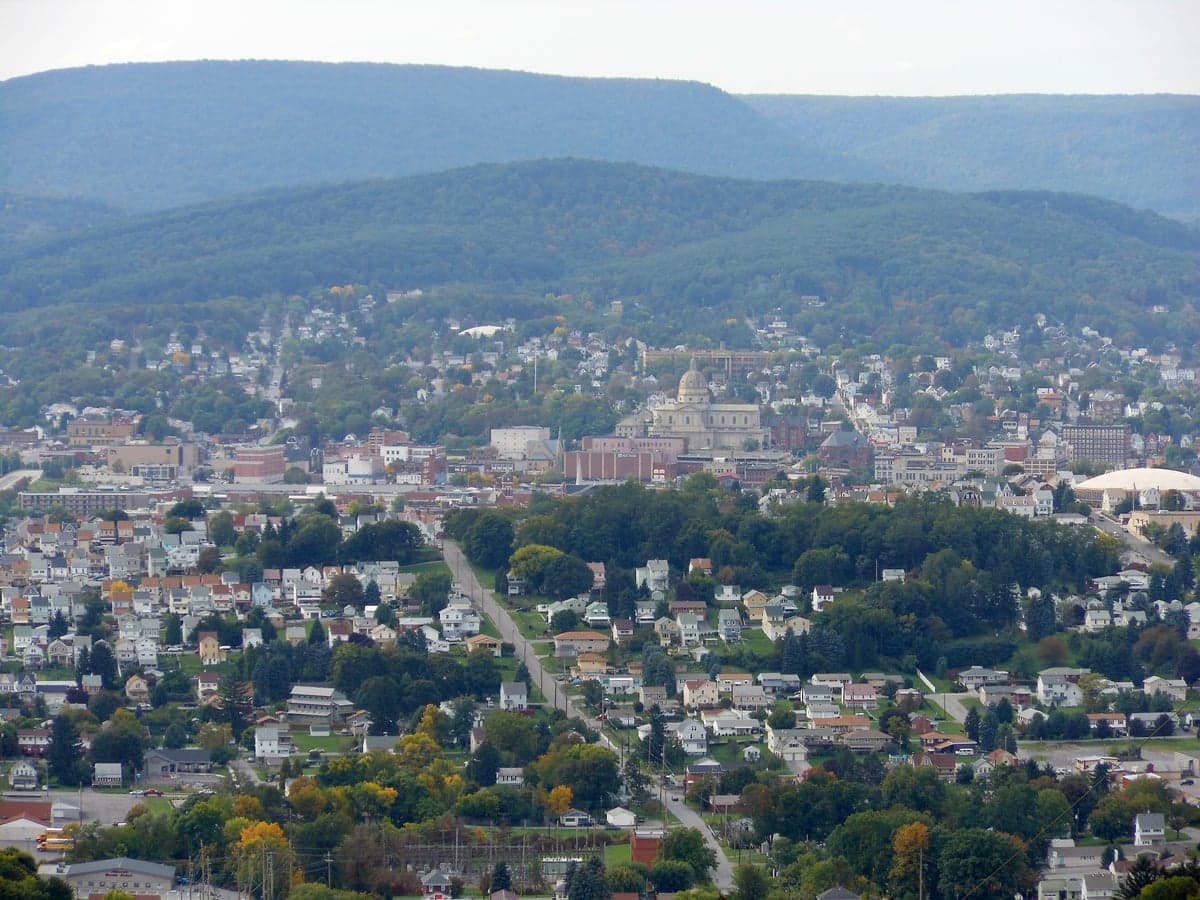
Altoona, Pennsylvania, is a city of 43,508 residents that remains overwhelmingly white (89.1%) and native-born, with a foreign-born population of just 0.6%. Its people are defined by a working-class, railroad-built heritage that has persisted through decades of industrial decline, creating a tight-knit but aging community where only 19.9% of adults hold a college degree. The city's identity is rooted in its historic ethnic neighborhoods, though today those enclaves have largely blended into a culturally homogeneous population facing steady population loss.
How the city was settled and grew
Altoona was founded in 1849 as a direct creation of the Pennsylvania Railroad, which selected the site in the Logan Valley for its railroad shops and maintenance complex. The city's original population was overwhelmingly native-born white Americans from surrounding rural Pennsylvania, joined by waves of Irish immigrants who built the railroad tracks and German immigrants who worked as machinists and carpenters in the shops. These groups settled in distinct neighborhoods: the Irish concentrated in Fairview and the lower parts of Eldorado, while German families established themselves in Llyswen and along the Pleasant Valley Boulevard corridor. By the 1880s, Italian immigrants arrived to work in the railroad yards and stone quarries, forming a tight community in Juniata around 10th Avenue and the Italian Catholic church. Eastern European immigrants—Slovaks, Poles, and Ukrainians—followed in the 1890s and early 1900s, settling in East Altoona near the car shops. The city peaked at 82,054 residents in 1930, with the railroad employing over 15,000 workers at its height. These ethnic groups maintained distinct parishes, social clubs, and mutual aid societies, but intermarriage and assimilation accelerated after World War II.
Modern era (post-1965)
After the 1965 Immigration Act, Altoona saw virtually no new immigrant influx—its foreign-born share today is a negligible 0.6%, far below the national average. The city's demographic story since the 1970s has been one of domestic out-migration and aging. The Pennsylvania Railroad's decline, culminating in the 1970 bankruptcy and subsequent Conrail takeover, triggered a sustained population exodus. Between 1970 and 2020, Altoona lost roughly 40% of its residents. The white population dropped from 97% in 1970 to 89.1% today, but this shift is primarily due to white out-migration rather than non-white in-migration. The Black population rose modestly to 3.1%, with most Black families settling in the West End and parts of Downtown near the former railroad hospital. Hispanic residents (1.8%) and East/Southeast Asian residents (0.4%) are scattered thinly, with no concentrated ethnic enclave forming. The Indian-subcontinent population is 0.2%, largely professionals associated with the UPMC Altoona hospital system. The historic ethnic neighborhoods of Juniata, Llyswen, and Fairview remain predominantly white, though their ethnic identities have faded into a generic working-class character. The college-educated share of 19.9% reflects the city's limited attraction for knowledge-economy workers, with most educated residents commuting to State College or leaving the region entirely.
The future
Altoona's population is projected to continue declining, with the 2020 census showing 43,508 residents—down from 46,320 in 2010. The city is homogenizing rather than diversifying: the white share is stable at roughly 89%, and the small Black and Hispanic populations are growing only incrementally. No immigrant community is large enough to sustain a distinct enclave or reverse the aging trend. The median age has risen to 40.5, and the city's school district has lost over 1,000 students since 2010. The most likely scenario for the next 10-20 years is continued slow decline, with the population settling around 38,000-40,000 as older residents pass away and younger adults leave for job markets in Pittsburgh, Harrisburg, or Philadelphia. The city's historic neighborhoods will likely become more affordable but also more vacant, with Juniata and East Altoona seeing the most pronounced housing abandonment. The small professional class tied to UPMC Altoona and the local Penn State campus may stabilize parts of Llyswen and the West End, but this will not offset overall losses.
For someone moving in now, Altoona offers a deeply affordable, safe, and culturally stable environment—but one that is shrinking and aging. The city is becoming a quieter, more insular version of its railroad-era self, where community ties remain strong but economic and demographic dynamism is absent. New residents should expect a place where nearly everyone is native-born, white, and working-class, and where the biggest change is the slow emptying of once-bustious neighborhoods.

* Values derived from national, state, county, city and local statistics and may differ in a specific area. Last updated: 2026-05-01T08:07:23.000Z
Narrative content on this page is AI-generated and may contain mistakes. Verify any details that matter before acting on them.
ReloMaps may earn a commission from affiliate links at no extra cost to you.

