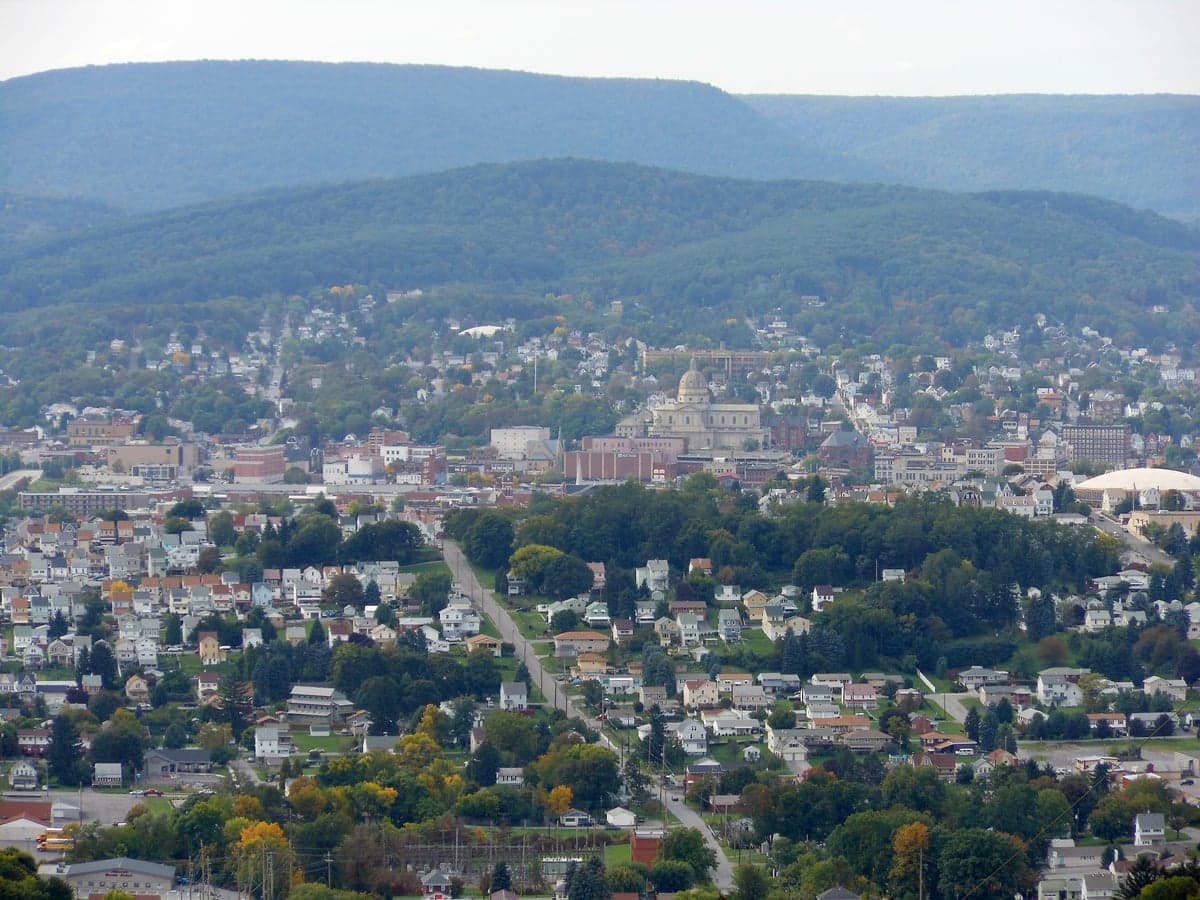
Photo: Wikipedia
Personal Sovereignty in Altoona, PA
Strong independent fundamentals that actively favor personal liberty and low regulation.
What does Personal Sovereignty tell us?
Personal Sovereignty measures your capacity for self-reliance and independence with minimal government friction. Higher scores mean fewer barriers between you and the way you want to live... but it assumes you have the space you need and good neighbors.
What does this tell us?
Personal Sovereignty measures your capacity for self-reliance and independence with minimal government friction. Higher scores mean fewer barriers between you and the way you want to live... but it assumes you have the space you need and good neighbors.
State Policy
Energy independence: Net exporter (150% of energy produced in-state)
Personal Liberty
Homesteading

Personal Liberty Analysis
Altoona, Pennsylvania offers a mixed but workable environment for personal sovereignty, where the state's preemption laws and rural character provide meaningful buffers against government overreach, though residents must contend with a state-level income tax and regulatory layers that can chafe. Nestled in Blair County, this former railroad hub sits in a region where self-reliance is still a cultural expectation, not a political slogan. For the survivalist or prepper looking to establish a foothold away from coastal chaos, Altoona presents a realistic trade-off: you get a low cost of living and a community that largely minds its own business, but you must navigate Pennsylvania's specific legal frameworks on taxes, guns, and property rights with eyes wide open.
Tax burden and regulatory posture in Altoona and Pennsylvania
Pennsylvania's tax structure is a mixed bag for those seeking maximum financial autonomy. The state levies a flat 3.07% personal income tax on all earned income, which is moderate compared to neighboring states like New York or New Jersey, but it's still a direct cut from your labor. There is no state-level tax on retirement income, including Social Security, pensions, and 401(k) withdrawals, which is a significant win for those planning long-term self-sufficiency. Property taxes in Altoona are relatively high for the region, with effective rates around 1.8% of assessed value, driven by school district funding needs. However, the median home value in Altoona hovers around $70,000, meaning the actual dollar amount is manageable. On the regulatory side, Pennsylvania is not a free-for-all. The state has a uniform construction code, and the Department of Environmental Protection (DEP) enforces rules on well water and septic systems that can complicate off-grid setups. That said, Blair County's local governments are generally less aggressive than Philadelphia or Pittsburgh in enforcing zoning or business licensing, giving you more breathing room to operate a home-based enterprise or workshop without constant interference.
Self-defense and gun law specifics for Altoona residents
Pennsylvania is a shall-issue state for concealed carry permits, meaning if you pass a background check and complete the application process, the sheriff's office must issue the permit. There is no discretionary denial based on a sheriff's personal opinion, which is a critical safeguard against local government overreach. Altoona residents can carry openly without a permit, and the state preempts all local firearm ordinances, so you won't face the patchwork of city-level bans that plague states like California or New York. Stand-your-ground laws apply, with no duty to retreat in any place you are lawfully present. However, there are nuances: private sales of long guns do not require a background check, but handgun transfers must go through a licensed dealer with a Pennsylvania Instant Check System (PICS) check. Magazine capacity is not restricted, and there is no state-level assault weapons ban. For the prepper, this means you can build a serious armory without worrying about sudden legislative bans, though you should monitor the state legislature in Harrisburg, as urban Democrats occasionally push for restrictions. The local culture in Altoona is strongly pro-Second Amendment, and gun ranges and private land for shooting are readily accessible within a 20-minute drive.
Self-reliance and homesteading viability in Altoona
Altoona's geography and zoning make it a viable location for a self-reliant lifestyle, especially if you look just outside the city limits. Within the city, lots are typically small—often under a quarter-acre—and zoning restricts keeping livestock or building large outbuildings. But move to the surrounding townships, such as Logan Township or Antis Township, and you can find half-acre to two-acre parcels for under $30,000, with far looser restrictions. Chickens are generally allowed in most rural zoning districts, and some areas permit goats or a single horse on an acre or more. Off-grid feasibility is moderate: Pennsylvania's DEP requires a permit for well drilling and septic system installation, which can cost $5,000–$10,000, but once installed, you are largely independent of municipal water and sewer. Solar panels are legal and encouraged by net metering policies, though you must connect to the grid to sell back excess power. Rainwater collection is not restricted at the state level, but local ordinances may limit it for potable use. The growing season is short—about 150 days—so serious food production requires a greenhouse or cold frames. Wood heating is common, with ample public and private forest land for firewood gathering, but you need a permit for cutting on state game lands. Overall, Altoona offers a solid foundation for a semi-off-grid setup, but full independence requires careful property selection and upfront investment in infrastructure.
Personal liberties: parental rights, medical autonomy, speech, and property
Pennsylvania generally respects parental rights, with a strong presumption that parents control their children's education, healthcare, and upbringing. Homeschooling is legal and relatively straightforward: you must file a notarized affidavit with the local school district each year, maintain a portfolio of work, and have the child evaluated by a certified teacher or standardized test annually. There is no requirement for parents to hold teaching credentials, and the curriculum is largely self-directed. Medical autonomy is more contested. The state has no broad religious or philosophical exemption to vaccination mandates for school attendance, though medical exemptions are available. During the COVID-19 pandemic, Pennsylvania imposed mask mandates and business closures that many in Altoona viewed as overreach, and the local sentiment remains skeptical of future public health orders. Free speech is protected under the state constitution, and there are no unique restrictions beyond federal law. Property rights are generally strong, with no state-level rent control or forced inclusionary zoning. However, eminent domain is a concern near transportation corridors; the Pennsylvania Turnpike and rail lines have historically been used for infrastructure projects. The biggest threat to personal liberty in Altoona is the potential for state-level overreach from Harrisburg, particularly on environmental regulations that could affect land use or energy independence. Local government in Blair County is more aligned with conservative values, but state preemption limits what they can shield you from.
Overall, Altoona ranks as a moderate-to-strong location for personal sovereignty when compared to the Northeast corridor. You are far enough from the regulatory gravity of Philadelphia and Pittsburgh to enjoy practical freedoms in gun ownership, homeschooling, and property use. The tax burden is manageable, and the cost of land allows for genuine self-reliance. The primary risks are state-level political shifts and the need to navigate DEP rules for off-grid systems. For a single individual or family with a prepper mindset, Altoona offers a realistic base of operations—not a libertarian paradise, but a place where you can build a life largely on your own terms without constant government friction.

* Values derived from national, state, county, city and local statistics and may differ in a specific area. Last updated: 2026-05-01T08:07:23.000Z
Narrative content on this page is AI-generated and may contain mistakes. Verify any details that matter before acting on them.
ReloMaps may earn a commission from affiliate links at no extra cost to you.

