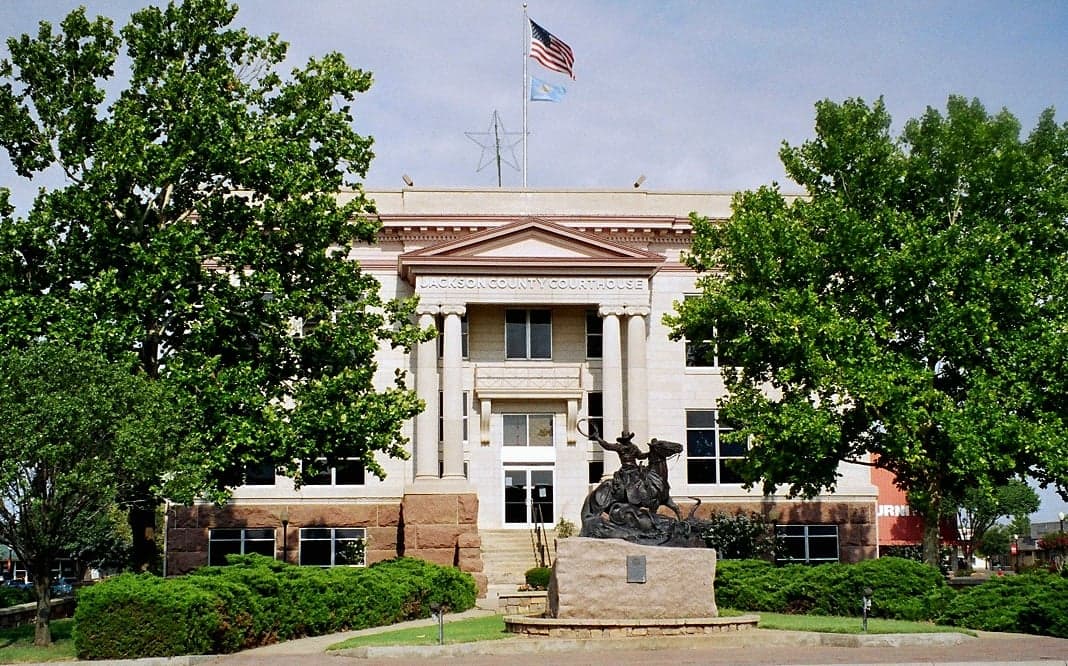
Photo: Wikipedia
Personal Sovereignty in Altus, OK
Strong independent fundamentals that actively favor personal liberty and low regulation.
What does Personal Sovereignty tell us?
Personal Sovereignty measures your capacity for self-reliance and independence with minimal government friction. Higher scores mean fewer barriers between you and the way you want to live... but it assumes you have the space you need and good neighbors.
What does this tell us?
Personal Sovereignty measures your capacity for self-reliance and independence with minimal government friction. Higher scores mean fewer barriers between you and the way you want to live... but it assumes you have the space you need and good neighbors.
State Policy
Energy independence: Net exporter (180% of energy produced in-state)
Personal Liberty
Homesteading

Personal Liberty Analysis
Altus, Oklahoma, offers a personal sovereignty environment that stands in stark contrast to the coastal and urban jurisdictions where government overreach has become the norm. For the survivalist or prepper, this small city in Jackson County represents a pocket where state-level constitutional protections and a deeply ingrained culture of self-reliance still hold sway. The legal framework here is designed to minimize interference in your life, from your property to your family decisions, making it a viable option for those seeking to escape the creeping authoritarianism seen elsewhere in the country.
Tax burden and regulatory posture: How much the state leaves in your pocket
Oklahoma’s overall tax burden is among the lowest in the nation, and Altus benefits directly from this posture. There is no state income tax on Social Security benefits, and the state’s flat income tax rate of 4.75% (as of 2026) is scheduled to drop further under recent legislation. Property taxes in Jackson County are exceptionally low, typically hovering around 0.8% of assessed value, meaning a $200,000 home carries an annual tax bill of roughly $1,600. This is a fraction of what you’d pay in blue states like California or New York. The regulatory environment is equally lean: Oklahoma is a right-to-work state with minimal business licensing hurdles, and there are no state-level red flag laws or universal background checks for private firearm sales. For the prepper, this means less of your income is confiscated to fund programs you oppose, and fewer bureaucratic barriers stand between you and your self-sufficiency goals. The state’s fiscal conservatism translates directly into more disposable income for land, supplies, and training.
Self-defense and gun law specifics: What you can carry and where
Oklahoma is a constitutional carry state, meaning that as of November 1, 2019, any law-abiding adult 21 or older can carry a firearm openly or concealed without a permit. Altus residents enjoy this right without the need for government permission slips, background checks for private transfers, or waiting periods. The state preempts local gun ordinances, so Altus city council cannot impose its own restrictions—a critical protection against the patchwork of local gun bans seen in states like Colorado or Washington. Stand-your-ground laws are fully in effect, with no duty to retreat in any place you are lawfully present. Castle doctrine protections extend to your home, vehicle, and place of business. For the survivalist, this legal landscape means you can keep a rifle in your truck, a sidearm on your hip, and a shotgun by the door without fear of running afoul of arbitrary rules. The only notable restriction is that carrying into federal buildings, schools (with exceptions for licensed carry), and certain government meetings is prohibited, but these are standard limitations nationwide. The state’s firearm preemption law is robust, ensuring that Altus remains a safe harbor for gun owners.
Self-reliance and homesteading viability: Lot sizes, zoning, and off-grid feasibility
Altus and the surrounding Jackson County area offer genuine opportunities for self-reliance that are increasingly rare in the United States. Residential lots within city limits can be as small as a quarter-acre, but the real draw is the unincorporated county land, where parcels of 1 to 40 acres are readily available at prices under $2,000 per acre. Zoning in the county is minimal: there are no restrictions on keeping chickens, goats, or even a few head of cattle on your property. Off-grid living is legally feasible, as Oklahoma has no state-level prohibition on rainwater collection, and solar panel installations are not subject to HOA-style restrictions outside of city limits. The county does not enforce building codes on agricultural land, meaning you can construct a workshop, root cellar, or even a tiny home without permits, as long as you are not within a platted subdivision. Water rights are tied to land ownership, and the Ogallala Aquifer provides reliable groundwater for wells. For the prepper, this means you can establish a self-sufficient homestead with a garden, livestock, and independent water and power systems without fighting a local bureaucracy. The main challenge is the semi-arid climate—average rainfall is only 25 inches per year—so drought-resistant crops and water storage are essential.
Personal liberties: Parental rights, medical autonomy, speech, and property
Oklahoma has taken a strong stance on parental rights, with state law affirming that parents have the fundamental right to direct the upbringing, education, and healthcare of their children. This means no school board can hide curriculum from parents, and medical decisions—including vaccination choices—remain firmly in the family’s hands. Medical autonomy is further protected by the Oklahoma Medical Freedom Act, which prohibits mandatory vaccination as a condition of employment or service, and the state has no forced quarantine laws that allow indefinite detention without due process. Free speech is robustly protected under the Oklahoma Constitution, which explicitly states that “every person may freely speak, write, or publish his sentiments on all subjects.” There are no hate speech laws that criminalize political or religious expression. Property rights are secured by strong eminent domain protections: the state cannot seize land for private economic development, a common abuse in other states. For the survivalist, this legal environment means you can homeschool your children without excessive state oversight, refuse medical mandates, speak your mind about government overreach without fear of prosecution, and know that your land cannot be taken for a shopping mall. These protections form a legal bulwark against the erosion of personal sovereignty seen in more progressive jurisdictions.
Compared to the rest of the country, Altus stands as a stronghold of personal sovereignty. The combination of constitutional carry, low taxes, minimal zoning, and robust parental and medical rights creates an environment where the individual—not the state—remains the primary decision-maker. While no location is perfect, and federal overreach remains a concern everywhere, Altus offers a legal and cultural foundation that allows a prepper or survivalist to build a life of genuine self-reliance without constantly fighting government intrusion. For those looking to escape the tightening grip of authoritarian governance, this corner of Oklahoma provides a viable, affordable, and legally protected sanctuary.

* Values derived from national, state, county, city and local statistics and may differ in a specific area. Last updated: 2026-04-21T11:45:43.000Z
Narrative content on this page is AI-generated and may contain mistakes. Verify any details that matter before acting on them.
ReloMaps may earn a commission from affiliate links at no extra cost to you.

