
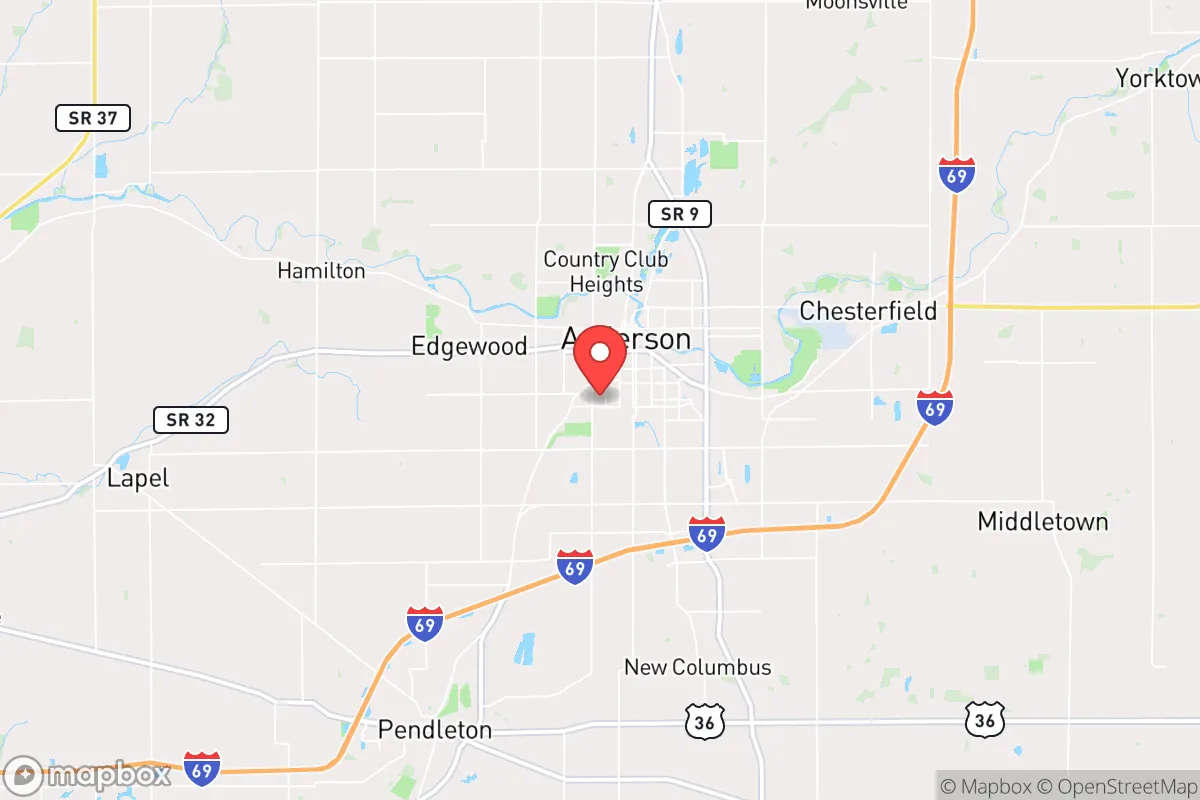
Photo: Wikipedia
Personal Sovereignty in Anderson, IN
Viable for self-reliance. Generally workable, though some barriers may limit total independence.
What does Personal Sovereignty tell us?
Personal Sovereignty measures your capacity for self-reliance and independence with minimal government friction. Higher scores mean fewer barriers between you and the way you want to live... but it assumes you have the space you need and good neighbors.
What does this tell us?
Personal Sovereignty measures your capacity for self-reliance and independence with minimal government friction. Higher scores mean fewer barriers between you and the way you want to live... but it assumes you have the space you need and good neighbors.
State Policy
Energy independence: Importer (35% of energy produced in-state)
Personal Liberty
Homesteading

Personal Liberty Analysis
Anderson, Indiana, offers a notably high degree of personal sovereignty relative to many Midwestern cities, largely due to Indiana’s consistently conservative state-level governance and a local culture that prizes self-reliance. For the strategic relocation researcher with a survivalist or prepper mindset, the key takeaway is that while Anderson is not a libertarian utopia, its legal and regulatory environment provides a solid foundation for individuals and families seeking to minimize government overreach into their daily lives. The city’s post-industrial character means lower land costs and less bureaucratic friction than in booming suburban centers, but it also means you must be vigilant about local ordinances that can nibble at the edges of your autonomy.
Tax burden and regulatory posture: How Indiana’s policies affect your wallet and freedom
Indiana’s tax structure is a clear win for those seeking to keep more of their earnings and reduce entanglement with state bureaucracy. The state levies a flat income tax of 3.15% as of 2025, with a scheduled reduction to 2.9% by 2027—a trajectory that rewards long-term planning. Property taxes in Madison County are among the lowest in the state, with effective rates typically hovering around 0.8% to 1.0% of assessed value, which is roughly half the national average. This means a $200,000 home might carry an annual tax bill of only $1,600 to $2,000. Crucially, Indiana has a strong homestead credit and a circuit breaker cap that prevents property taxes from exceeding 1% of gross assessed value for owner-occupied homes. On the regulatory front, Indiana is a right-to-work state and has a generally pro-business climate, which translates to fewer occupational licensing hurdles and less red tape for starting a small business or home-based enterprise. However, be aware that Madison County has adopted the state’s building codes, so any major construction or off-grid modifications will require permits and inspections—a point of friction for those wanting to build entirely outside the system. The state also has no inventory tax and no inheritance tax, further reducing the government’s reach into your assets.
Self-defense and gun law specifics: What you can carry, where, and without what permission
Indiana is a constitutional carry state, meaning that as of July 1, 2022, any law-abiding adult 18 or older can carry a handgun openly or concealed without a permit. This is a foundational liberty for anyone prioritizing self-defense. There is no state-level registry for firearms, no waiting period for purchases, and no ban on standard-capacity magazines or common semi-automatic rifles. The state preempts local gun ordinances, so Anderson’s city council cannot impose its own restrictions—a critical safeguard against the patchwork of local gun laws seen in states like Colorado or Illinois. Stand-your-ground laws are fully in effect, with no duty to retreat in any place you have a legal right to be. For preppers, this means you can lawfully maintain a substantial armory without fear of sudden regulatory changes at the city level. The only notable limitation is that Indiana does require a background check for all firearm purchases from licensed dealers (federal law), but private sales between individuals remain unregulated. For those with a survivalist mindset, this legal environment allows you to focus on training and stockpiling rather than navigating a maze of permits and restrictions.
Self-reliance and homesteading viability: Lot sizes, zoning, and off-grid feasibility in Anderson
Anderson’s zoning code is a mixed bag for serious homesteaders. Within the city limits, standard residential lots are typically 6,000 to 10,000 square feet, which is enough for a substantial garden and a few chickens, but not for larger livestock or extensive off-grid infrastructure. The city does allow backyard chickens (hens only, no roosters) with a permit, and beekeeping is permitted. However, the real opportunity lies in the unincorporated areas of Madison County, just a 10- to 15-minute drive from downtown Anderson. There, you can find parcels of 1 to 10 acres for $5,000 to $15,000 per acre—dirt cheap by national standards. Zoning in these areas is far more permissive: you can keep horses, goats, and other livestock, and there are no restrictions on rainwater collection or composting toilets. Off-grid solar is legal, though you must still connect to the grid for net metering if you want to sell excess power; going fully off-grid is technically allowed but may complicate future property sales. The county has no building codes in unincorporated areas, meaning you can erect a pole barn, workshop, or tiny home without permits—a major win for those wanting to build incrementally and outside the inspection system. The main constraint is well and septic permits, which are required by the county health department and can cost $2,000 to $5,000. For the serious prepper, the strategy is clear: buy land just outside city limits, build a self-sufficient compound, and use Anderson’s amenities (hardware stores, medical facilities, grocery) as a supply hub.
Personal liberties: Parental rights, medical autonomy, speech, and property protections
Indiana has become a battleground for personal liberties, with recent legislative trends favoring parental rights and medical freedom. In 2023, the state passed a law requiring schools to notify parents of any changes in a student’s health or well-being, effectively giving parents veto power over gender-related accommodations. This aligns with a broader conservative push for family sovereignty. On medical autonomy, Indiana does not have a state-level vaccine mandate for adults, and the state has banned COVID-19 vaccine passports for government services. However, the state does require certain childhood immunizations for school attendance, with a broad religious exemption that is easy to invoke. For those concerned about medical privacy, Indiana has no law requiring employers to mandate vaccines, and the state’s health department has limited enforcement power over individual choices. Free speech is robustly protected under the Indiana Constitution, which has its own free speech clause that courts have interpreted as at least as protective as the First Amendment. Property rights are strong: Indiana has no statewide rent control, no ban on short-term rentals (though Anderson may have local registration requirements), and no forced annexation without a vote. The state also has a strong eminent domain law that requires just compensation and a public purpose, with recent court rulings limiting the use of eminent domain for private economic development. For the prepper, this means you can speak your mind, refuse medical mandates, and control your property without fear of government seizure for a private developer’s profit.
In the broader landscape of American personal sovereignty, Anderson, Indiana, ranks as a solid B+—not the libertarian frontier of rural Alaska or New Hampshire, but far more accommodating than the heavily regulated states of the Northeast or West Coast. The combination of constitutional carry, low taxes, permissive rural zoning, and strong parental rights creates a legal environment where a determined individual or family can build a self-reliant life with minimal government interference. The main trade-offs are the need to navigate local zoning if you stay within city limits and the reality that Indiana is not a nullification state—federal laws still apply. But for those looking to escape the creeping overreach of blue-state governance while staying within driving distance of major employment centers like Indianapolis (45 minutes south), Anderson offers a pragmatic balance of freedom and opportunity. The key is to buy land outside the city, stay informed on local ordinance changes, and leverage the state’s pro-liberty tilt while it lasts.

* Values derived from national, state, county, city and local statistics and may differ in a specific area. Last updated: 2026-04-30T01:45:18.000Z
Narrative content on this page is AI-generated and may contain mistakes. Verify any details that matter before acting on them.
ReloMaps may earn a commission from affiliate links at no extra cost to you.

