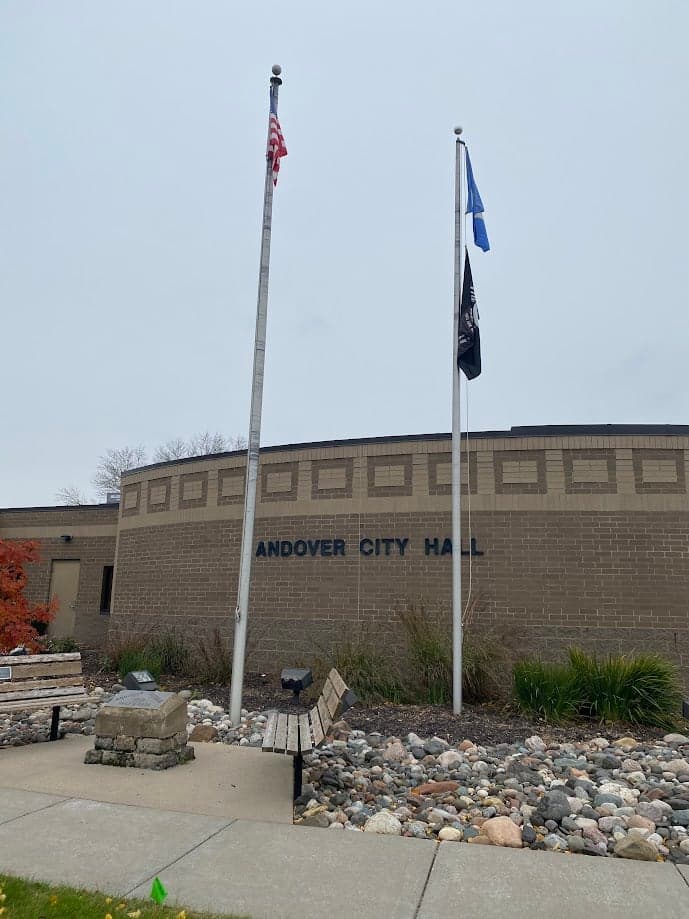
Photo: Wikipedia
Demographics of Andover, MN
Affluence Level in Andover, MN
An upper-middle-class area. Household wealth, education levels, and homeownership run ahead of national benchmarks.
People of Andover, MN
The people of Andover, Minnesota, today form a predominantly white, family-oriented suburb of 32,825 residents, characterized by its low density (roughly 1,200 people per square mile) and a strong sense of local identity distinct from the nearby Twin Cities. With a foreign-born population of just 0.9% and a 37.7% college-educated rate, Andover is a relatively homogeneous, middle-to-upper-middle-class community where single-family homes dominate the landscape. Its distinctive identity markers include a high rate of homeownership, a robust park system, and a reputation as a safe, quiet place to raise children, attracting families who prioritize space and schools over urban amenities.
How the city was settled and grew
Andover’s human history begins not with colonial settlement but with the land’s original inhabitants, the Dakota people, who used the Rum River area for hunting and fishing before being displaced through treaties in the mid-19th century. European-American settlement began in earnest after the 1854 Treaty of Washington opened the region to logging and farming. The first wave of settlers were primarily Yankee and German immigrants drawn by cheap land and the timber industry along the Rum River. These early families clustered in what is now the Old Andover neighborhood, centered around the intersection of Bunker Lake Boulevard and Hanson Boulevard, where the first school and church were built. A second wave of Scandinavian immigrants—Swedes and Norwegians—arrived in the 1880s and 1890s, establishing farms in the Crooked Lake area, named for the glacial lake that remains a local landmark. By 1900, the population was a few hundred, and the economy was entirely agricultural, with small sawmills dotting the river. The city was officially incorporated in 1974, but its character remained rural until the late 20th century.
Modern era (post-1965)
The post-1965 transformation of Andover was driven not by immigration reform but by domestic suburbanization, as the 1990s and 2000s saw explosive growth fueled by the expansion of Highway 10 and the construction of the Anoka County Highway 116 corridor. The city’s population surged from roughly 5,000 in 1990 to over 30,000 by 2010, as white, middle-class families from Minneapolis and inner-ring suburbs sought larger lots and newer homes. This wave settled in master-planned subdivisions like Rum River Hills (east of the Rum River) and Bunker Hills Estates (near the Bunker Hills Regional Park), both developed in the 1990s and 2000s. The Sunfish Lake neighborhood, built around a small lake and golf course, attracted upper-income professionals. The city’s racial composition remained overwhelmingly white through this period, with the 2020 Census showing 86.7% white, 4.5% Black, 2.9% East/Southeast Asian, and 2.0% Hispanic. The Black population, while small, is concentrated in the newer developments near the Andover Crossings commercial district, reflecting a modest diversification among younger families. The East/Southeast Asian community—primarily Hmong and Vietnamese families—is most visible in the Rum River Hills area, where a handful of Asian-owned businesses have opened along Bunker Lake Boulevard. The Indian subcontinent population is statistically zero, and the Arab population is negligible.
The future
Andover’s population is likely to continue its slow, steady growth, reaching an estimated 35,000–38,000 by 2040, driven by infill development on remaining agricultural parcels and the aging of existing residents. The city is not homogenizing further—it is already highly homogeneous—but it is slowly diversifying at the margins. The Black and East/Southeast Asian populations are growing from a very low base, primarily through domestic migration from the Twin Cities, not international immigration. The Bunker Hills area, with its newer townhomes and apartments, is absorbing most of this diversification, while older neighborhoods like Old Andover and Crooked Lake remain overwhelmingly white and aging. The Hispanic population is plateauing, and the foreign-born share is unlikely to rise above 2% given the lack of entry-level jobs and affordable rental housing. The city is not tribalizing into distinct ethnic enclaves; instead, it is experiencing a slow, quiet assimilation of small minority populations into a predominantly white, English-speaking fabric. The next decade will likely see Andover become slightly more diverse in absolute numbers but remain one of the least diverse suburbs in the northern metro.
For someone moving in now, Andover is becoming a stable, mature suburb where the population is aging in place and new arrivals are overwhelmingly white families from other parts of Minnesota. The city offers a safe, low-density environment with good schools and ample parks, but it lacks the ethnic diversity and cultural amenities of closer-in suburbs. If you value space, safety, and a predictable, family-oriented community, Andover is a strong choice—but it is not a place where you will find significant racial or cultural variety.

* Values derived from national, state, county, city and local statistics and may differ in a specific area. Last updated: 2026-04-30T09:09:00.000Z
Narrative content on this page is AI-generated and may contain mistakes. Verify any details that matter before acting on them.
ReloMaps may earn a commission from affiliate links at no extra cost to you.

