Photo: Wikipedia
Demographics of Anniston, AL
Affluence Level in Anniston, AL
A low-income area with significant economic hardship. Household wealth and educational attainment are well below national averages.
People of Anniston, AL
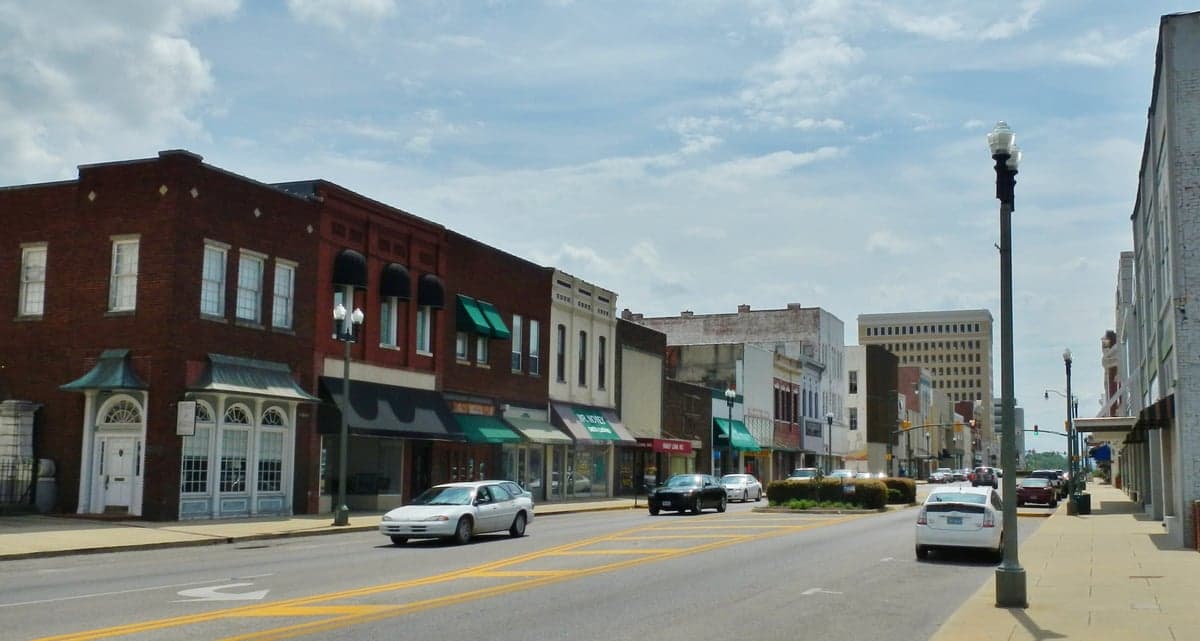
Anniston, Alabama, is a city of roughly 21,400 residents defined by a near-even Black (49.1%) and White (42.8%) population, with a small Hispanic community (4.5%) and negligible foreign-born presence (0.7%). Its character remains deeply rooted in its industrial past and the racial dynamics that shaped its neighborhoods, resulting in a highly segregated but stable demographic landscape. The city is notably less educated than national averages, with only 21.5% of adults holding a college degree, and its population has been slowly declining for decades. For a conservative-leaning mover, Anniston offers a low cost of living and a strong sense of local identity, but with limited ethnic diversity and a clear historical divide between its eastern and western halves.
How the city was settled and grew
Anniston was founded in 1872 as a planned industrial town by the Woodstock Iron Company, deliberately sited at the intersection of two railroads to exploit local iron ore and limestone deposits. The original population was overwhelmingly native-born White, drawn from surrounding Appalachian counties to work in the blast furnaces and rolling mills. These early workers and managers settled in the West Anniston neighborhood, which grew up around the mill complex and remains the city's historic White working-class core. By the early 1900s, the booming iron and pipe industries attracted a second wave: Black laborers from rural Alabama and Georgia, who were recruited to fill lower-wage foundry and railroad jobs. They established the East Anniston district, also known as "the Bottom," a segregated enclave east of the railroad tracks that became the city's primary Black residential area. A third, smaller wave arrived during World War I and the 1920s: a handful of Italian and Greek immigrants who opened grocery stores and restaurants, settling in a mixed-use strip along Noble Street in what is now Downtown Anniston. By 1950, the city had grown to over 31,000 residents, with a rigid racial geography that would persist for decades.
Modern era (post-1965)
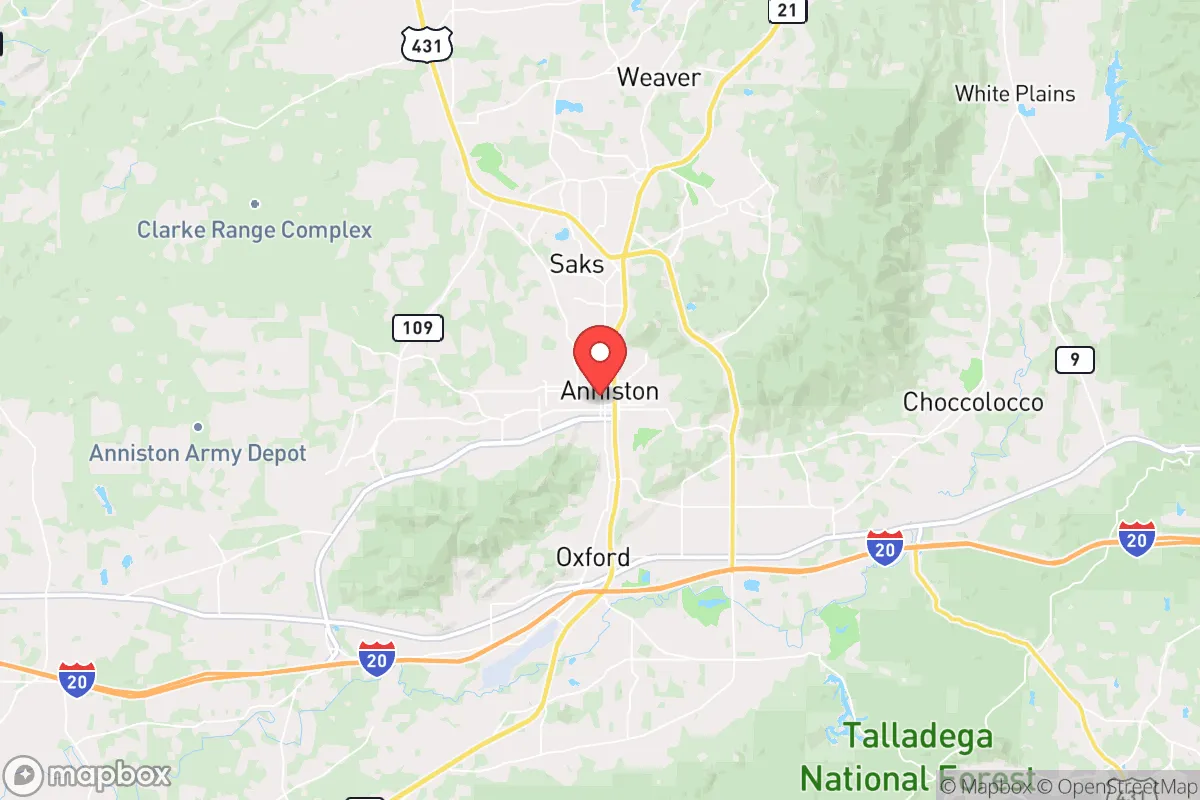
The post-1965 period brought no significant new immigration to Anniston—the foreign-born share today is just 0.7%, one of the lowest in any U.S. city of its size. Instead, the major demographic shift was suburbanization and White flight. After the Civil Rights Act and the desegregation of Anniston High School in the late 1960s, many White families moved to the unincorporated areas north and west of the city limits, particularly to the Golden Springs and Oxford communities (Oxford is a separate municipality but functionally part of the same metro area). Within Anniston proper, the White population dropped from roughly 60% in 1970 to 42.8% today, while the Black share rose from 38% to 49.1%. The East Anniston neighborhood expanded southward into the Hobson City area (a historically Black town annexed by Anniston in the 1990s), while West Anniston aged in place and lost population. The Hispanic community, now 4.5% of the city, began arriving in the 1990s, primarily from Mexico and Central America, to work in poultry processing plants in nearby Piedmont and in construction. They settled in a small corridor along Quintard Avenue (U.S. Highway 431), where a handful of tiendas and taquerias now operate. East/Southeast Asian residents (0.4%) and Indian-subcontinent residents (0.1%) are present in negligible numbers, mostly professionals at the Anniston Army Depot or the Regional Medical Center.
The future
Anniston's population is projected to continue a slow decline, from its 1960 peak of 33,657 to perhaps 19,000–20,000 by 2040, driven by out-migration of young adults and low birth rates among the aging White population. The city is not homogenizing; rather, it is tribalizing into its existing enclaves. West Anniston is becoming older and emptier, with many homes now owned by absentee landlords. East Anniston remains overwhelmingly Black and is seeing modest reinvestment through community development corporations, but poverty rates there exceed 35%. The Hispanic community is growing slowly—roughly 0.1% per year—but is not large enough to transform the city's character. No significant immigrant group is arriving to replace the departing population. The most likely future is a smaller, poorer, and more racially polarized Anniston, with the economic anchor shifting to the Anniston Army Depot and the medical corridor along Highway 21. For a new resident, this means choosing between the older, quieter West Side or the more densely populated East Side, with limited options for integrated, mixed-income neighborhoods.
Anniston is becoming a smaller, more economically strained city where the historic Black-White divide remains the dominant social fact. For a conservative mover seeking a low-cost, slow-paced environment with strong community ties, the city offers affordability and a clear sense of place—but also limited job growth, a shrinking tax base, and a population that is not diversifying. The best bet for stability is the Golden Springs fringe or the nearby town of Oxford, rather than the city core itself.

* Values derived from national, state, county, city and local statistics and may differ in a specific area. Last updated: 2026-04-19T18:42:14.000Z
Narrative content on this page is AI-generated and may contain mistakes. Verify any details that matter before acting on them.
ReloMaps may earn a commission from affiliate links at no extra cost to you.

