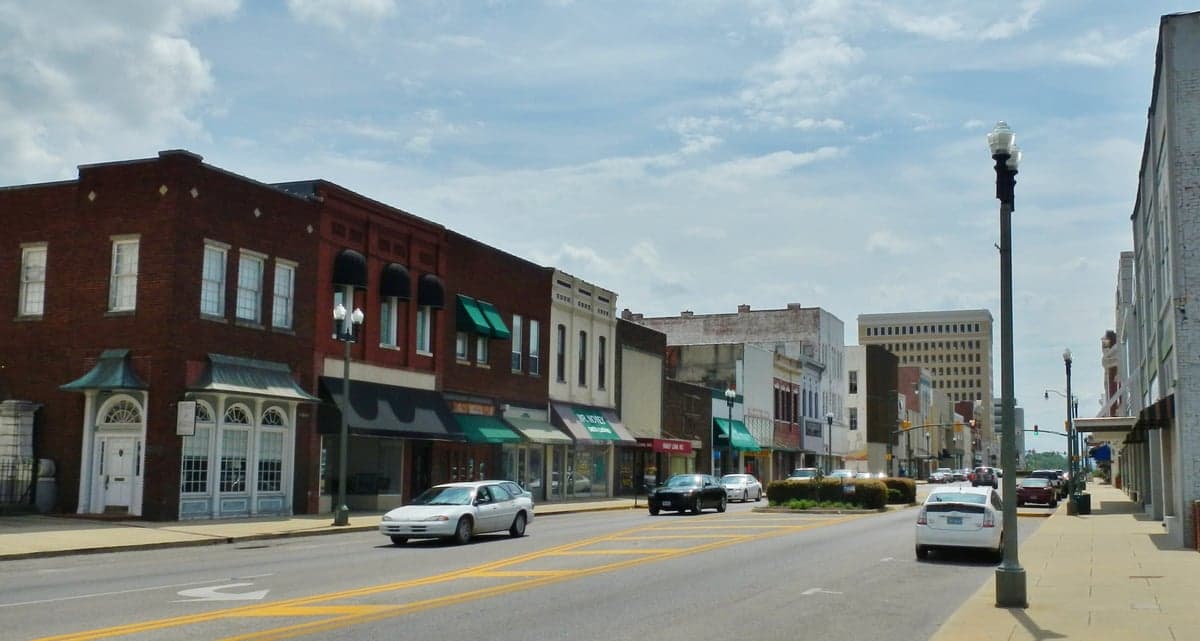
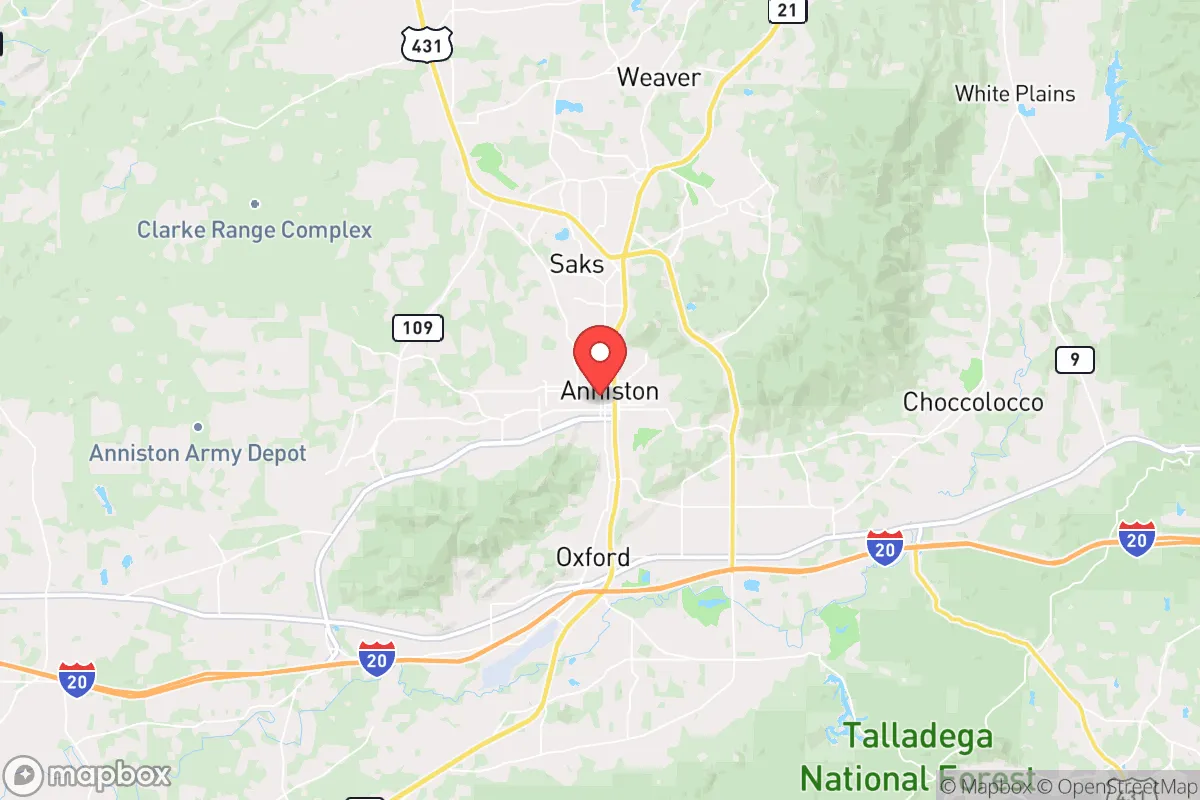
Photo: Wikipedia
Personal Sovereignty in Anniston, AL
Viable for self-reliance. Generally workable, though some barriers may limit total independence.
What does Personal Sovereignty tell us?
Personal Sovereignty measures your capacity for self-reliance and independence with minimal government friction. Higher scores mean fewer barriers between you and the way you want to live... but it assumes you have the space you need and good neighbors.
What does this tell us?
Personal Sovereignty measures your capacity for self-reliance and independence with minimal government friction. Higher scores mean fewer barriers between you and the way you want to live... but it assumes you have the space you need and good neighbors.
State Policy
Energy independence: Importer (45% of energy produced in-state)
Personal Liberty
Homesteading

Personal Liberty Analysis
For the individual or family prioritizing personal sovereignty, Anniston, Alabama, offers a strategic foothold in a state that consistently ranks among the most liberty-minded in the nation. While no location is immune from the creeping tide of federal overreach and cultural decay, Anniston’s position in Calhoun County provides a tangible buffer—lower taxes, permissive gun laws, and a regulatory environment that still respects the individual’s right to live as they see fit. The trade-off is real: you are trading the amenities of a blue-state metro for a slower, more self-reliant existence where the government is less likely to be your adversary in daily life.
Tax burden and regulatory posture in Calhoun County
Alabama’s tax structure is a clear advantage for those seeking to keep more of what they earn. The state’s combined state and local sales tax rate averages around 9.22% in Anniston, which is high for a small city, but this is offset by the absence of any state or local income tax on wages. Property taxes are among the lowest in the nation, with Calhoun County levying an effective rate of roughly 0.41% of a home’s assessed value. For a $200,000 home, that’s under $900 annually. The state’s regulatory posture is similarly light: Alabama is a right-to-work state, has no state-level occupational licensing for many trades, and its environmental and business regulations are far less burdensome than those in neighboring Georgia or Tennessee. The Alabama Department of Environmental Management (ADEM) is notably less aggressive than its counterparts in the Northeast or West Coast, meaning fewer hurdles for small-scale farming, light manufacturing, or even a home-based firearms business. For the prepper, this translates to less paperwork and fewer inspections when setting up a workshop, a root cellar, or a private water system.
Self-defense and gun law specifics in Anniston
Alabama is a constitutional carry state, meaning no permit is required to carry a concealed firearm for anyone legally allowed to possess one. Anniston sits in Calhoun County, where local law enforcement is generally supportive of the Second Amendment. The state preempts local gun ordinances, so Anniston cannot enact its own bans on magazine capacity, firearm types, or carry locations beyond what state law allows. Stand-your-ground laws are fully in effect, with no duty to retreat in any place you are lawfully present. Castle doctrine protections extend to your vehicle and workplace. For the survivalist, this means you can legally keep a rifle in your truck, carry a sidearm while hiking the nearby Talladega National Forest, and defend your home without fear of prosecution. The only notable restriction is the federal Gun-Free School Zones Act, which applies near schools, but Alabama does not add its own layer of restrictions. Ammunition is not taxed separately, and there are no state-level background checks for private sales. This legal environment is a significant draw for those who view self-defense as a non-negotiable right.
Self-reliance and homesteading viability: lot sizes, zoning, and off-grid feasibility
Anniston and its surrounding unincorporated areas in Calhoun County offer genuine opportunities for self-reliance. Within the city limits, lot sizes vary, but many residential parcels are a quarter-acre or less, and city zoning can be restrictive—requiring permits for chicken coops, garden sheds over a certain size, or rainwater collection systems that tie into the municipal water supply. The real potential lies just outside town. In unincorporated Calhoun County, minimum lot sizes for rural residential zoning are typically one to five acres, and many parcels are available for under $5,000 per acre. There are no county-level restrictions on rainwater harvesting, composting toilets, or solar panel installation. The county does not enforce building codes in unincorporated areas, meaning you can build a cabin, a workshop, or a bunker without government inspection—provided you meet basic septic and well regulations from the Alabama Department of Public Health. Off-grid living is entirely feasible: the area receives about 52 inches of rain annually, making well water and rainwater catchment reliable. The local utility, Alabama Power, is a monopoly, but net metering is available for solar, and many residents simply disconnect from the grid entirely. For the prepper, the key is to buy land outside the city limits, where the county’s laissez-faire attitude allows you to live as you choose.
Personal liberties: parental rights, medical autonomy, speech, and property
Alabama has been a battleground for parental rights, and the state’s laws generally favor the family over the state. The Alabama Parental Rights Act (2022) explicitly affirms that parents have the fundamental right to direct the upbringing, education, and healthcare of their children. This means no forced medical procedures, no school-based gender ideology without parental consent, and the ability to opt your child out of any curriculum you find objectionable. Medical autonomy is similarly strong: Alabama has no state-level vaccine mandate for adults, and while some employers require them, the state does not enforce any. The Alabama Medical Cannabis Act is restrictive, but the state does not prosecute adults for possession of small amounts of marijuana in private—though it remains illegal under federal law. Free speech is robustly protected under the Alabama Constitution, which explicitly states that “no law shall ever be passed to curtail or restrain the liberty of speech.” Property rights are also strong: Alabama is a “Dillon’s Rule” state, meaning local governments only have powers explicitly granted by the state, which limits Anniston’s ability to impose rent control, zoning overlays, or eminent domain abuse. For the conservative individual, this legal framework provides a solid foundation for living without constant government interference in personal decisions.
Compared to the regulatory nightmares of the Pacific Northwest or the Northeast Corridor, Anniston offers a breathing space where personal sovereignty is not just a talking point but a lived reality. The trade-offs are real—limited economic opportunity, a slower pace, and the need to drive 90 minutes to Birmingham for specialized services—but for those who value autonomy over convenience, this area remains one of the more viable options in the Southeast. The state’s political leadership is reliably conservative, the courts are generally pro-liberty, and the culture still respects the idea that a man’s home is his castle. If you are looking to plant roots in a place where the government is more likely to leave you alone than to get in your way, Anniston deserves a serious look.

* Values derived from national, state, county, city and local statistics and may differ in a specific area. Last updated: 2026-04-19T18:42:14.000Z
Narrative content on this page is AI-generated and may contain mistakes. Verify any details that matter before acting on them.
ReloMaps may earn a commission from affiliate links at no extra cost to you.

