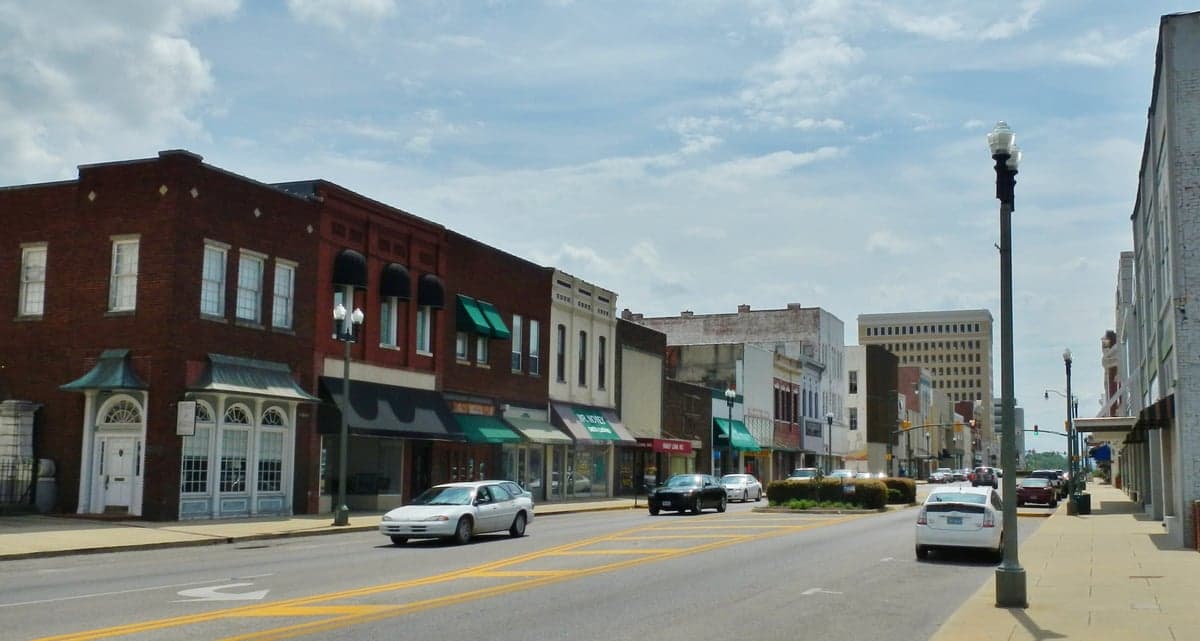
Photo: Wikipedia
Quality of Life in Anniston, AL
A high quality of life with strong walkability, manageable living costs, healthy neighborhood signals, and solid amenity access.
What does Quality of Life tell us?
Quality of Life blends cost of living, nearby amenities, socioeconomic signals, and neighborhood character. City-level scores represent the whole municipality; individual neighborhoods can differ.
What does this tell us?
Quality of Life blends cost of living, nearby amenities, socioeconomic signals, and neighborhood character. City-level scores represent the whole municipality; individual neighborhoods can differ.
Cost of Living
40% below national average
The Real Cost of Living in Anniston, AL for 2026
| Tier | Individual | Family (4) |
|---|---|---|
| Survival | $12k | $23k |
| Comfortable | $28k | $40k |
| Luxury | $81k+ | $125k+ |
| Elite (Top 5%) | $118k+ | $183k+ |
111%
The Area Signal
A metric tracking the socioeconomic signals of the area.


Hobbies
Explore the areaGroceries
5 within 10 miles
Gas
0 within 10 miles
Hospital
3 within 20 miles
Airport
ATL — Hartsfield–Jackson Atlanta International
Post Office
USPS — Anniston, AL
Critical Amenities
Quality-of-Life Analysis
Anniston, Alabama, presents a notably low cost of living that attracts a mix of retirees, military-affiliated families (due to the nearby Fort Novosel), and workers in manufacturing and healthcare. With a cost-of-living index of 60—40 percent below the national average—the city offers a financial cushion that is increasingly rare in the U.S., though this affordability comes with trade-offs in local amenities and economic dynamism. The population skews older and more blue-collar than the national median, and the area’s modest affluence is reflected in a median household income that trails the state average.
How housing costs and affordability compare to Birmingham and Oxford
Anniston’s housing market is among the most affordable in the Calhoun County region. The median home value sits at $141,600, roughly half the national median and significantly below Birmingham’s median of about $220,000. Median rent is $777, making it a viable option for renters priced out of Oxford (just east, with a median rent near $950) or the more expensive suburbs of Birmingham. The average commute of 23.2 minutes is slightly shorter than the national average of 26 minutes, reflecting the area’s compact geography and limited traffic congestion. However, property taxes are low—Alabama’s effective rate is about 0.41%—so homeowners keep more of their equity. The trade-off is a slower rate of home value appreciation; Anniston’s values have risen only modestly since 2020 compared to the double-digit gains seen in Huntsville or Birmingham.
What daily life is like for families: schools, amenities, and local rhythm
Daily life in Anniston centers on a handful of reliable anchors. The Anniston City School System includes Anniston High School and several elementary schools, though many families with school-age children opt for Oxford City Schools or private options like The Donoho School, which offer stronger academic ratings. Healthcare access is a genuine asset: Northeast Alabama Regional Medical Center is the largest hospital in the region and a major employer, providing specialized care that reduces the need to travel to Birmingham for routine procedures. For recreation, residents use the Mountain Longleaf National Wildlife Refuge for hiking and birding, and the Anniston Museum of Natural History offers a family-friendly afternoon. Dining and shopping are limited compared to a metro area; most national chains and sit-down restaurants cluster along Quintard Avenue (US-431), while local staples like Classic on Noble provide a farm-to-table option. The pace is slow—even on weekends, downtown sees light foot traffic—and the social scene revolves around church, high school sports, and community events like the annual Alabama Shakespeare Festival’s touring productions at the Anniston Performing Arts Center.
Who will thrive in Anniston’s low-cost, low-hustle environment
Anniston is best suited for people who prioritize financial breathing room over urban energy. Retirees on fixed incomes benefit directly from the 60 COL index and low property taxes, stretching Social Security or pension checks further than in most U.S. cities. Military personnel and civilian contractors at Fort Novosel (a 40-minute drive) find the commute manageable and the housing costs a fraction of what they’d pay near larger bases. Remote workers with stable incomes can enjoy a high savings rate, though they should be prepared for limited coworking spaces and slower internet speeds in some neighborhoods. Families seeking top-tier schools or a vibrant nightlife will likely feel constrained; the area’s strengths are affordability, quiet, and proximity to outdoor recreation, not cultural density or career mobility. For those who value a low-stress, low-cost base with decent healthcare and easy access to the Appalachian foothills, Anniston delivers on its core promise.

Crime in Anniston, AL
Significantly higher crime rates than 83% of comparable U.S. locations.
Violent CrimeViolent Crime Analysis
Property CrimeProperty Crime Analysis
Crime Analysis
Anniston, Alabama, faces a serious public safety challenge, with violent and property crime rates that significantly exceed both state and national averages. The city's violent crime rate of 727.5 incidents per 100,000 residents is more than double the national average, while its property crime rate of 3,613.9 per 100,000 is roughly 75% higher than the U.S. figure. These statistics place Anniston among the more dangerous communities in Alabama, a concern for anyone considering relocation to the area.
Crime in context
To understand Anniston's safety landscape, it is essential to compare its crime rates to broader benchmarks. The national violent crime rate stands at approximately 380 per 100,000, while Alabama's statewide rate is around 450 per 100,000. Anniston's rate of 727.5 is nearly double the national average and roughly 60% higher than the state average. Property crime tells a similar story: the national rate is about 2,100 per 100,000, and Alabama's is roughly 2,800. Anniston's 3,613.9 rate is 72% above the national figure and 29% above the state figure. These numbers indicate that Anniston is a high-crime outlier within its own state.
What residents experience
For those living in Anniston, the elevated crime rates translate into tangible daily concerns. Violent offenses, including aggravated assault, robbery, and homicide, occur at a frequency that makes personal safety a persistent issue. Property crimes such as burglary, larceny-theft, and motor vehicle theft are even more common, affecting homeowners and renters alike. The high property crime rate suggests that residents face a significant risk of having their homes or vehicles broken into. Compounding these problems is the broader judicial environment in Alabama. While Anniston itself is not a large progressive metro, the state's larger urban centers—such as Birmingham and Montgomery—have seen the influence of liberal district attorneys and judges who often prioritize rehabilitation over incarceration. This progressive ideology, while sympathetic to offenders, can lead to shorter sentences and more criminals returning to the streets, which negatively impacts justice for victims and the general public. This trend can spill over into surrounding communities like Anniston, as offenders may relocate or operate across jurisdictional lines.
Neighborhood-level variation in Anniston is notable. Areas closer to the city's core, particularly around the downtown corridor and older residential districts, tend to report higher concentrations of both violent and property crime. In contrast, outlying neighborhoods and newer subdivisions on the city's periphery, such as those near the Oxford city line or along the McClellan development zone, generally experience lower crime rates. Prospective residents should research specific block-level data and consult local law enforcement reports before choosing a neighborhood, as safety can vary dramatically within a few miles.
* Values derived from national, state, county, city and local statistics and may differ in a specific area. Last updated: 2026-04-19T18:42:14.000Z
Narrative content on this page is AI-generated and may contain mistakes. Verify any details that matter before acting on them.
ReloMaps may earn a commission from affiliate links at no extra cost to you.

