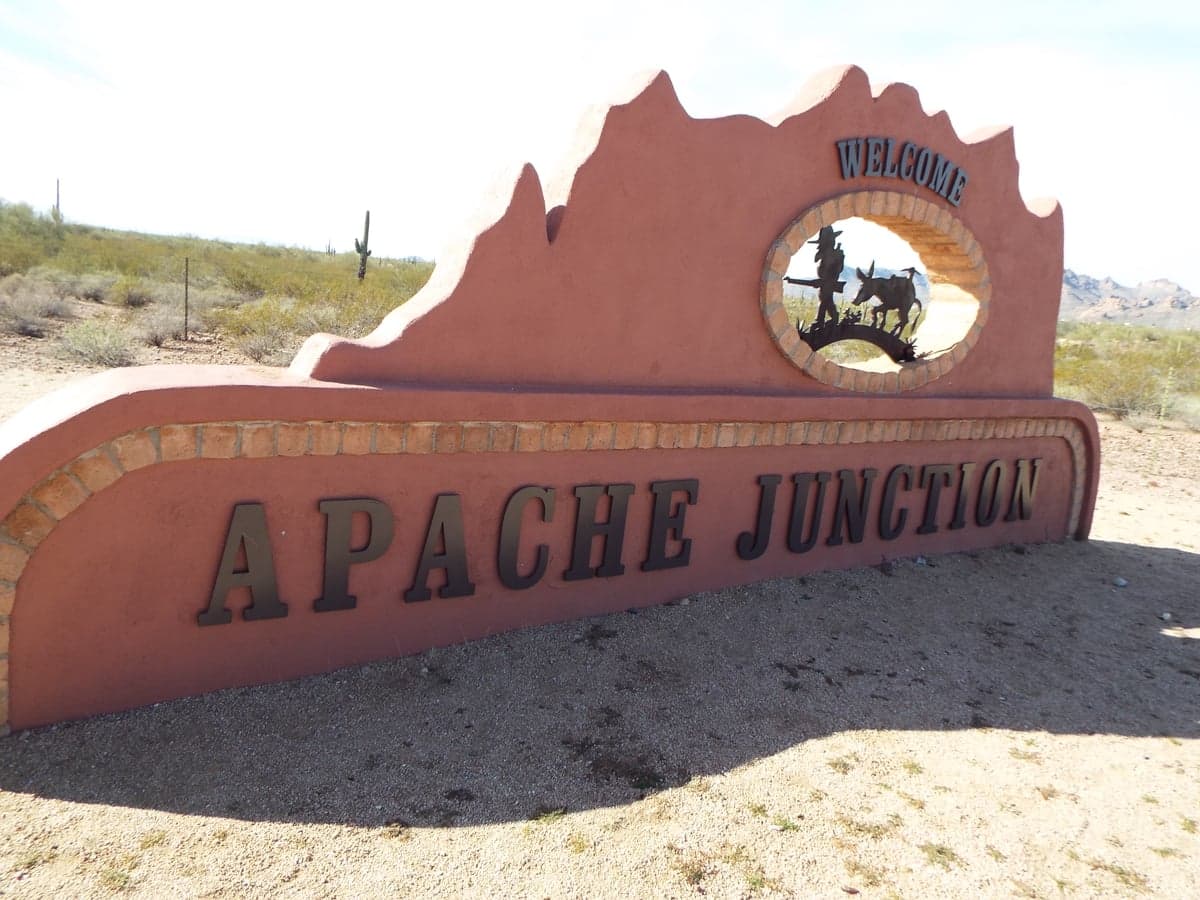
Photo: Wikipedia
Personal Sovereignty in Apache Junction, AZ
Strong independent fundamentals that actively favor personal liberty and low regulation.
What does Personal Sovereignty tell us?
Personal Sovereignty measures your capacity for self-reliance and independence with minimal government friction. Higher scores mean fewer barriers between you and the way you want to live... but it assumes you have the space you need and good neighbors.
What does this tell us?
Personal Sovereignty measures your capacity for self-reliance and independence with minimal government friction. Higher scores mean fewer barriers between you and the way you want to live... but it assumes you have the space you need and good neighbors.
State Policy
Energy independence: Importer (20% of energy produced in-state)
Personal Liberty
Homesteading

Personal Liberty Analysis
Apache Junction offers a notably high degree of personal sovereignty compared to many urban and suburban areas in the United States, largely because it sits at the intersection of a strong state-level preemption framework and a local culture that prizes self-reliance. For the individual or family operating from a survivalist or prepper mindset, this translates into fewer legal barriers to living life on your own terms. The city’s position in Pinal County, combined with Arizona’s aggressive stance against local government overreach, means that state law consistently overrides municipal attempts to restrict personal freedoms—whether that involves firearms, property use, or medical choices. This is not a place where the county or city will micromanage your daily existence; the regulatory environment is intentionally thin, and the expectation is that you handle your own affairs.
Tax burden and regulatory posture: keeping the state out of your wallet and your life
Arizona’s tax structure is a major draw for those seeking to minimize government extraction. There is no state income tax on wages, and the state has been actively reducing its flat income tax rate, which now sits at 2.5% for most earners. Apache Junction itself imposes no city income tax, so your paycheck is not nibbled at by local bureaucrats. Property taxes are among the lowest in the nation, with an effective rate around 0.62% of assessed value—roughly half the national average. For a survivalist, this means more capital stays in your hands for land, supplies, and infrastructure rather than funding programs you may not support. The regulatory posture is equally lean: Arizona is a right-to-work state, has no state-level business inventory tax, and enforces strict limits on local zoning powers. The state’s “Private Property Rights Protection Act” (Proposition 207) requires government to compensate landowners if a regulation reduces property value by 20% or more, effectively chilling most overreaching land-use rules. You are not going to face the kind of zoning battles common in California or the Pacific Northwest.
Self-defense and gun law specifics: constitutional carry and castle doctrine in practice
For anyone prioritizing the right to defend themselves and their family, Apache Junction sits in one of the most firearm-friendly legal environments in the country. Arizona is a constitutional carry state, meaning no permit is required to carry a concealed firearm—open carry is also fully legal without a license. The state preempts all local gun ordinances, so Apache Junction cannot enact its own bans on magazine capacity, firearm types, or carry locations beyond what state law allows. The Castle Doctrine is codified in statute (A.R.S. § 13-418), establishing a legal presumption that a person using deadly force against an intruder in their home, vehicle, or occupied structure acted in reasonable self-defense. There is no duty to retreat in any place where you are lawfully present. Stand Your Ground protections are explicit. For a prepper, this means your vehicle and home are legally defensible spaces without fear of prosecution for defending them. Additionally, Arizona does not require registration of firearms, and there are no waiting periods for purchases. Private sales between individuals are unregulated. The only notable restriction is that you must be 21 to carry concealed, but that is a minor speed bump in an otherwise permissive framework.
Self-reliance and homesteading viability: lot sizes, zoning, and off-grid feasibility
Apache Junction’s rural character is its strongest asset for those seeking to live off-grid or pursue serious homesteading. The city’s zoning code allows for residential lots as small as 6,000 square feet in some subdivisions, but the real opportunity lies in the unincorporated areas of Pinal County surrounding the city, where parcels of 1 to 40 acres are common and affordable. There is no county-wide ban on rainwater harvesting, and Arizona law actually encourages it—state statute (A.R.S. § 45-141) explicitly protects the right to collect rainwater from your roof. Solar panels are unrestricted, and net metering is available through the local utility (Arizona Public Service or Sulphur Springs Valley Electric Cooperative), though you can also go fully off-grid with battery storage and no grid connection. Livestock regulations are minimal: chickens, goats, and even horses are generally allowed on lots of one acre or more, though you should check specific HOA covenants if buying in a subdivision. The city does not have a building code that mandates expensive seismic or energy-efficiency upgrades beyond basic structural safety. For a prepper, the ability to drill a well (typical depth 300-600 feet, cost $10,000-$20,000) and install a septic system without endless permitting delays is a major advantage. The county health department handles well and septic permits, and the process is straightforward compared to states like Oregon or Washington.
Personal liberties: parental rights, medical autonomy, speech, and property
Arizona has been a battleground for parental rights, and the state’s laws generally favor family autonomy over government intervention. The state’s “Parental Rights” statute (A.R.S. § 1-601) explicitly affirms that parents have the fundamental right to direct their children’s education, healthcare, and religious upbringing. This has practical implications: school districts cannot implement mask mandates or vaccine requirements for students without parental opt-out, and the state has banned critical race theory and gender ideology instruction in K-12 classrooms (A.R.S. § 15-7-105). For medical autonomy, Arizona does not have a state-level vaccine mandate for adults, and the state’s emergency powers law was reformed in 2021 to prevent governors from unilaterally shutting down businesses or imposing indefinite lockdowns. The “Arizona Medical Marijuana Act” (Proposition 203) allows for the use of cannabis for qualifying conditions, and recreational use was legalized in 2020 (Proposition 207), though local municipalities can ban dispensaries—Apache Junction has not done so. Property rights are further protected by the aforementioned Proposition 207, which also requires voter approval for any new local tax increases. Free speech is robust: there are no hate speech laws that criminalize political or religious expression, and the state has a strong public records law that keeps government transparency high. For a survivalist, the key takeaway is that the state is not going to compel you to participate in medical experiments, indoctrinate your children against your values, or seize your property without just compensation.
Overall, Apache Junction ranks among the top-tier locations in the continental U.S. for personal sovereignty, particularly when compared to states like California, New York, or Illinois, where local governments routinely override individual rights through zoning, taxation, and public health mandates. The combination of constitutional carry, low taxes, minimal zoning, strong parental rights, and off-grid feasibility creates an environment where a self-reliant individual or family can operate with minimal government interference. The trade-off is that you are largely on your own—emergency services are stretched thin in rural areas, and the nearest trauma center is 30 minutes away in Mesa. But for those who view that as a feature rather than a bug, Apache Junction represents a rare pocket of genuine freedom in an increasingly regulated nation.

* Values derived from national, state, county, city and local statistics and may differ in a specific area. Last updated: 2026-04-19T19:46:50.000Z
Narrative content on this page is AI-generated and may contain mistakes. Verify any details that matter before acting on them.
ReloMaps may earn a commission from affiliate links at no extra cost to you.

