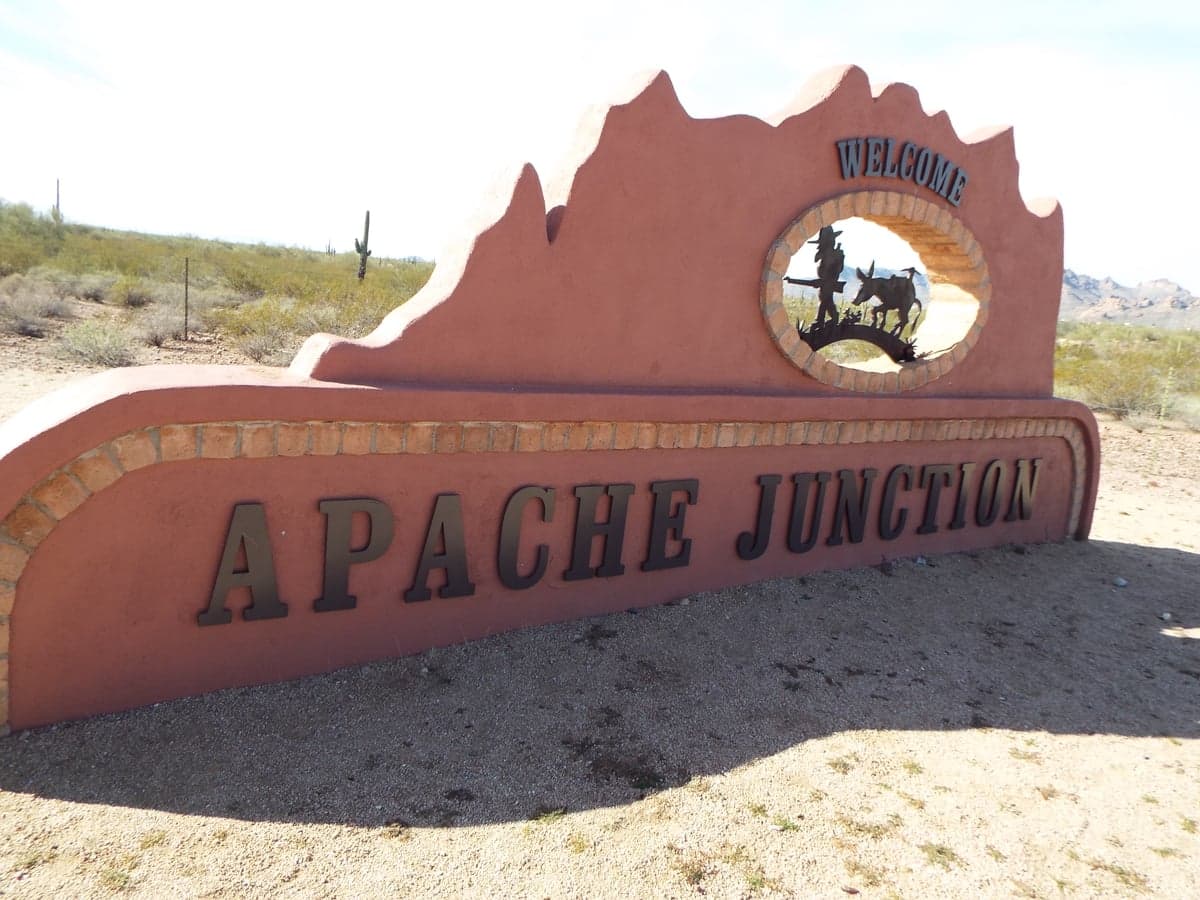
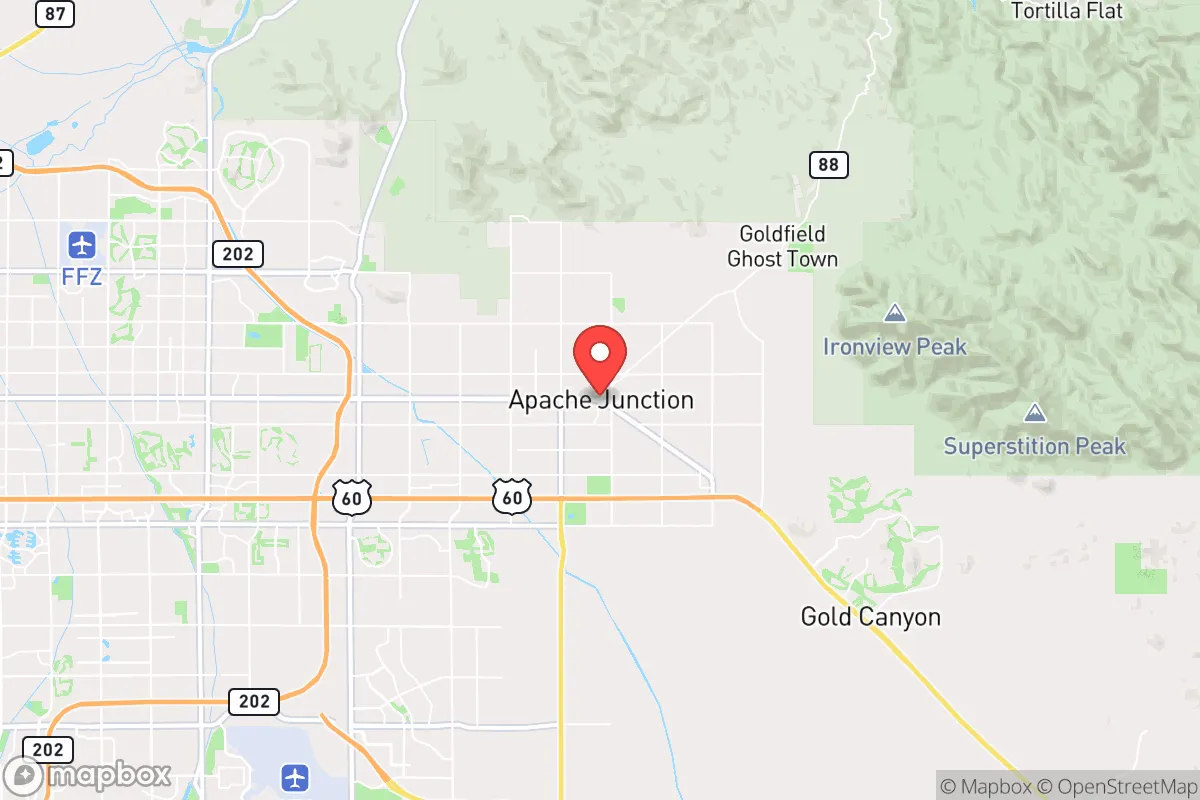
Photo: Wikipedia
Demographics of Apache Junction, AZ
Affluence Level in Apache Junction, AZ
A middle-class area roughly in line with national averages across income, home values, education, and employment.
People of Apache Junction, AZ
Apache Junction, Arizona, is home to roughly 39,746 residents, a population that is predominantly white (72.8%) with a significant Hispanic minority (18.5%) and a very small foreign-born share of just 4.4%. The city’s character is defined by its roots as a rugged, low-density desert outpost and its modern identity as a retirement and family-oriented community, with only 17.2% of adults holding a college degree. Distinctive markers include a strong libertarian-leaning independence, a high proportion of mobile homes and manufactured housing, and a culture centered on outdoor recreation and the nearby Superstition Mountains.
How the city was settled and grew
Apache Junction was never a colonial-era settlement; its history begins in earnest after 1900, driven by mining and the promise of cheap desert land. The original population consisted of Anglo-American prospectors and homesteaders drawn by copper and gold mining in the Superstition Mountains, with the first permanent structures appearing around the 1920s. The historic Goldfield district, now a ghost town tourist attraction, was the original hub for these miners. A second wave arrived during the Great Depression, when families seeking self-sufficiency purchased small plots for subsistence farming and ranching, settling in what is now the Lost Dutchman Heights neighborhood. The post-World War II era saw a trickle of returning veterans and snowbirds, who built modest homes and trailer parks in areas like Mountain View, establishing the city’s early reputation as a low-cost, no-frills desert haven.
Modern era (post-1965)
The modern demographic shape of Apache Junction was set after the 1965 Immigration and Nationality Act, though the city’s foreign-born population remains very low at 4.4%. The major domestic shift came with the Sun Belt migration of the 1970s and 1980s, which brought a wave of white retirees from the Midwest and Northeast, drawn by warm winters and affordable mobile home parks. These retirees concentrated in the Superstition Shadows and Gold Canyon Ranch neighborhoods, which remain heavily white and older today. A secondary domestic wave of younger families, many from California and other high-cost states, arrived in the 1990s and 2000s, settling in newer subdivisions like Prospector’s Ridge. The Hispanic population, now 18.5%, grew steadily through this period, largely from Mexican-American families moving from Phoenix’s East Valley for cheaper housing, and they are dispersed throughout the city rather than concentrated in a single barrio. The Black population remains tiny at 1.5%, and East/Southeast Asian communities (1.3%) and Indian-subcontinent residents (0.3%) are present in very small numbers, mostly in newer subdivisions near the Superstition Freeway corridor.
The future
The population of Apache Junction is likely to continue growing slowly, driven by domestic in-migration from more expensive parts of Arizona and California, rather than by international immigration. The city is not tribalizing into distinct ethnic enclaves; instead, it is slowly homogenizing as new housing developments attract a mix of white and Hispanic families, while the older white retiree population gradually declines. The Hispanic share is expected to rise modestly, possibly approaching 25% by 2040, but the foreign-born rate will likely remain below 10% due to the city’s lack of immigrant-heavy industries. The East/Southeast Asian and Indian communities are too small to form significant enclaves and will likely remain scattered. The biggest demographic shift will be generational: as the large retiree cohort passes away, the city will become younger and more family-oriented, with a growing share of residents commuting to jobs in Mesa and Phoenix.
For someone moving in now, Apache Junction is becoming a more balanced, family-friendly suburb of the Phoenix metro area, shedding its purely retiree-and-snowbird image. It remains a predominantly white, low-density, and politically conservative community with a growing Hispanic presence, but it lacks the ethnic diversity and immigrant dynamism of larger cities. New residents should expect a quiet, affordable lifestyle with strong ties to the desert landscape, but limited job opportunities and a population that is slowly, steadily becoming younger and more diverse.

* Values derived from national, state, county, city and local statistics and may differ in a specific area. Last updated: 2026-04-19T19:46:50.000Z
Narrative content on this page is AI-generated and may contain mistakes. Verify any details that matter before acting on them.
ReloMaps may earn a commission from affiliate links at no extra cost to you.

