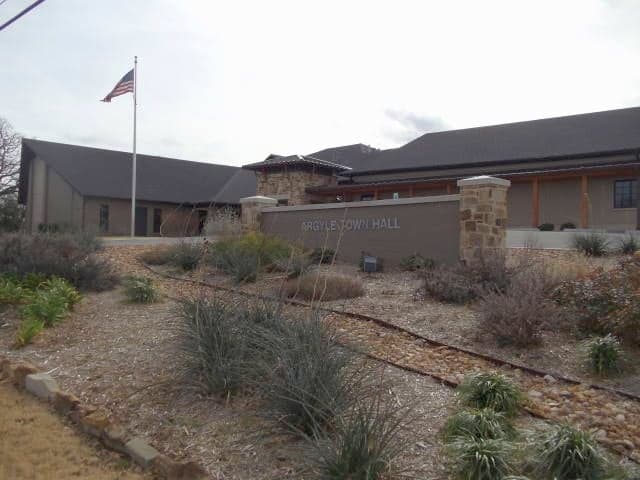
Photo: Wikipedia
Demographics of Argyle, TX
Affluence Level in Argyle, TX
An upper-middle-class area. Household wealth, education levels, and homeownership run ahead of national benchmarks.
People of Argyle, TX
The people of Argyle, Texas today number roughly 4,970, forming a dense, affluent, and predominantly white community with a notably high concentration of Indian-subcontinent professionals. With 63.6% of adults holding a college degree and a foreign-born population of 11.6%, Argyle is a modern, education-driven suburb where family-oriented conservatism and high property values define daily life. Distinctive identity markers include a strong local sports culture centered on Argyle High School, a rapidly growing Indian-American professional class, and a social fabric that remains overwhelmingly white (78.3%) even as it diversifies.
How the city was settled and grew
Argyle was founded in the late 19th century as a railroad stop along the Texas and Pacific Railway, drawing its earliest settlers—primarily Anglo-American farmers and ranchers from the U.S. South and Midwest—who were attracted by cheap land grants and the promise of cotton and cattle operations. The original townsite, platted in 1881, clustered around the depot in what is now Old Town Argyle, where the first general store, blacksmith, and church served a sparse, rural population. By 1900, the community had fewer than 200 residents, almost entirely white and native-born, with a handful of Mexican-American laborers working on area ranches. A second wave arrived in the 1910s–1930s, when German and Czech immigrant families purchased farmland in the surrounding Prairie Springs area, establishing small dairy and grain operations that persisted through the mid-20th century. Argyle remained a tiny agricultural hamlet—population never exceeding 500—until the post-war era, when the expansion of nearby Dallas-Fort Worth began to reshape its character.
Modern era (post-1965)
The 1965 Hart-Cellar Act had little immediate effect on Argyle, as the town remained overwhelmingly white and rural through the 1970s. The real demographic shift began in the 1990s and accelerated after 2000, driven by domestic in-migration from other parts of Texas and the U.S., as families sought large lots, low crime, and top-rated schools within commuting distance of DFW. This wave settled primarily in master-planned subdivisions like Canyon Falls and Argyle South, which offered new construction homes on acreage and attracted upper-middle-class white professionals. The most notable modern change has been the arrival of Indian-subcontinent immigrants—engineers, doctors, and IT managers—who began moving into Harvest and Lantana (the latter straddling Argyle’s southern border) after 2010, drawn by the same school quality and safety metrics. Today, Indian-subcontinent residents make up 8.5% of Argyle’s population, a share roughly 12 times the national average, while East/Southeast Asian communities remain tiny at 0.7%. The Hispanic share (9.0%) is concentrated among service workers living in older rental stock near FM 407, while the Black population (1.5%) is scattered and small. Argyle’s modern growth has been almost entirely domestic and Indian-subcontinent in-migration, not broad international diversification.
The future
Argyle’s population is heading toward continued growth and modest diversification, but within a framework of increasing economic and ethnic stratification. The Indian-subcontinent community is likely to grow further—possibly reaching 12–15% by 2035—as tech and medical professionals continue to be priced out of closer-in suburbs like Coppell and Plano. These families are concentrating in newer, higher-end developments like Robson Ranch (an active-adult community) and the Argyle Crossing area, creating a distinct professional enclave that is culturally conservative but politically moderate. The white population, while still dominant, is aging in place in Old Town and Prairie Springs, with younger white families increasingly choosing newer subdivisions farther north. The Hispanic population is plateauing, as service-sector housing becomes scarcer and more expensive. Argyle is not tribalizing into hostile enclaves, but it is quietly segregating by income and origin: Indian-subcontinent professionals in the newest homes, white families in established subdivisions, and Hispanic workers in older rentals. The next 10–20 years will likely see Argyle become whiter in its older core, more Indian-subcontinent in its periphery, and slightly less accessible to lower-income households of any background.
For someone moving in now, Argyle is becoming a two-tier suburb: a wealthy, white-majority town with a fast-growing, highly educated Indian-subcontinent professional class, where newcomers should expect a conservative, family-first culture, excellent schools, and very little racial or economic mixing outside of school and sports. The city’s future is one of managed growth and demographic sorting, not melting-pot integration.

* Values derived from national, state, county, city and local statistics and may differ in a specific area. Last updated: 2026-10-10T16:26:29.000Z
Narrative content on this page is AI-generated and may contain mistakes. Verify any details that matter before acting on them.
ReloMaps may earn a commission from affiliate links at no extra cost to you.

