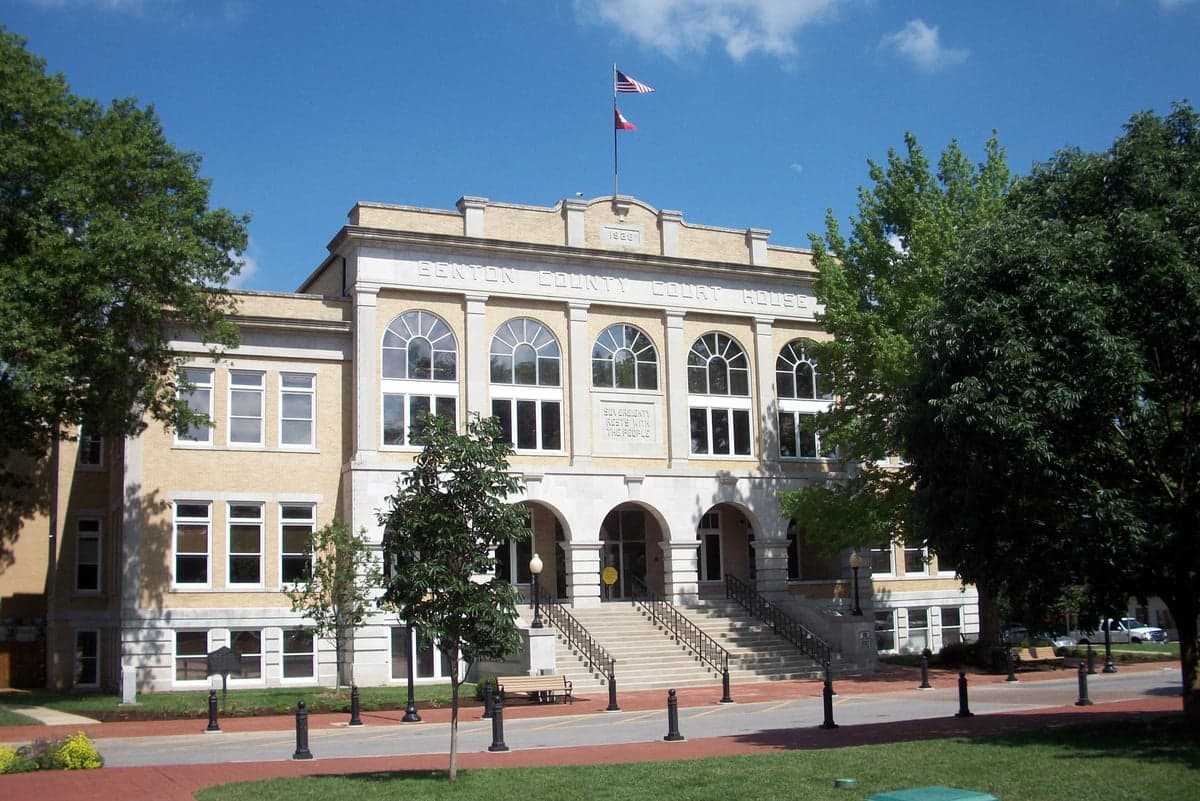
Photo: Wikipedia
Demographics of Benton County
Affluence Level in Benton County
An upper-middle-class area. Household wealth, education levels, and homeownership run ahead of national benchmarks.
People of Benton County
The people of Benton County, Arkansas today form a rapidly growing, predominantly white but increasingly diverse population of over 294,000, concentrated in the booming corridor from Rogers to Bentonville. The county’s identity is shaped by its role as the global headquarters of Walmart, which has drawn a highly educated, professional workforce and a significant Indian and Hispanic community, while its rural fringes retain a traditional, family-oriented character. With a median age below the national average and a college attainment rate of 36.6%, Benton County is a magnet for both young families and established professionals seeking economic opportunity in a low-tax, pro-business environment. The population is notably less diverse than the national average in Black representation (1.8%) but far more Hispanic (18.1%) than the state as a whole, reflecting a unique blend of Sun Belt migration, corporate recruitment, and agricultural labor history.
Settlement & growth (pre-1960)
Before American settlement, the area now known as Benton County was part of the ancestral homeland of the Osage Nation, who controlled the Ozark highlands and used the region for hunting and seasonal camps. The first permanent non-Native settlers arrived in the 1820s and 1830s, primarily Scots-Irish and English families migrating from Tennessee, Kentucky, and Missouri via the Ozark Trail. These early homesteaders were drawn by cheap, fertile land in the White River valley and the promise of subsistence farming, establishing small communities like Bentonville (founded 1836) and Rogers (founded 1881) as trading posts along the Butterfield Overland Mail route.
The arrival of the St. Louis–San Francisco Railway (the “Frisco”) in the 1880s transformed the county’s economy and demographics. The railroad opened the Ozarks to timber extraction and fruit orchards, particularly apples, which became the region’s cash crop. This boom attracted a wave of German and Swiss immigrants in the 1880s and 1890s, who settled in Bella Vista (originally a summer resort for railroad workers) and the farming hamlets of Gravette and Siloam Springs. These groups brought dairy farming and fruit-processing skills that anchored the local economy for decades. A smaller number of Italian and Polish families arrived around 1900 to work in the limestone quarries near Decatur and the railroad yards in Rogers.
The Dust Bowl and Great Depression of the 1930s pushed a second wave of white migrants from Oklahoma and the Texas Panhandle into Benton County, often called “Okies” or “Arkies,” who found work in the apple orchards and timber mills. This influx reinforced the county’s overwhelmingly white, Protestant, and rural character. By 1950, the population stood at just 38,000, with Bentonville and Rogers as the only towns exceeding 2,000 residents. The county’s economy remained tied to agriculture and small-scale manufacturing until a single event rewrote its future: Sam Walton opened the first Walmart in Bentonville in 1962.
Modern era (post-1965)
The 1965 Hart-Cellar Act had a modest direct impact on Benton County compared to coastal metros, but the corporate growth of Walmart after 1970 created a powerful indirect pull for international migration. As Walmart expanded into a global retail giant, its Bentonville headquarters began recruiting highly skilled professionals from around the world, particularly from India. The Indian population in Benton County, now 2.7% of the total, is one of the highest shares of any mid-sized county in the South, with families concentrated in Bentonville and Rogers, where Indian-owned grocery stores, restaurants, and cultural associations have formed a visible enclave. This community is overwhelmingly composed of tech, logistics, and finance professionals, many on H-1B visas who later gained permanent residency.
Domestic migration has been the dominant driver of population growth since 1980. The county’s population has more than tripled from 78,000 in 1980 to 294,541 today, fueled by white and Hispanic families moving from California, Texas, and the Rust Belt for jobs at Walmart and its vast supplier ecosystem (including Tyson Foods and J.B. Hunt). The Hispanic share, now 18.1%, began rising in the 1990s as poultry processing plants in Siloam Springs and Gentry recruited Mexican and Central American workers. Today, Hispanic residents are spread across the county, with significant concentrations in Rogers (where over 30% of the population is Hispanic) and Springdale (just south of the county line), and a growing presence in Bentonville’s service sector.
Suburbanization has reshaped the county’s geography. The corridor along Interstate 49 from Bentonville to Rogers and Lowell is now a continuous strip of corporate campuses, retail centers, and master-planned subdivisions. Bella Vista, originally a retirement community, has reinvented itself as a commuter suburb for young families, while Centerton and Pea Ridge have absorbed spillover growth from the core. The East/Southeast Asian population (1.6%) is smaller but growing, with Vietnamese and Korean families concentrated in Rogers and Bentonville, often working in healthcare, engineering, or running small businesses. The Black population remains very low at 1.8%, reflecting the county’s historical lack of a large African American community and limited in-migration from the Deep South.
The future
Benton County’s population is projected to exceed 400,000 by 2040, driven by continued corporate expansion and domestic migration from high-cost states. The county is becoming more diverse, but the change is coming primarily through Hispanic and Indian growth, not Black or East/Southeast Asian in-migration. The Hispanic share is likely to rise toward 25-30% over the next two decades, as second-generation families age into the workforce and new arrivals continue to fill construction, hospitality, and manufacturing roles. The Indian community will likely grow more slowly but remain highly concentrated in professional occupations, reinforcing Bentonville’s reputation as a “mini Silicon Valley” for retail tech.
Geographically, the densest growth will continue along the I-49 corridor, with Rogers and Bentonville absorbing most new multifamily development, while Centerton, Pea Ridge, and Gravette see single-family home construction on former farmland. The county’s cultural identity is evolving from a rural, white, evangelical baseline toward a more suburban, multiethnic, and professionally oriented character, though political conservatism remains dominant. Tensions between long-time residents and newcomers over growth, traffic, and school crowding are common, but the county’s low taxes, strong job market, and high quality of life continue to attract a net inflow of over 5,000 people per year.
For someone moving to Benton County now, the bottom line is this: you are joining one of the fastest-growing, most economically dynamic counties in the South, where a Walmart-driven economy has created a unique blend of Ozark tradition and global corporate culture. The population is young, family-focused, and increasingly diverse, but the social fabric remains anchored by conservative values, strong schools, and a low cost of living. If you are a professional in retail, logistics, or tech, or a family seeking safe suburbs with good schools, Benton County offers a rare combination of opportunity and affordability—but be prepared for rapid change and a community still negotiating its identity between small-town roots and big-city ambitions.

* Values derived from national, state, county, city and local statistics and may differ in a specific area. Last updated: 2026-09-25T06:28:37.000Z
Narrative content on this page is AI-generated and may contain mistakes. Verify any details that matter before acting on them.
ReloMaps may earn a commission from affiliate links at no extra cost to you.

