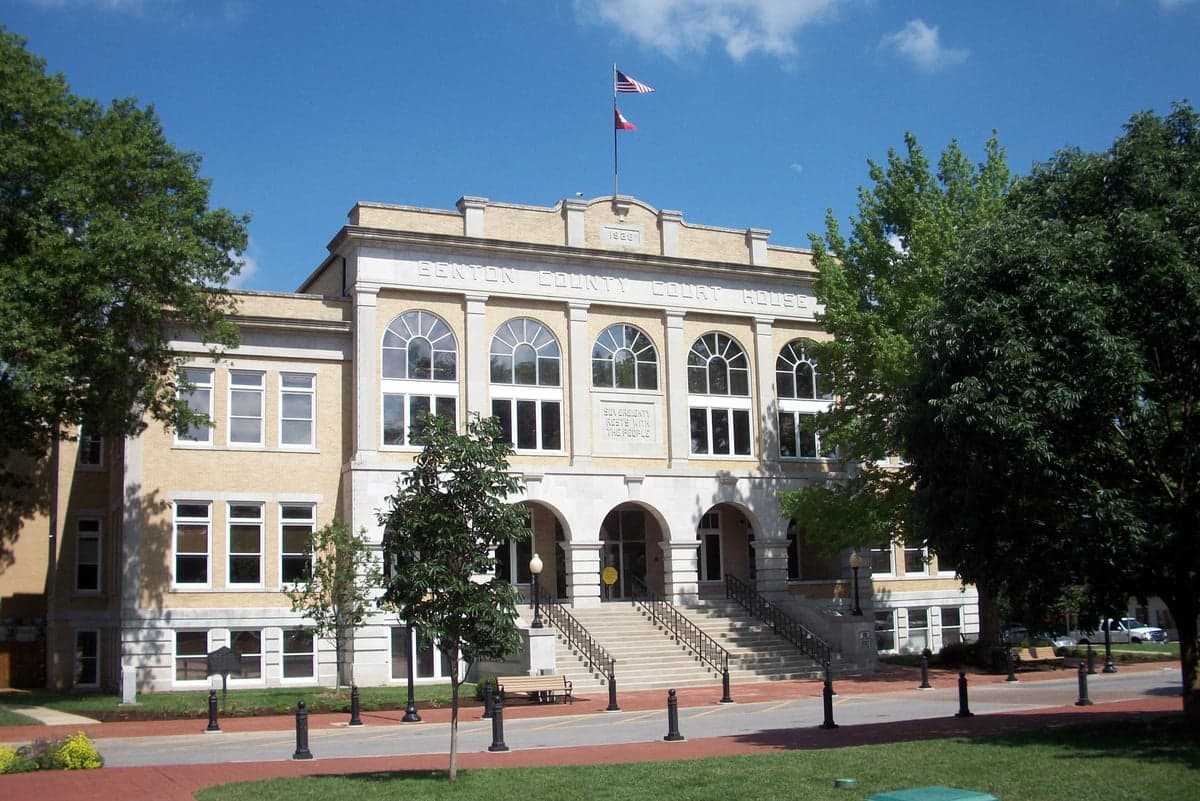
Photo: Wikipedia
Political ClimatePolitical Climate in Benton County
Showing district-level results — no local-only data available.
Local Political AnalysisPolitical Analysis of Benton County
Benton County has been a reliably Republican stronghold for decades, but its political character is shifting faster than the statewide average. The Cook PVI of R+13 is actually three points less Republican than Arkansas as a whole (R+16), a gap that reflects the county's explosive growth and in-migration from more moderate and even left-leaning parts of the country. While the county still votes solidly red in most races, the margins have been tightening in presidential elections—Donald Trump won Benton County by about 20 points in 2020, down from 27 points in 2016—and local politics are increasingly shaped by a tug-of-war between longtime conservative residents and newcomers who bring different priorities.
How it compares
The difference between Benton County's R+13 and the state's R+16 might sound small, but it's the most significant political divergence in Northwest Arkansas. In practice, this means the county is less reliably Republican than rural Arkansas counties like Madison or Washington (the latter being the only county in the region that leans blue, at D+4). Within Benton County itself, the political geography is surprisingly varied. Bella Vista and the far northern parts of the county remain deeply conservative, with precincts routinely voting 70-80% Republican. In contrast, downtown Rogers and the newer subdivisions around Centerton and Lowell show more competitive numbers, often splitting 55-45 or even 50-50 in local races. The city of Bentonville, home to Walmart's global headquarters, is the most politically mixed—its older neighborhoods lean red, but the fast-growing areas near the Crystal Bridges Museum and the 8th Street corridor have become swing precincts where Democratic candidates can pull 45% or more. This intra-county variation is much more pronounced than in most of Arkansas, where rural counties are overwhelmingly one-party.
What this means for residents
For conservative residents, Benton County remains a comfortable place to live politically. Republican candidates almost always win countywide offices, and the local GOP is well-organized. But the growing moderate wing means that primary elections are increasingly competitive, especially in state legislative districts covering Rogers and Bentonville. For liberal residents, the picture is more nuanced. You won't find many openly progressive elected officials, but the county's rapid growth has created space for left-leaning advocacy groups, particularly around education funding, environmental issues, and affordable housing. The political reality is that both sides have to engage with each other more than they used to. A decade ago, a conservative candidate could win a county commission seat by just running on party loyalty. Now, candidates have to address specific local concerns—traffic, school capacity, water rights—that cut across party lines.
Culturally, Benton County's political shift shows up in subtle but real ways. The county has become more welcoming to diverse viewpoints in public life, with the Bentonville Film Festival and the Walmart shareholder meetings drawing national attention. At the same time, the area's strong evangelical and gun-rights communities remain deeply influential. The practical result is a kind of pragmatic conservatism that's less ideological than what you'd find in, say, rural Faulkner County. Local leaders tend to focus on economic development and quality-of-life issues rather than culture-war battles, which is why you see bipartisan support for things like the Razorback Greenway trail system and the expansion of the Northwest Arkansas National Airport. For anyone moving here, the key takeaway is that Benton County is politically red but not monolithic—and it's getting more purple every year.

State Political ClimatePolitical Climate in Arkansas
State Political AnalysisPolitical Environment in the State
Arkansas is a deeply red state with a Cook PVI of R+16, meaning it votes about 16 points more Republican than the nation as a whole. Over the past 20 years, the state has shifted from a competitive, split-ticket state to a solidly Republican one, driven by the realignment of rural white voters and the collapse of the old Democratic machine that once dominated the Delta and the Ozarks. While Democrats still hold a few local offices and have a base in the capital, Little Rock, the GOP now controls every statewide office, both chambers of the legislature, and all four U.S. House seats.
Urban vs. rural divide
The political map of Arkansas is a classic study in contrast. The state’s two major metros—Little Rock (Pulaski County) and Fayetteville-Springdale-Rogers (Washington and Benton counties)—are the only real blue or purple spots. Pulaski County, home to the state capital and a significant Black population (about 37%), has voted Democratic in every presidential election since 2000, though by shrinking margins. The Northwest Arkansas corridor, anchored by the University of Arkansas and corporate headquarters like Walmart and Tyson Foods, has become a fast-growing, moderate-to-liberal enclave; Washington County voted for Joe Biden in 2020 by a slim margin, a stark shift from its Republican past. Outside these two islands, the state is overwhelmingly red. The Arkansas Delta—counties like Lee, St. Francis, and Phillips—was once a Democratic stronghold due to its large Black population, but turnout there has dropped sharply, and many of those counties now vote Republican. The Ozarks and the River Valley, including cities like Fort Smith and Harrison, are deeply conservative, with Harrison being a known hub for white nationalist activity. The southern part of the state, around Texarkana and El Dorado, is reliably red, driven by oil, timber, and a strong evangelical presence. The divide isn’t just rural vs. urban—it’s also cultural: the state’s small towns and rural areas are overwhelmingly white, older, and more religious, while the metros are younger, more diverse, and more educated.
Policy environment
Arkansas’s policy environment is a textbook example of a low-tax, low-regulation, socially conservative state. There is no state income tax on capital gains, and the top marginal income tax rate was cut from 7% to 4.9% in 2023, with a path to 3.9% by 2027. The state has a right-to-work law, meaning you can’t be forced to join a union as a condition of employment. Property taxes are relatively low, with a median effective rate of about 0.55%. On the social side, Arkansas has some of the strictest abortion laws in the nation—a near-total ban with no exceptions for rape or incest, only to save the mother’s life. The state also passed a law in 2021 banning transgender girls from participating in school sports, and in 2023, it banned gender-affirming care for minors. Education policy is a major focus: the state has a robust school choice program, including the LEARNS Act (2023), which created a universal school voucher system and raised teacher salaries to $50,000 minimum. Election laws are restrictive: voter ID is required, absentee ballot drop boxes are banned, and the state purges inactive voters regularly. Gun laws are among the most permissive in the country—constitutional carry (no permit needed) was enacted in 2021, and there are no red-flag laws.
Recent policy direction
The last five years have seen Arkansas accelerate its conservative agenda. In 2023, Governor Sarah Huckabee Sanders signed the LEARNS Act, which not only created universal school vouchers but also banned “critical race theory” and “indoctrination” in public schools, and prohibited the teaching of gender identity in K-3. On gun rights, the state passed a “Second Amendment Sanctuary” law in 2021, prohibiting state and local officials from enforcing federal gun laws that violate the state constitution. On privacy and surveillance, Arkansas passed a law in 2023 requiring age verification for adult websites, and it has no broad data privacy law like California’s. On medical and bodily autonomy, the state has banned nearly all abortions and gender-affirming care for minors, but it also expanded Medicaid under the private option (Arkansas Works) in 2013, a rare bipartisan compromise that still covers about 300,000 low-income adults. Property rights are strong: the state has a “right to farm” constitutional amendment (2014) that protects agricultural operations from nuisance lawsuits. Voting access has tightened: in 2021, the legislature passed a law requiring absentee voters to provide a copy of their ID and shortening the early voting period. The overall direction is clear: Arkansas is moving to entrench conservative policies on education, family, and guns, while keeping taxes low and regulation light.
Civil unrest & political movements
Arkansas has a history of political activism that ranges from the mundane to the extreme. In 2020, Black Lives Matter protests erupted in Little Rock and Fayetteville, with some turning violent in the capital, but they were smaller than in larger states. The state has a visible, organized conservative movement, including the Arkansas Family Council (a Christian conservative group) and the Arkansas Citizens for Liberty (a Tea Party offshoot). Immigration politics are relatively quiet—Arkansas has a small foreign-born population (about 5%), and there are no sanctuary cities. However, the town of Springdale has a large Marshallese community, and there have been tensions over housing and language access. The most visible flashpoint is in Harrison, where the white nationalist group the National Socialist Movement held rallies in the 2010s, and the city has a reputation as a “sundown town.” In 2021, the state passed a law banning “critical race theory” in schools, which sparked protests from teachers and civil rights groups. Election integrity has been a hot topic: after the 2020 election, the state GOP pushed for tighter voting laws, citing unfounded fraud claims, and the legislature overrode the governor’s veto of a bill banning ballot drop boxes. There is no serious secession or nullification movement, though some rural counties have passed symbolic “Second Amendment Sanctuary” resolutions.
Projection
Over the next 5-10 years, Arkansas is likely to become even more Republican, but with a twist. The state’s population is growing slowly (about 0.5% annually), and most growth is in the Northwest Arkansas corridor, which is becoming more moderate and diverse. This could create a tension between the deeply conservative rural areas and the increasingly purple suburbs of Bentonville and Rogers. The state’s Democratic base is shrinking and aging, concentrated in Little Rock and the Delta, but the Delta is losing population fast. The GOP will likely maintain supermajorities in the legislature, but internal fights between the establishment (pro-business, pro-education reform) and the far-right (anti-vaccine, anti-immigration) could intensify. The biggest wildcard is in-migration: if the state continues to attract conservative-leaning families from California and the Northeast (drawn by low taxes and school choice), the political culture could harden further. Conversely, if the Northwest Arkansas tech and logistics boom brings in younger, more secular workers, the state could see a slow shift toward libertarian-leaning conservatism rather than social conservatism. Either way, a Democrat winning a statewide office in the next decade is highly unlikely.
For a new resident, the bottom line is this: Arkansas is a state where conservative values are baked into the law and the culture. If you’re a conservative, you’ll find a welcoming environment with low taxes, strong gun rights, and a government that prioritizes school choice and religious freedom. If you’re a liberal, you’ll find a small but active community in Little Rock and Fayetteville, but you’ll also face a state government that is actively hostile to many of your priorities, from abortion access to LGBTQ+ rights. The state is safe, affordable, and politically stable, but it’s not a place where political change is likely to come from the ballot box anytime soon. If you’re moving here, know that your vote will likely be in the minority, but the state’s low cost of living and natural beauty—the Ozarks, the Buffalo River, the Delta—offer a quality of life that transcends politics. Just be prepared for a political environment that is deeply, unapologetically red.
* Values derived from national, state, county, city and local statistics and may differ in a specific area. Last updated: 2026-09-25T06:28:37.000Z
Narrative content on this page is AI-generated and may contain mistakes. Verify any details that matter before acting on them.
ReloMaps may earn a commission from affiliate links at no extra cost to you.

