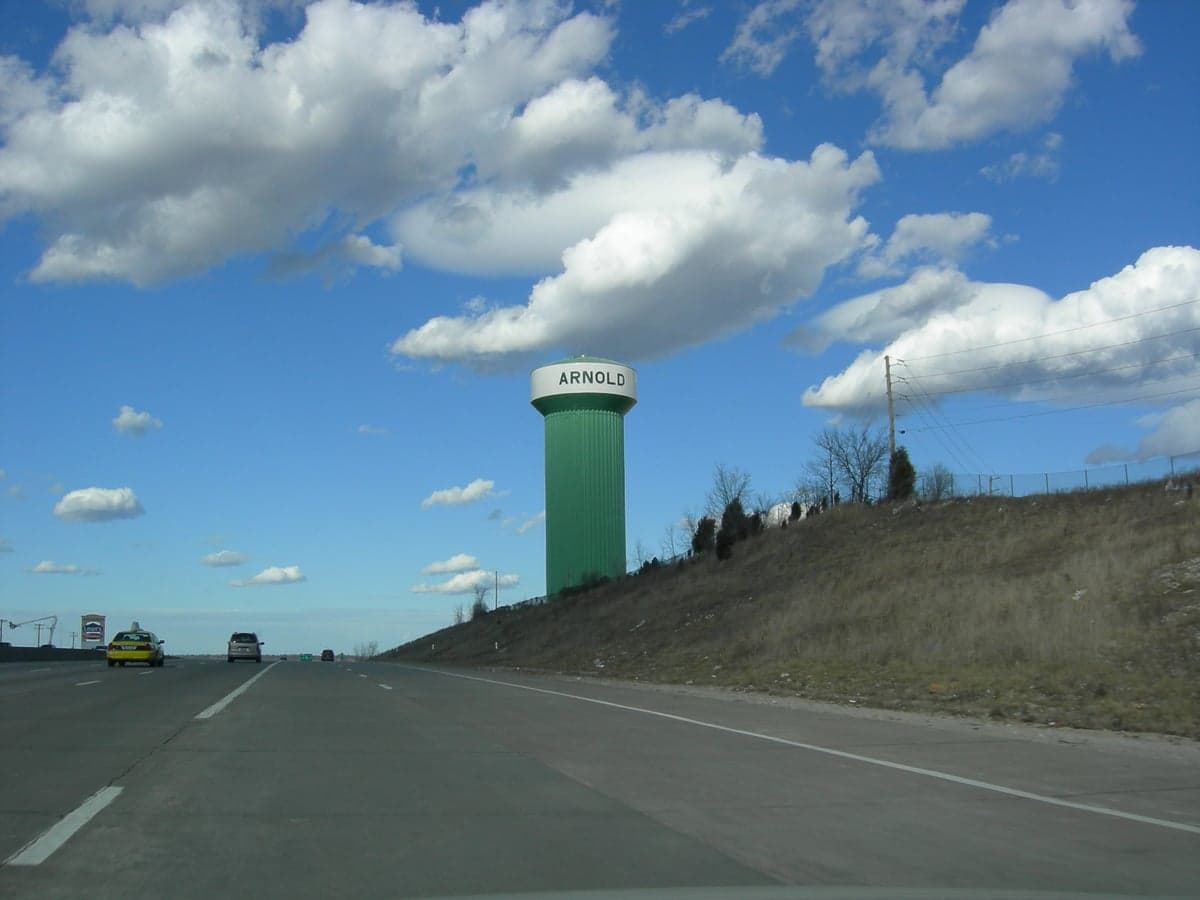
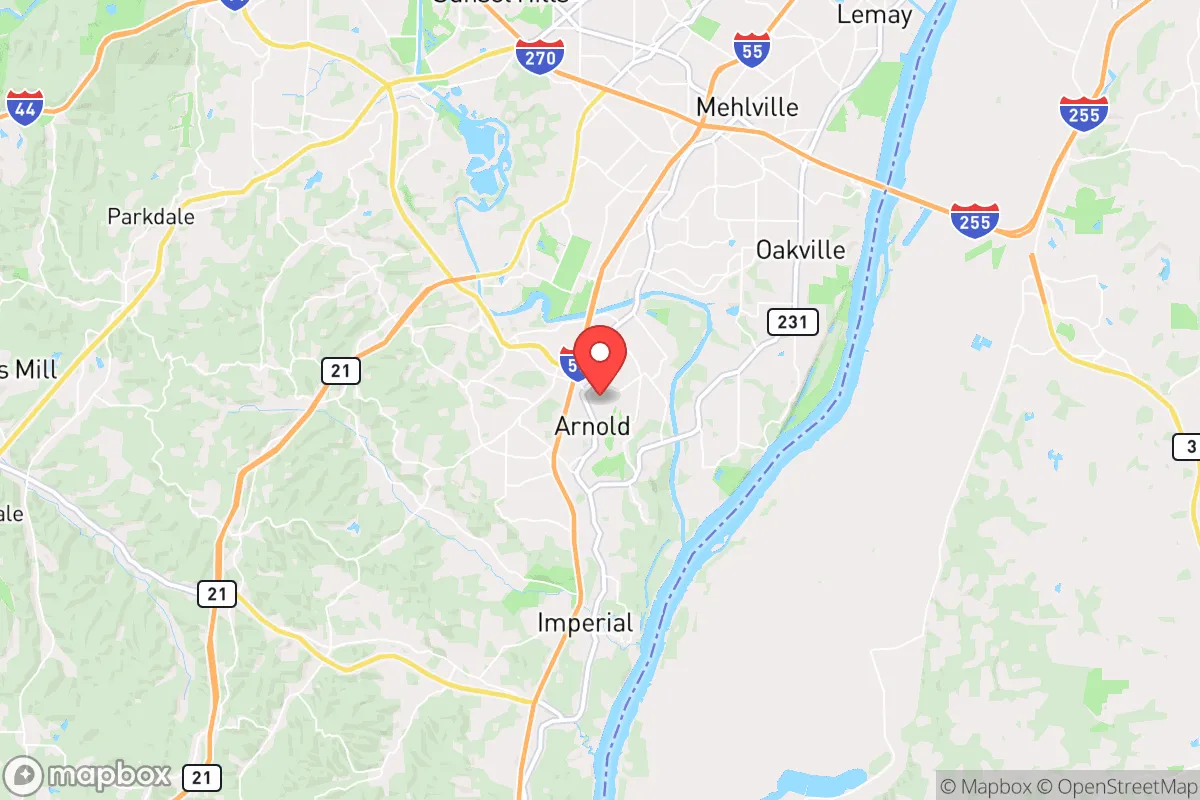
Photo: Wikipedia
Demographics of Arnold, MO
Affluence Level in Arnold, MO
A middle-class area roughly in line with national averages across income, home values, education, and employment.
People of Arnold, MO
The people of Arnold, Missouri, today form a predominantly white, family-oriented community of roughly 20,884 residents, characterized by a strong sense of local identity and a slower pace of life than nearby St. Louis. With a foreign-born population of just 2.5% and a racial composition that is 90.0% white, 2.2% Hispanic, and 1.0% East/Southeast Asian, Arnold is notably less diverse than the national average. The city’s identity is rooted in its history as a working-class suburb, where a majority of residents hold high school diplomas but only 24.0% have a college degree, reflecting a community that values practical trades and local employment over professional-class migration.
How the city was settled and grew
Arnold’s population history begins not with colonial settlement but with post-Civil War expansion along the Mississippi River. The area was originally part of rural Jefferson County, with the first significant wave of settlers arriving in the late 19th century, drawn by the railroad and the promise of farmland. The community was officially platted in 1902 and named after a local railroad official, but it remained a small hamlet for decades. The earliest neighborhoods, such as Old Town Arnold near the railroad tracks and River Bend along the Mississippi, were built by German and Irish immigrant families who worked in the nearby limestone quarries and on the riverboats. These families established the area’s Catholic and Lutheran church communities, which remain influential today. A second wave came during the 1930s and 1940s, when families from the Ozarks and rural southern Missouri moved north for industrial jobs in the St. Louis area, settling in the Hilltop district, a modest neighborhood of small frame houses on the city’s western ridge.
Modern era (post-1965)
The post-1965 era transformed Arnold from a rural crossroads into a bedroom suburb. The construction of Interstate 55 in the 1960s made the city accessible to commuters working in St. Louis, triggering a suburban boom. The dominant migration during this period was domestic: white families from St. Louis city and the inner-ring suburbs, such as Affton and South County, moved south seeking larger lots and lower crime rates. These families filled new subdivisions like Fox Creek Estates and Windmill Ridge, which were developed in the 1970s and 1980s. Unlike many St. Louis suburbs, Arnold did not experience significant white flight from desegregation; rather, it grew as a voluntary destination for those who wanted a suburban lifestyle without the urban tensions of the 1970s. The city’s racial composition remained overwhelmingly white, with the 1990 census showing a population that was 98.5% white. The small Hispanic population (2.2% today) began arriving in the 1990s, primarily as workers in the construction and landscaping trades, and has concentrated in the Arnold Commons area near the commercial corridor. The East/Southeast Asian community (1.0%) is a more recent arrival, largely consisting of Vietnamese and Filipino families who moved into Mastodon Park neighborhood in the 2000s, drawn by affordable housing and proximity to St. Louis’s Asian grocery stores and cultural centers.
The future
Arnold’s population is projected to remain stable or grow slowly, with the city nearing build-out capacity. The demographic trend is toward homogenization rather than tribalization: the white share has held steady at 90% for the past decade, and the small Hispanic and Asian populations are assimilating into the broader community rather than forming distinct ethnic enclaves. The foreign-born population, at 2.5%, is not growing significantly, as Arnold lacks the industrial or service-sector jobs that attract new immigrants. The biggest demographic shift is generational: younger families are being priced out of St. Louis city and are moving to Arnold for its affordable housing stock, while older residents are aging in place. This is creating a slight uptick in the number of children under 18, reversing a decades-long decline. Over the next 10-20 years, Arnold will likely become slightly more diverse as the children of the small Hispanic and Asian populations reach adulthood, but it will remain a predominantly white, middle-class suburb. The city’s lack of major employers and its distance from St. Louis’s urban core mean it will not attract the kind of international migration seen in larger metro areas.
For someone moving in now, Arnold is a stable, predictable community where the population is not rapidly changing. The city offers a safe, family-oriented environment with good schools and a low cost of living, but it is not a place of demographic dynamism or cultural diversity. The people here value continuity, and the population trends suggest they will get it.

* Values derived from national, state, county, city and local statistics and may differ in a specific area. Last updated: 2026-04-23T00:59:28.000Z
Narrative content on this page is AI-generated and may contain mistakes. Verify any details that matter before acting on them.
ReloMaps may earn a commission from affiliate links at no extra cost to you.

