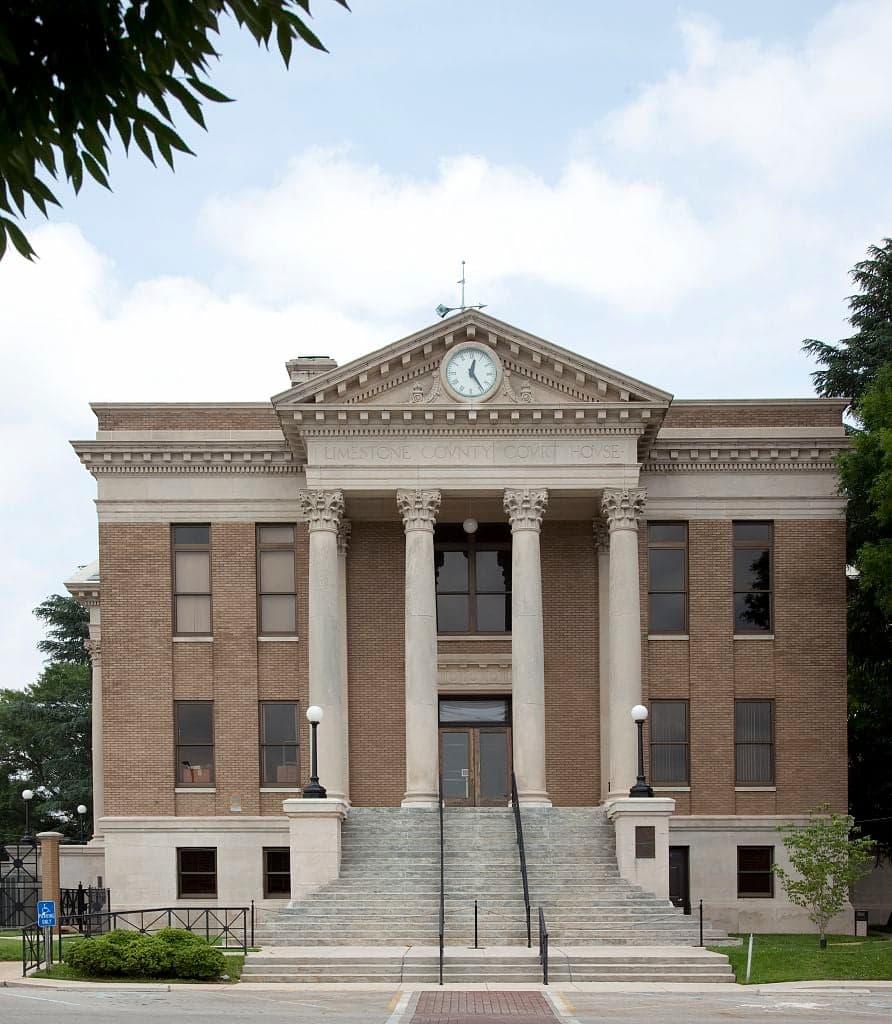
Photo: Wikipedia
Strategic Assessment of Athens, AL
Workable tactical position. Some exposure to population density or targets, but generally defensible in a crisis.
What does the Strategic Assessment tell us?
Our Strategic Assessment grades tactical survivability of an area. Major population centers, military targets, fallout zones, natural disasters, and border exposure all drive risk — lower exposure means a more defensible position in a crisis.
This is heavily inspired by Joel Skousen's Strategic Relocation book. Highly recommended you checkout the book ($)What does this tell us?
Our Strategic Assessment grades tactical survivability of an area. Major population centers, military targets, fallout zones, natural disasters, and border exposure all drive risk — lower exposure means a more defensible position in a crisis.
This is heavily inspired by Joel Skousen's Strategic Relocation book. Highly recommended you checkout the book ($)Strategic Pillars

Key Distances
Regional Safe Places
Below is our recommended "safe zones" in Alabama and the surrounding area based on our strategic heuristics. For most people, it's unrealistic to live in a “safe zone” full-time due to work, family or other personal reasons. They tend to be more rural. However, many of these areas are perfect for second homes and retreat properties that double as a vacation home or even a short-term rental.
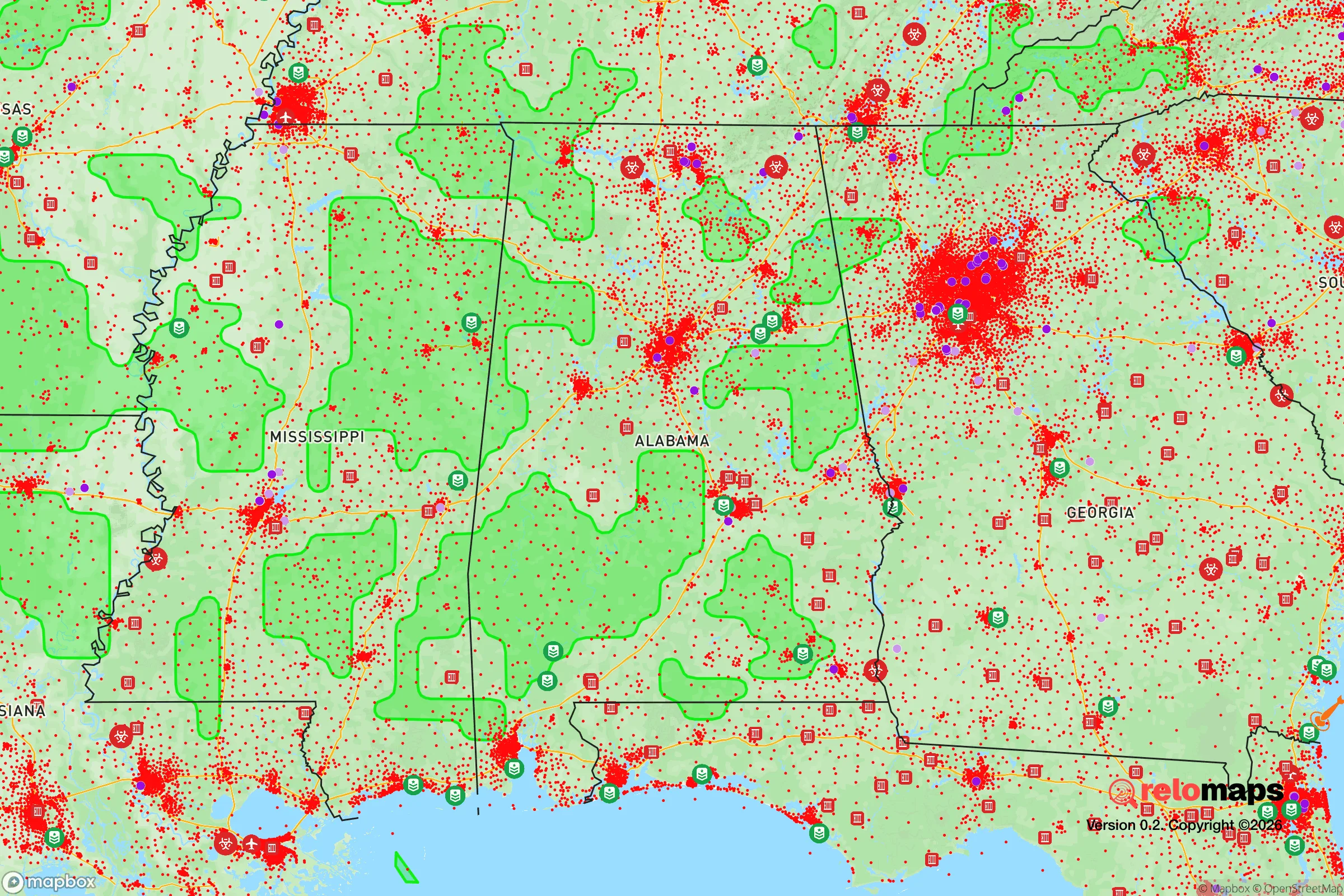
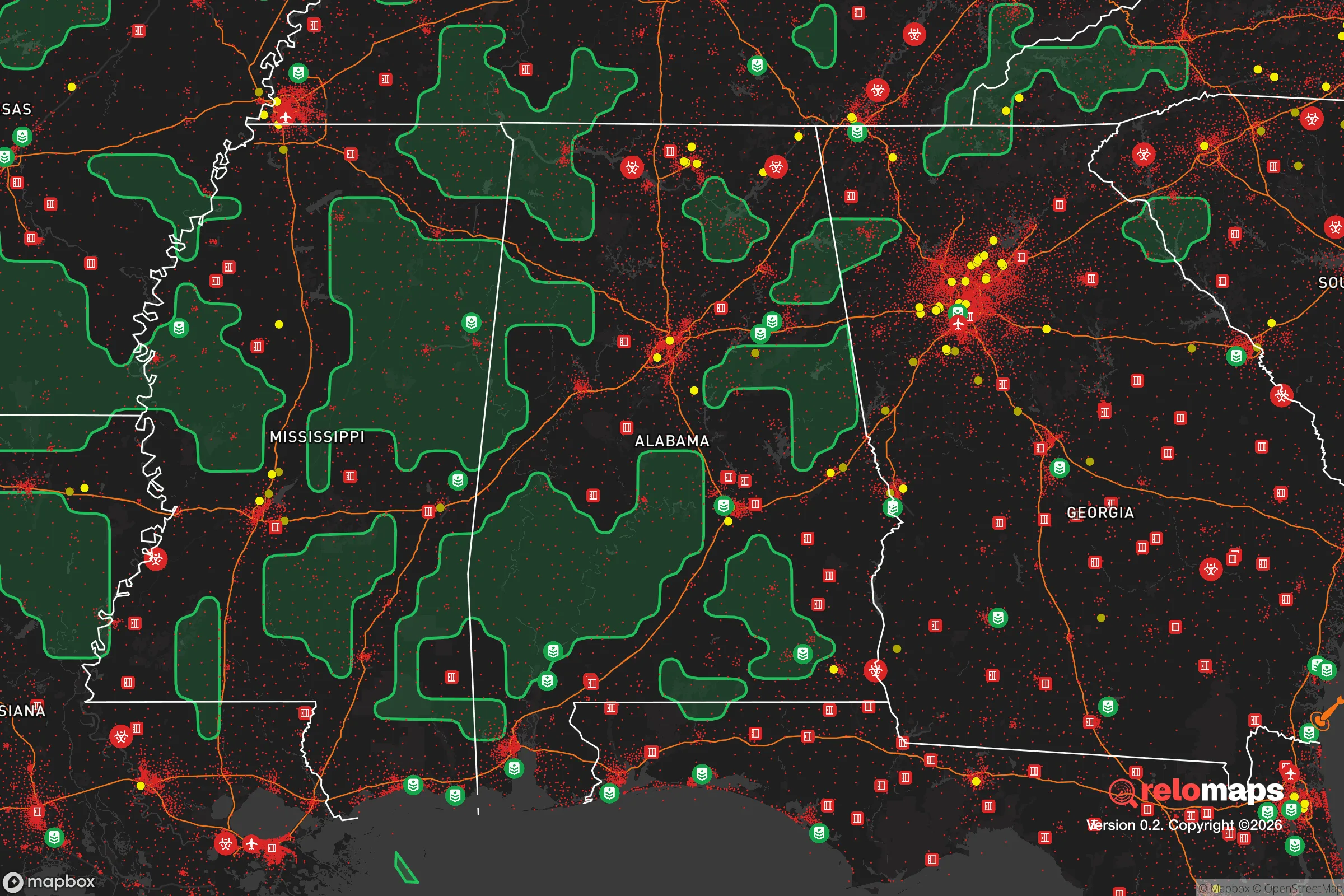


Important Note: For informational purposes only. This does not mean nothing bad ever happens in the green zones. Please use common sense. This is based on public data and modeled with AI. We tried to take a conservative approach but mistakes happen. We update this regularly as new information becomes available.
Solar Generator Recommendations
Backup power matters more here than in safer locations. We've picked three solar generators across budgets and capacity tiers — start with the budget unit if you only need a few essentials, or step up if you want to run a fridge and HVAC for days at a time.

Jackery Portable Power Station Explorer 300
Budget OptionPower on the Go: Weighing only 11 lbs, it's convenient to set up and store with book-sized foldable solar panels

BLUETTI Portable Power Station AC180
Designed for both indoor and outdoor scenarios, AC180 is highly capable as it has a robost capacity and continuous output power.

EF ECOFLOW DELTA Pro Ultra Power Station
Upgraded PickEcoFlow DELTA Pro Ultra is a whole-home energy system designed to grow with your family. Integrated with the Smart Home Panel 2, it scales to meet your evolving energy needs — keeping your home powered, intelligent, and secure through every stage of life.
We earn a commission, at no additional cost to you.
Strategic Assessment Analysis
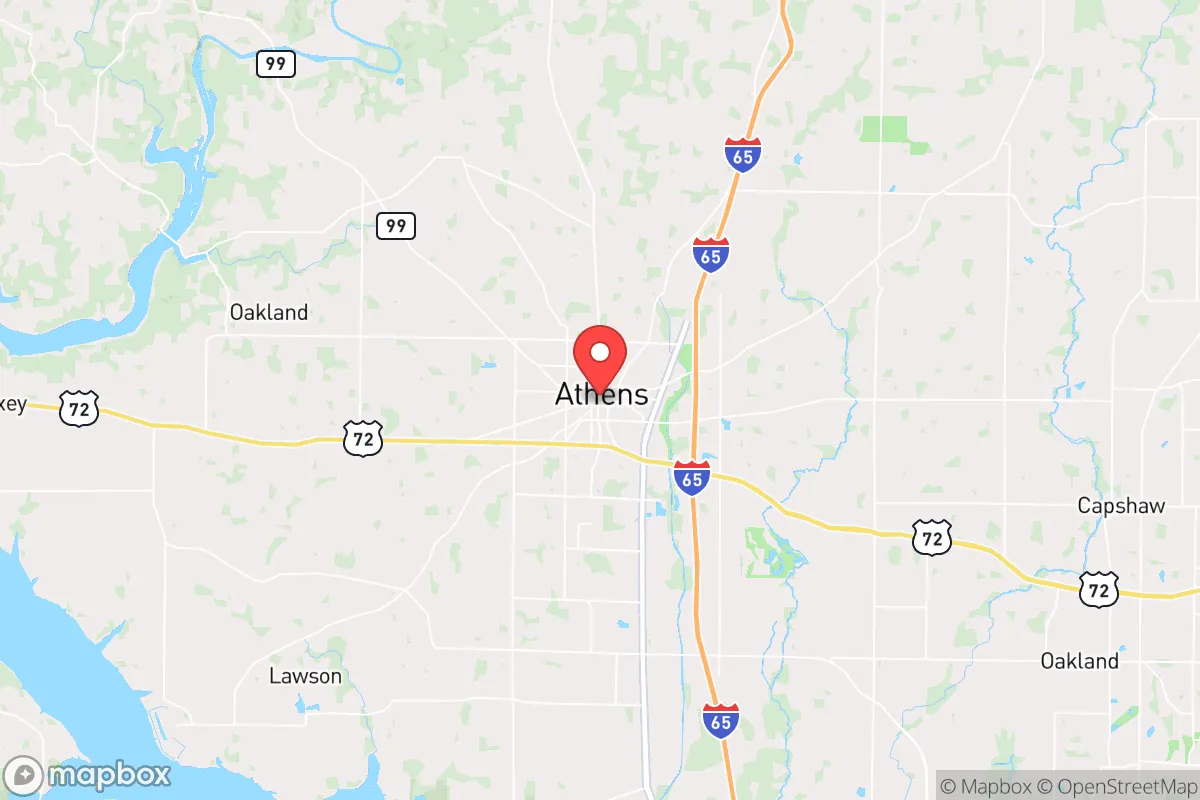
Athens, Alabama, sits in a strategic sweet spot that few relocators fully appreciate: close enough to major infrastructure to be practical, far enough from the obvious bullseyes to offer genuine breathing room. Located in Limestone County, roughly 20 miles west of Huntsville and 90 miles north of Birmingham, this town of about 28,000 people benefits from the economic engine of the Tennessee Valley without absorbing the direct risks that come with being inside a major metropolitan area. For someone thinking in terms of long-term resilience—civic unrest, supply chain disruptions, or larger-scale destabilization—Athens offers a combination of geographic insulation, agricultural access, and community cohesion that is increasingly rare in the modern South.
Geographic position and natural advantages for long-term stability
Athens sits on the southern edge of the Tennessee Valley, a region defined by the Tennessee River and its tributaries, which provide a reliable freshwater source that is not dependent on a single reservoir or aquifer. The area's topography is gently rolling, with enough elevation variation to offer natural drainage and defensible positions without the isolation of mountainous terrain. The climate is humid subtropical, with four distinct seasons and an average annual rainfall of around 54 inches—enough to support year-round agriculture without the drought risks that plague the western states. The growing season stretches from mid-March to early November, giving relocators a solid eight-month window for food production. Soils in Limestone County are predominantly clay-loam, which holds moisture well and is suitable for row crops, orchards, and pasture. For someone planning a self-sufficient homestead or even a suburban garden with serious output, this is a significant advantage over sandy coastal soils or rocky Appalachian ground. The area is also outside the primary tornado alley that runs through central Oklahoma and north Texas, though severe weather does occur. The real natural advantage here is water: the Tennessee River system, Wheeler Lake, and the Elk River all lie within a 30-minute drive, providing redundancy for both personal use and potential community-scale supply.
Risks, exposures, and proximity to fallout-relevant landmarks
The most significant risk factor for Athens is its proximity to Huntsville, home to Redstone Arsenal, the U.S. Army's missile and rocket development hub, and NASA's Marshall Space Flight Center. In a major conflict scenario—whether conventional war or a terrorist strike targeting military-industrial infrastructure—Huntsville is a high-value target. Athens sits roughly 20 miles west of the arsenal, placing it outside the immediate blast radius of a conventional strike but well within the fallout zone of a nuclear event. Prevailing winds in the region are from the south and southwest, meaning that a detonation at Redstone would push contamination northeast, away from Athens, but this is not a guarantee under all weather conditions. The Tennessee Valley Authority's Browns Ferry Nuclear Plant, located about 15 miles southeast of Athens near Decatur, is another concern. While the plant has a solid safety record, any major incident there—whether from accident or sabotage—would put Athens in a downwind risk corridor. On the positive side, Athens is far from the major ports, financial centers, and political capitals that would be primary targets in a coordinated attack. It is not a transportation hub, not a refinery center, and not a military base itself. This relative obscurity is a genuine asset. The area also has no major dams upstream that could cause catastrophic flooding if breached, and the local power grid is part of the TVA system, which is more robust than many rural co-ops but still vulnerable to cyberattack or EMP. For a relocator, the key takeaway is that Athens is not a safe zone in a total war scenario, but it is far safer than any major city or suburb of a primary target.
Practical resilience for a relocator: food, water, energy, and defensibility
For someone serious about preparedness, Athens offers a mix of suburban convenience and rural practicality that is hard to beat. The town itself has a historic downtown with a walkable square, but most residential areas are single-family homes on lots ranging from a quarter-acre to several acres. Zoning is relatively lax compared to larger cities, meaning that backyard chickens, small livestock, and substantial gardens are generally permitted without bureaucratic hassle. The local agricultural extension office through Auburn University provides soil testing, pest management advice, and seed recommendations tailored to the region—a resource that serious preppers should use. Water access is the strongest card Athens holds. The Tennessee River is a massive, reliable surface water source, and the area's groundwater is generally good, with wells producing 10 to 50 gallons per minute at depths of 100 to 300 feet. For those on city water, the Athens Utilities system draws from the Tennessee River and has backup generators, but a private well with a hand pump or solar-powered pump is a wise investment. Energy resilience is more challenging. The local grid is reliable day-to-day, but a long-term outage would require either a whole-house generator with a substantial fuel store or a solar array with battery backup. Natural gas is available in most of the town, which is a plus for heating and cooking without grid dependence. Defensibility is moderate. Athens is not a gated community or a remote compound; it is a small town with multiple road access points. However, the surrounding rural areas offer plenty of properties with tree lines, long driveways, and natural barriers. The local law enforcement presence is adequate but not overwhelming—the Limestone County Sheriff's Office has about 60 deputies for a county of 100,000 people, meaning that in a crisis, response times could stretch significantly. Building a network of like-minded neighbors is more important here than in a dense urban area, but the culture is generally self-reliant and community-oriented, which is a strong foundation for mutual aid.
The overall strategic picture for Athens, Alabama, is one of cautious optimism for the prepared relocator. It is not a bug-out location for a total collapse scenario—no place in the continental U.S. truly is, given the interconnected nature of modern infrastructure. But for someone looking to establish a base that can weather economic disruption, localized civil unrest, or even a regional conflict, Athens offers a rare combination of water security, agricultural potential, and relative obscurity. The proximity to Huntsville is a double-edged sword: it provides access to jobs, healthcare, and supply chains in normal times, but it also introduces a risk profile that cannot be ignored. The smart move is to treat Athens as a staging ground—a place to build skills, store supplies, and establish relationships, while maintaining the ability to relocate further into the Tennessee Valley or the Appalachian foothills if the threat environment escalates. For the conservative-minded individual who values self-reliance, community, and a slower pace of life, Athens is a solid bet. Just don't mistake it for a fortress. It is a garden, not a bunker, and that is exactly what most people actually need.

* Values derived from national, state, county, city and local statistics and may differ in a specific area. Last updated: 2026-04-19T18:42:49.000Z
Narrative content on this page is AI-generated and may contain mistakes. Verify any details that matter before acting on them.
ReloMaps may earn a commission from affiliate links at no extra cost to you.

