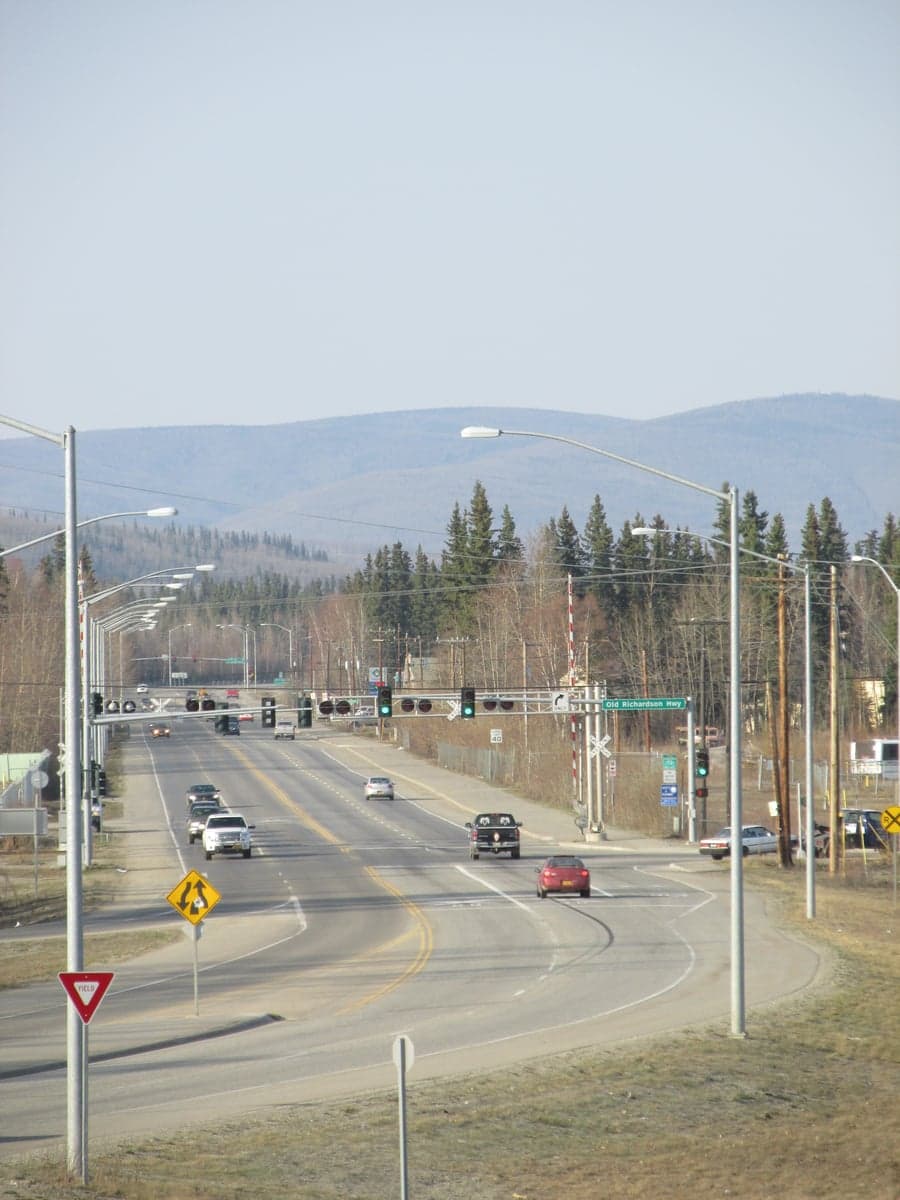
Photo: Wikipedia
Political ClimatePolitical Climate in Badger, AK
District shown is the primary district for this city’s centroid. Cities may span multiple districts.
Inherited from parent state — no local data available.
Local Political AnalysisPolitical Analysis of Badger, AK
Badger, Alaska, has long been a place where folks value their independence and don’t take kindly to being told how to live their lives. The area leans solidly conservative, with a Cook PVI of R+6 that mirrors the rest of the state, and that’s not just a number—it reflects a deep-rooted belief in personal responsibility and limited government. For decades, the political vibe here has been steady, with most residents voting to keep outside interference at bay, whether it’s from Juneau or Washington D.C. But like many places in Alaska, you can feel a subtle shift in the air, and it’s worth keeping an eye on how that might change things for the folks who call this place home.
How it compares
When you stack Badger up against the rest of Alaska, the political landscape is surprisingly uniform—both share that R+6 rating, which tells you the state as a whole isn’t exactly swinging left. But the real contrast shows up when you look at nearby cities like Fairbanks, just a stone’s throw away. Fairbanks has a more mixed political scene, with a noticeable progressive presence, especially around the university and some of the newer developments. In Badger, you don’t see that as much; it’s a place where people are more likely to be out hunting or working on their trucks than attending a city council meeting about bike lanes. The surrounding areas, like North Pole and Ester, also lean conservative, but they’ve got their own quirks—Ester, for instance, has a small but vocal libertarian streak that sometimes clashes with the more traditional GOP crowd. Compared to Anchorage, which has been trending bluer in recent years, Badger feels like a holdout, a pocket where the old-school Alaska spirit of self-reliance still dominates.
What this means for residents
For the folks living in Badger, the political climate directly shapes daily life in ways that matter. You’re not dealing with a lot of government overreach here—property taxes are low, zoning is minimal, and there’s a general understanding that your land is your business. That’s a big deal for people who value their privacy and don’t want someone telling them they can’t have a shed or a few chickens in the backyard. The downside is that services can be sparse, and you’ve got to be self-sufficient, but most residents see that as a fair trade-off. The recent push for more progressive policies in the state, like expanded gun control measures or stricter environmental regulations, has raised some eyebrows here. There’s a real concern that if those ideas gain traction, they could start chipping away at the freedoms that make Badger a good place to live. For now, the community stays engaged, showing up to vote and keeping the pressure on local representatives to hold the line.
Culturally, Badger stands apart from some of the more urbanized parts of Alaska in a few key ways. You won’t find a lot of the trendy coffee shops or art galleries that pop up in Anchorage or even parts of Fairbanks—instead, it’s more about practical living, with a strong emphasis on outdoor skills and community support. The policy distinctions are subtle but real: Badger residents tend to push back hard on any talk of new taxes or land-use restrictions, and there’s a healthy skepticism of federal mandates, especially when it comes to resource development. Looking ahead, the long-term trajectory depends on who moves in and how the state’s economy shifts. If the trend of people fleeing high-tax states continues, Badger could see an influx of folks who appreciate the conservative values here, which would likely reinforce the current political lean. But if outside influences start creeping in—like more government-funded programs or a push for denser housing—you might see a slow erosion of the independent spirit that’s defined this area for generations. For now, it’s a solid red spot in a red state, but nothing stays the same forever, and the folks here are watching closely.

State Political ClimatePolitical Climate in Alaska
State Political AnalysisPolitical Environment in the State
Alaska has long been a reliably Republican state at the presidential level, with a Cook PVI of R+6, but its political climate is far more libertarian and independent-minded than the Lower 48’s red-blue binary suggests. Over the past 20 years, the state has shifted from a solidly conservative stronghold—where Republicans routinely won by double digits—to a more volatile battleground where independent and moderate candidates can win statewide, as seen in the 2022 U.S. House race won by Democrat Mary Peltola in a ranked-choice voting system. The dominant coalition remains center-right on fiscal issues and resource development, but there’s a strong streak of personal liberty that resists both big government and social conservatism, making Alaska a unique environment for those seeking freedom from overreach.
Urban vs. rural divide
The political map of Alaska is starkly divided between its urban core and vast rural expanse. Anchorage, home to roughly 40% of the state’s population, leans slightly left of the state average—its Assembly often features a progressive majority on social issues, though fiscal conservatism still holds in the Mat-Su Borough suburbs like Wasilla and Palmer. Fairbanks, the second-largest city, is more mixed, with a strong military and university presence that creates a libertarian-leaning swing area. Juneau, the capital, is the most reliably Democratic city, driven by state government employees and a tourism economy. The real conservative strongholds are the Mat-Su Borough (north of Anchorage) and the Kenai Peninsula, where towns like Soldotna and Homer vote heavily Republican. Rural Alaska—including the vast Bush regions like Nome, Bethel, and Utqiaġvik—votes overwhelmingly Democratic due to strong tribal and subsistence ties, but turnout is low and issues like subsistence rights and federal land management dominate, not national culture wars. The urban-rural split here is less about density and more about access to resources: the road-connected areas (Anchorage, Fairbanks, Kenai) are more conservative, while the fly-in villages are progressive on social spending but deeply skeptical of federal control.
Policy environment
Alaska’s policy environment is a mixed bag for a conservative audience. The state has no income tax and no statewide sales tax—a huge plus for personal freedom—but relies heavily on oil revenue and the Permanent Fund Dividend (PFD), which has become a political football. The regulatory posture on resource extraction is generally business-friendly, though the Biden administration’s restrictions on ANWR and the Willow Project have created friction. Education policy is decentralized, with local school boards controlling curriculum, but the state has seen battles over parental rights, including a 2023 law (HB 105) requiring schools to notify parents of any changes to a student’s health or well-being. Healthcare is a mixed bag: Alaska expanded Medicaid under the ACA in 2015, which some conservatives see as overreach, but the state also has a robust telehealth network and a strong private insurance market. Election laws are a flashpoint: Alaska adopted ranked-choice voting in 2020 via ballot initiative, which has been criticized by conservatives for diluting partisan power and confusing voters. The state also has no voter ID law, which some see as a vulnerability. Overall, the policy environment is libertarian-leaning on taxes and resource use, but progressive on election and healthcare systems.
Trajectory & freedom
Alaska’s trajectory on personal freedom is a mixed picture, trending both more and less free depending on the issue. On the positive side, the state has some of the strongest gun rights in the nation—no permit required for concealed carry, no magazine bans, and a 2022 law (SB 17) that prohibits state enforcement of federal gun laws that violate the Second Amendment. Property rights are strong, with minimal zoning outside cities and a homestead exemption that protects primary residences from creditors. However, the ranked-choice voting system (passed in 2020) has been a major point of contention, with conservatives arguing it reduces voter choice and empowers special interests. The state also has a high degree of government involvement in energy and housing through the Alaska Housing Finance Corporation, which some see as overreach. Medical autonomy is a bright spot: Alaska has no vaccine mandates for adults, and a 2023 law (HB 48) prohibits discrimination based on vaccination status. Parental rights were strengthened with HB 105, but the state’s education system still faces pressure from progressive school boards in Anchorage and Juneau. The bottom line: Alaska remains freer than most states on guns, taxes, and medical choice, but the ranked-choice voting system and some federal land restrictions are concerning trends.
Civil unrest & political movements
Alaska has seen relatively little civil unrest compared to the Lower 48, but there are notable flashpoints. The 2020 Black Lives Matter protests in Anchorage were small and largely peaceful, but they sparked a backlash that energized conservative and libertarian groups. The state has a strong secessionist and nullification movement, with the Alaska Independence Party (AIP) advocating for a vote on independence from the U.S., though it remains fringe. More mainstream is the “Alaska First” sentiment that crosses party lines, opposing federal control of land (the state is 60% federally owned). Immigration politics are muted—Alaska has a small foreign-born population—but the state has no sanctuary city policies, and local law enforcement generally cooperates with ICE. Election integrity has been a hot topic since the 2020 switch to ranked-choice voting, with conservatives organizing recall efforts against legislators who supported it. The most visible flashpoint for a new resident would be the annual PFD debate: every year, the amount and eligibility are fought over in Juneau, with progressives pushing to reduce the dividend to fund government programs, and conservatives fighting to protect it as a property right. This is the issue that gets Alaskans into the streets, not national culture wars.
Projection
Over the next 5-10 years, Alaska is likely to become more politically volatile, not more stable. In-migration from the Lower 48—particularly from California and Washington—is bringing a mix of libertarian-leaning conservatives and progressive urbanites, which could shift the balance in Anchorage and Fairbanks. The ranked-choice voting system will continue to produce unpredictable results, potentially favoring moderate or independent candidates over hardline conservatives. The state’s reliance on oil revenue is a ticking clock: as production declines, the pressure to impose an income tax or cut the PFD will grow, which could trigger a political realignment. On the freedom front, expect continued battles over federal land control, with conservatives pushing for more state management and resource extraction. The parental rights movement will likely expand, with more school board fights over curriculum and library books. For a conservative moving in now, the next decade will feel like a tug-of-war: the state’s libertarian DNA is strong, but the ranked-choice voting system and demographic shifts could erode it. The key is to get involved locally—school boards, borough assemblies, and the PFD fight—because Alaska’s politics are still small enough that a few hundred active citizens can shape outcomes.
For a new resident, the bottom line is this: Alaska offers a rare combination of low taxes, strong gun rights, and personal autonomy that is increasingly hard to find in the Lower 48. But it’s not a conservative utopia—the ranked-choice voting system, federal land control, and progressive pockets in Anchorage and Juneau require vigilance. If you’re willing to engage locally and accept that the state’s politics are more libertarian than Republican, you’ll find a place where your freedom is respected. Just don’t expect it to stay that way without effort.
* Values derived from national, state, county, city and local statistics and may differ in a specific area. Last updated: 2026-05-15T01:43:45.000Z
Narrative content on this page is AI-generated and may contain mistakes. Verify any details that matter before acting on them.
ReloMaps may earn a commission from affiliate links at no extra cost to you.

