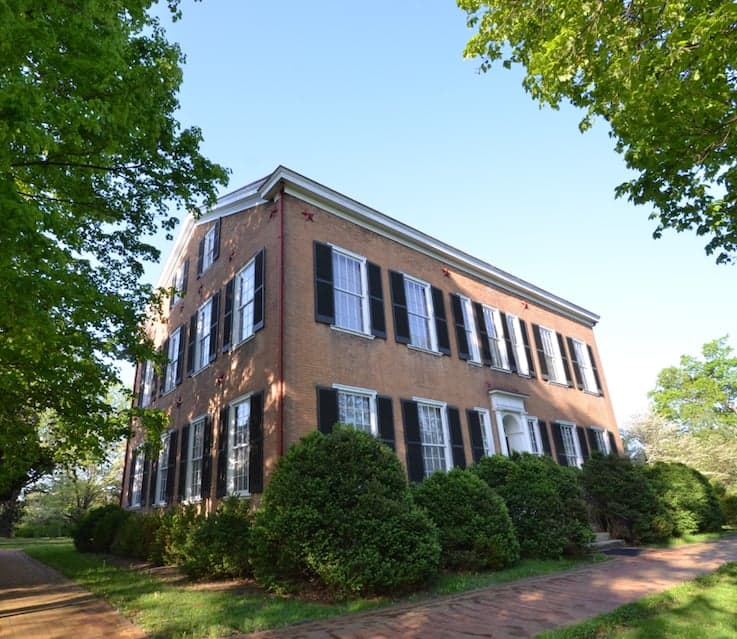
Photo: Wikipedia
Demographics of Bardstown, KY
Affluence Level in Bardstown, KY
A middle-class area roughly in line with national averages across income, home values, education, and employment.
People of Bardstown, KY
Bardstown, Kentucky, is a city of 13,673 residents where the population is predominantly White (79.2%) and Black (13.3%), with a small but growing Hispanic community (4.6%) and a very limited East/Southeast Asian presence (0.5%). The city’s identity is rooted in its historic role as the "Bourbon Capital of the World," a heritage that has shaped a conservative, family-oriented culture with a strong Catholic and Protestant religious character. Despite its small size, Bardstown has a distinct sense of place, with a historic downtown core and surrounding neighborhoods that reflect the settlement patterns of different waves of arrivals.
How the city was settled and grew
Bardstown was founded in 1780 by William Bard, a land speculator, and was one of the earliest settlements in Kentucky, drawing primarily Scots-Irish and English pioneers moving west through the Cumberland Gap. These early settlers were farmers and tradesmen who established the city as a regional market and religious center, with the Basilica of St. Joseph Proto-Cathedral (built 1816) anchoring the Catholic community. The original population clustered in the Historic Downtown area, around Court Square, and in the Fairview neighborhood, where many of the city’s oldest homes still stand. The arrival of the Louisville and Nashville Railroad in the 1850s spurred a second wave of German and Irish immigrants, who worked in the bourbon distilleries and found housing in the Bardstown Junction area near the rail lines. By the early 20th century, the city’s population was overwhelmingly White and native-born, with a small Black community concentrated in the West Bardstown neighborhood, near the distilleries and tobacco warehouses where many worked.
Modern era (post-1965)
After the 1965 Immigration and Nationality Act, Bardstown saw minimal direct immigration, with the foreign-born population remaining at just 3.2% today. The most significant demographic shift has been domestic: a steady outflow of younger residents to larger cities like Louisville (45 miles north) and Lexington, offset by in-migration of retirees and families seeking a slower pace and lower cost of living. The Hispanic population, now 4.6%, began growing in the 1990s, driven by labor demand in the bourbon industry and agriculture, with many settling in the Bardstown Estates subdivision and along the New Haven Road corridor. The Black population, at 13.3%, remains concentrated in the historic West Bardstown and South Bardstown areas, though some families have moved into newer subdivisions like Maple Grove. The East/Southeast Asian population (0.5%) is negligible, consisting mostly of a few families employed in professional roles at distilleries or local healthcare. The Indian-subcontinent population is effectively zero. The city’s college-educated share (24.7%) is below the national average, reflecting a workforce heavily oriented toward manufacturing, distilling, and service jobs rather than white-collar professions.
The future
Bardstown’s population is projected to grow slowly, driven by bourbon tourism and the expansion of distilleries like Heaven Hill and Jim Beam, which continue to attract workers from surrounding rural areas. The Hispanic community is likely to grow modestly as a share of the population, but it remains small and is not creating distinct ethnic enclaves; instead, Hispanic families are dispersing into existing neighborhoods like Bardstown Estates and Fairview. The Black population is stable, with no major in-migration from outside the region. The White population, while still the overwhelming majority, is aging, and the city faces a challenge in retaining young adults who leave for college and do not return. The city is not tribalizing into distinct ethnic enclaves; rather, it is homogenizing into a predominantly White, conservative community with a small but stable Black minority and a tiny Hispanic presence. The next 10-20 years will likely see continued slow growth, with the population becoming slightly more Hispanic and slightly less White, but the overall character of Bardstown as a tight-knit, bourbon-centric, religiously conservative town will persist.
For someone moving in now, Bardstown offers a stable, family-oriented environment with a strong sense of local identity and low crime rates, but it is not a place of rapid demographic change or diversity. The city’s future is one of gradual, organic growth, where newcomers—whether from Louisville or rural Kentucky—will find a community that values tradition, faith, and a slower pace of life. The bourbon industry will remain the economic and cultural anchor, ensuring that Bardstown stays a distinct destination rather than becoming a generic suburb.

* Values derived from national, state, county, city and local statistics and may differ in a specific area. Last updated: 2026-04-21T09:12:39.000Z
Narrative content on this page is AI-generated and may contain mistakes. Verify any details that matter before acting on them.
ReloMaps may earn a commission from affiliate links at no extra cost to you.

