
Photo: Wikipedia
Political ClimatePolitical Climate in Bardstown, KY
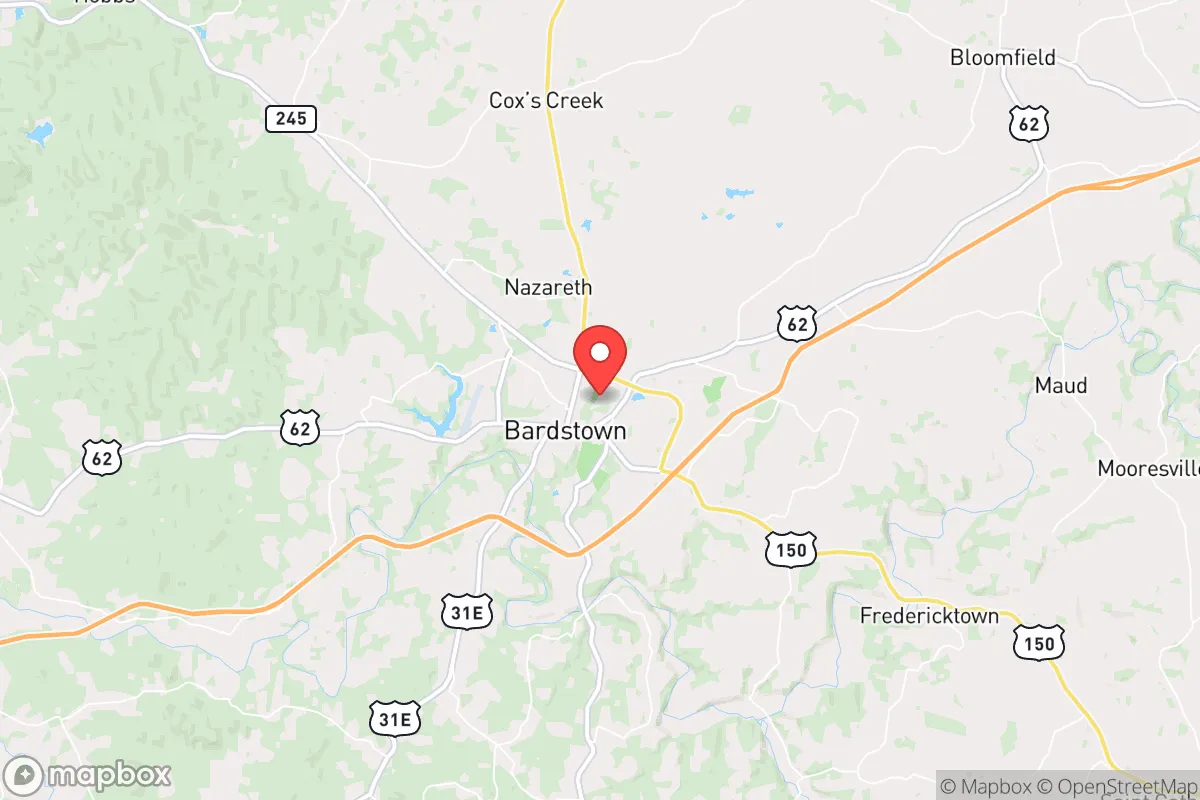
District shown is the primary district for this city’s centroid. Cities may span multiple districts.
Local Political AnalysisPolitical Analysis of Bardstown, KY
Bardstown, Kentucky, sits in a deeply conservative pocket of the Bluegrass State, with a Cook PVI of R+20 that reflects a community where traditional values and limited-government principles are the norm. For as long as I can remember, this town has leaned solidly Republican, and the 2024 election results only reinforced that—Nelson County went for the GOP ticket by a comfortable margin, and local races rarely see serious Democratic challengers. But if you’ve been around here as long as I have, you’ve noticed a subtle shift in the air over the past decade. The old guard of fiscal conservatism and personal liberty is still strong, but there’s a growing undercurrent of progressive influence creeping in from Louisville, just 40 miles north, and even from Lexington to the east. It’s not a takeover by any means, but it’s enough to make a long-time resident pay attention.
How it compares
Compared to the surrounding towns, Bardstown is a bit of a mixed bag politically. Head south to Springfield or Lebanon, and you’ll find even redder territory—those areas are rock-solid conservative, with little appetite for any kind of government overreach. But drive north toward Louisville, and the contrast is stark. Jefferson County is a blue stronghold, and its influence sometimes trickles down through state policy and media coverage. Locally, Bardstown’s city council and county commission have stayed mostly conservative, but you’ll see the occasional push for zoning changes or tax hikes that feel like they’re borrowed from the city playbook. The real contrast, though, is with nearby Bloomfield or New Haven—smaller towns where the idea of a mask mandate or a business regulation would be laughed out of the room. Bardstown, being a bit larger and more tourist-driven, has to balance that small-town independence with the pressures of growth and outside money.
What this means for residents
For folks living here, the political climate means you can generally expect a government that stays out of your way—low taxes, minimal red tape, and a school system that still emphasizes local control. But there are warning signs. The push for more “equity” initiatives in the county schools, for instance, has raised eyebrows among parents who see it as a foot in the door for progressive ideology. Property taxes have inched up, and there’s chatter about expanding public transit or affordable housing mandates, which sound good on paper but often come with strings attached from state or federal grants. The good news is that the community pushes back hard when it feels overreached. The Second Amendment is still a given here, and you won’t find many people apologizing for their faith or their flag. If you value personal freedom—whether it’s homeschooling, running a small business without endless permits, or just living your life without a government nanny—Bardstown is still a safe bet. But keep an eye on the long-term trends; the same forces reshaping Louisville are slowly making their way south.
Culturally, Bardstown has always been a place where bourbon, faith, and family come first, and that hasn’t changed. But there’s a growing tension between the old-school conservatism that says “live and let live” and a newer strain that wants to use government to enforce a progressive agenda. You see it in debates over downtown development, where some want to preserve the historic character while others push for more “inclusive” public spaces. The policy distinction that matters most here is the local commitment to low taxation and limited regulation—something that sets Bardstown apart from the more interventionist cities to the north. If you’re considering a move, know that this is still a place where your neighbor will help you fix a fence and your local representative will actually listen to your concerns. But don’t take it for granted. The political winds are shifting, and the only way to keep Bardstown true to its roots is to stay engaged and vote like your freedoms depend on it—because they do.

State Political ClimatePolitical Climate in Kentucky
State Political AnalysisPolitical Environment in the State
Kentucky has long been a reliably red state in federal elections, but its political landscape is more nuanced than a simple partisan label suggests. The commonwealth has voted for the Republican presidential candidate in every election since 2000, often by double-digit margins, and both U.S. Senate seats are held by Republicans. However, the state’s political trajectory over the past 20 years has been a steady march rightward, driven by a rural backlash against national Democratic trends and a realignment of working-class voters. While Louisville and Lexington remain blue strongholds, the rest of the state has consolidated into a deeply conservative coalition, making Kentucky one of the most reliably Republican states in the nation.
Urban vs. rural divide
The political map of Kentucky is a textbook study in the urban-rural split. The two major population centers—Louisville (Jefferson County) and Lexington (Fayette County)—are the only reliably Democratic areas, and even they are not monolithic. Louisville’s eastern suburbs, like Prospect and Anchorage, lean Republican, while the city’s West End and South End drive the Democratic vote. Lexington’s urban core votes blue, but surrounding Fayette County is more competitive. The real story is the rest of the state. The Purchase region in far western Kentucky, including Paducah and Murray, has shifted hard right over the past decade. Bowling Green, home to a growing immigrant population and Western Kentucky University, is a rare purple dot in an otherwise red expanse. The Appalachian counties in the east, like Pike and Harlan, were once Democratic strongholds but now vote Republican by margins of 60-70%. The Northern Kentucky suburbs of Cincinnati—Fort Thomas, Independence, and Florence—are reliably red, with the exception of Covington, which has a small progressive enclave. The rural-urban divide is stark: in 2024, Jefferson County voted for the Democratic presidential candidate by 20 points, while the rest of the state gave the Republican a 35-point margin.
Policy environment
Kentucky’s policy environment has shifted decisively conservative over the past decade. The state has a flat income tax rate of 4.5%, down from 6% in 2018, with a path to elimination by 2029. Property taxes are low, and there is no state tax on Social Security benefits. The regulatory posture is business-friendly, with right-to-work laws and a tort reform system that caps non-economic damages. Education policy has been a flashpoint: the state has a robust school choice movement, with charter schools legalized in 2017 (though few have opened) and a growing number of homeschooling families. The Kentucky General Assembly passed a 2022 law allowing parents to opt their children out of mask mandates and vaccine requirements, a major win for parental rights. Healthcare is a mixed bag: the state expanded Medicaid under the Affordable Care Act, but the legislature has resisted further expansion and has passed laws restricting abortion to the first 15 weeks, with a near-total ban triggered in 2022. Election laws have tightened: voter ID is required, and the state has purged inactive voters from rolls. The legislature also passed a 2021 law limiting absentee voting and banning ballot harvesting. Overall, the policy environment is one of limited government, low taxes, and a strong emphasis on local control—though the state’s heavy reliance on federal Medicaid funding creates a tension between conservative rhetoric and practical reality.
Trajectory & freedom
Kentucky is becoming more free in several key areas, particularly fiscal policy and Second Amendment rights. The state passed constitutional carry in 2019, allowing permitless concealed carry, and has preempted local gun ordinances, meaning Louisville cannot enact its own gun restrictions. In 2023, the legislature passed a law prohibiting any state or local enforcement of federal gun laws that violate the Second Amendment—a direct challenge to federal overreach. Parental rights have expanded: the 2022 "Parents’ Bill of Rights" law requires schools to notify parents about curriculum changes and allows them to opt their children out of sex education. Medical freedom saw a win with the 2021 law banning vaccine passports and prohibiting employers from mandating COVID-19 vaccines. However, there are concerning trends. The state’s medical marijuana program, signed into law in 2023, is heavily restricted and won’t be operational until 2025—a slow roll that frustrates advocates. More troubling is the state’s handling of property rights: the Kentucky Supreme Court has upheld the use of eminent domain for private economic development projects, a threat to individual landowners. The state also has a history of asset forfeiture abuse, though 2021 reforms now require a criminal conviction before the state can permanently take property. On balance, Kentucky is trending toward greater personal liberty, but the pace is uneven and the state’s bureaucratic inertia remains a concern.
Civil unrest & political movements
Kentucky has seen its share of political flashpoints. The 2020 protests in Louisville over the death of Breonna Taylor were among the largest in the nation, with the city seeing nightly demonstrations, property damage, and a heavy police presence. The state’s response was a mixed bag: the governor, a Democrat, deployed the National Guard, while the Republican-led legislature passed a 2021 law increasing penalties for rioting and blocking local governments from defunding police. The Breonna Taylor case also sparked a movement for police reform, but the legislature has resisted significant changes. On the right, the state has a strong Second Amendment movement, with groups like the Kentucky Gun Owners Association holding regular rallies at the capitol. Immigration politics are less heated than in border states, but there is tension in Louisville and Bowling Green, where refugee resettlement has grown. The state has no sanctuary cities, and a 2020 law requires local law enforcement to cooperate with federal immigration authorities. Election integrity has been a hot topic: the 2020 election saw no major fraud in Kentucky, but the legislature passed a 2021 law requiring signature verification for absentee ballots and limiting drop boxes. The state’s nullification rhetoric is mostly symbolic, but the 2023 law challenging federal gun enforcement shows a willingness to push back against Washington. A new resident would notice the strong presence of "Don’t Tread on Me" flags and pro-life bumper stickers in rural areas, while Louisville’s progressive enclaves display Black Lives Matter and Pride flags.
Projection
Over the next 5-10 years, Kentucky will likely become even more conservative, driven by two demographic trends. First, the state is seeing a steady influx of retirees and remote workers from blue states like California and Illinois, drawn by low taxes and housing costs. These newcomers tend to be more libertarian than traditional conservatives, which could shift the state’s politics toward a more "leave me alone" ethos. Second, the state’s rural population is aging and shrinking, while the urban centers of Louisville and Lexington are growing slowly. This will not flip the state blue, but it could make the urban-rural divide even sharper. The state’s Republican supermajority in the legislature is likely to persist, meaning continued tax cuts, school choice expansion, and Second Amendment protections. However, there are risks: the state’s heavy reliance on federal funding for healthcare and infrastructure could create a fiscal crisis if Washington cuts spending. The opioid epidemic, while receding, has left deep scars in eastern Kentucky, and the state’s low workforce participation rate remains a drag. A new resident moving in now should expect a state that is increasingly conservative but also increasingly divided between its urban and rural populations. The political climate will remain stable, but the culture wars will intensify, particularly around education and LGBTQ issues.
For a new resident, the bottom line is this: Kentucky offers a low-tax, high-freedom environment for those who value limited government and traditional values. The state is safe, affordable, and politically aligned with conservative principles. However, you will need to navigate the urban-rural divide—if you move to Louisville, you will be in a blue bubble with progressive policies on housing and policing. If you choose a smaller city like Bowling Green or Paducah, you will find a more uniform conservative culture. The key is to pick your location wisely, understand the local dynamics, and be prepared for a state that is proud of its independence but still grappling with the challenges of poverty and addiction. Kentucky is a good bet for someone looking to escape high-tax, high-regulation states, but it is not a libertarian paradise—it is a deeply red state with a strong sense of community and a healthy skepticism of government overreach.
* Values derived from national, state, county, city and local statistics and may differ in a specific area. Last updated: 2026-04-21T09:12:39.000Z
Narrative content on this page is AI-generated and may contain mistakes. Verify any details that matter before acting on them.
ReloMaps may earn a commission from affiliate links at no extra cost to you.

