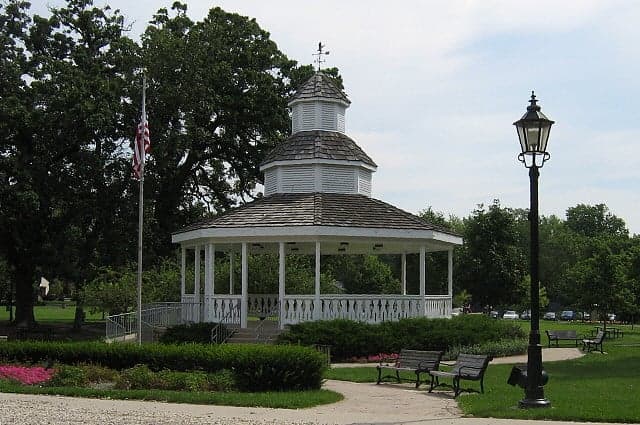
Photo: Wikipedia
Strategic Assessment of Bartlett, IL
Multiple tactical vulnerabilities. Population density, target proximity, or disaster risk are likely compounding. A retreat property and exit planning is required.
What does the Strategic Assessment tell us?
Our Strategic Assessment grades tactical survivability of an area. Major population centers, military targets, fallout zones, natural disasters, and border exposure all drive risk — lower exposure means a more defensible position in a crisis.
This is heavily inspired by Joel Skousen's Strategic Relocation book. Highly recommended you checkout the book ($)What does this tell us?
Our Strategic Assessment grades tactical survivability of an area. Major population centers, military targets, fallout zones, natural disasters, and border exposure all drive risk — lower exposure means a more defensible position in a crisis.
This is heavily inspired by Joel Skousen's Strategic Relocation book. Highly recommended you checkout the book ($)Strategic Pillars

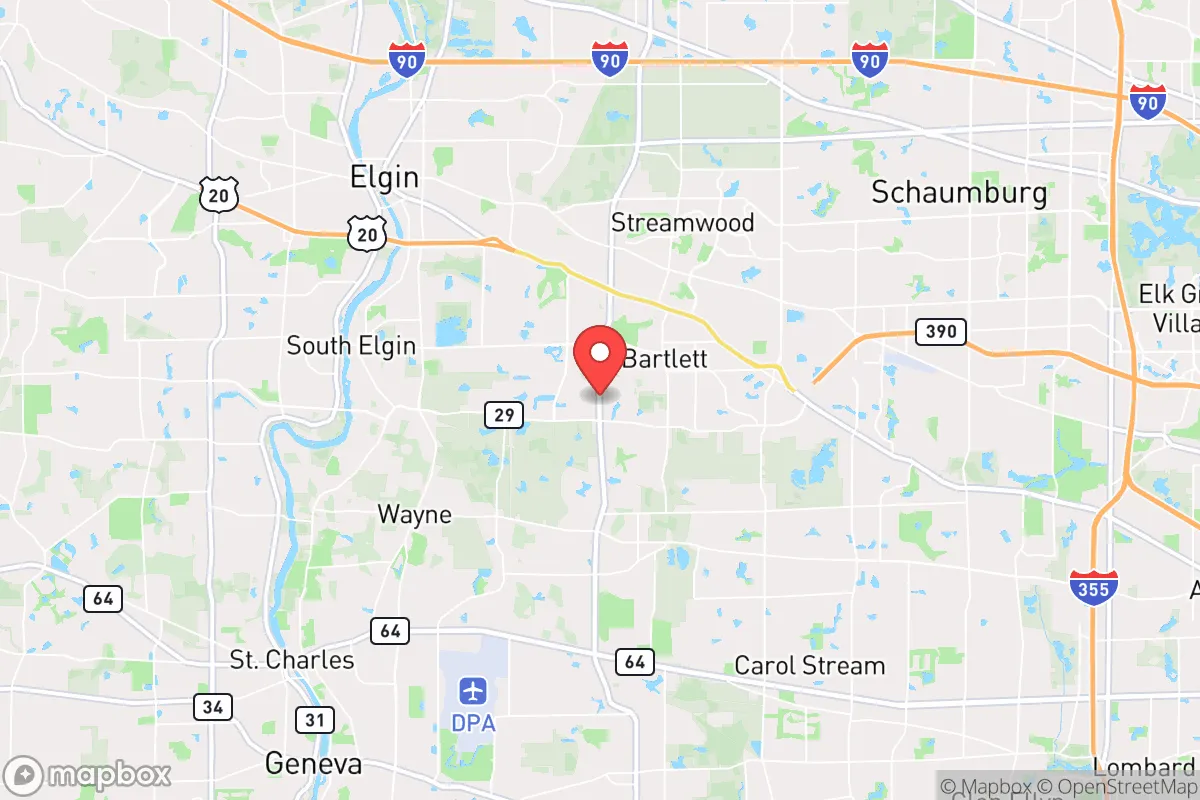
Key Distances
Regional Safe Places
Below is our recommended "safe zones" in Illinois and the surrounding area based on our strategic heuristics. For most people, it's unrealistic to live in a “safe zone” full-time due to work, family or other personal reasons. They tend to be more rural. However, many of these areas are perfect for second homes and retreat properties that double as a vacation home or even a short-term rental.
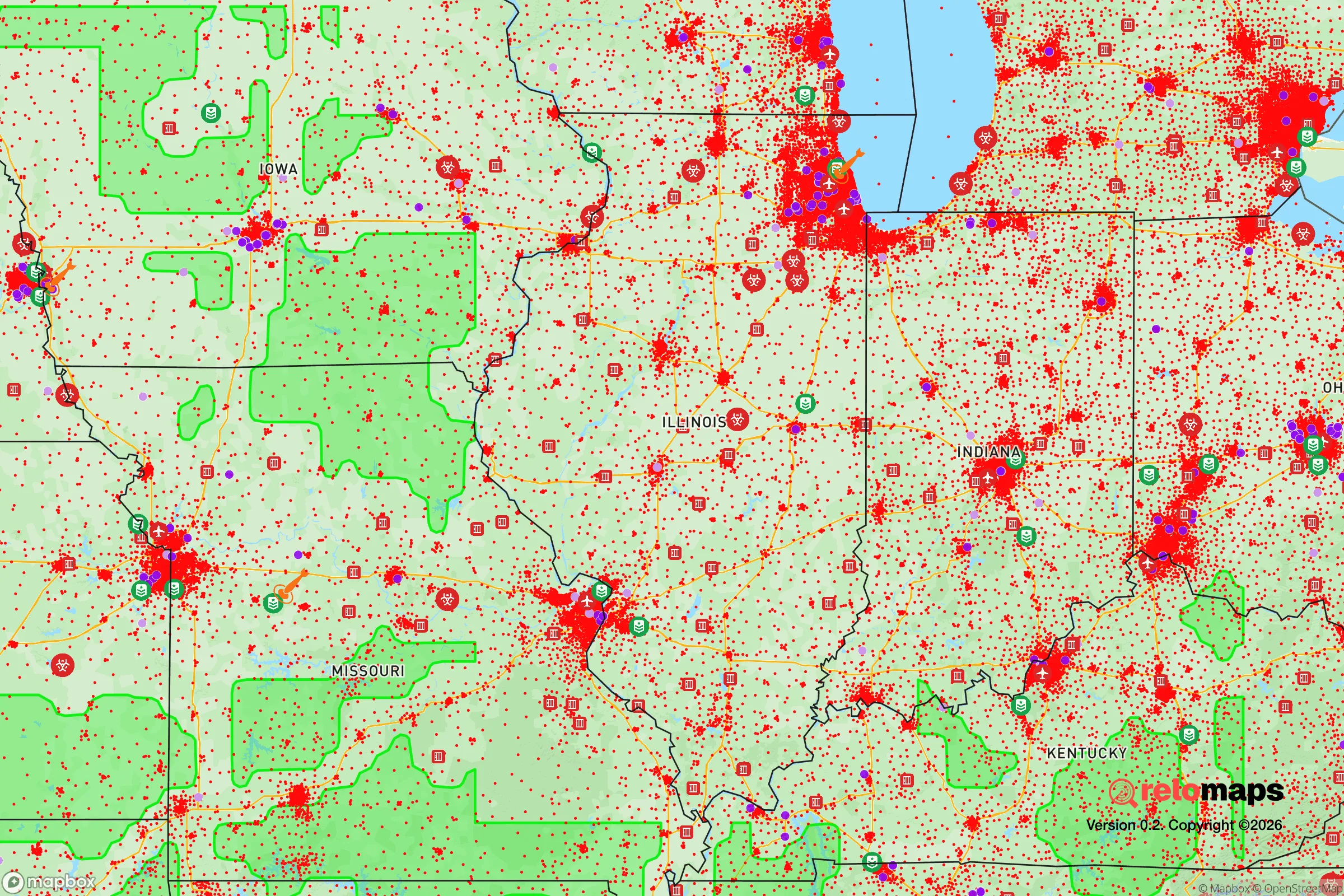
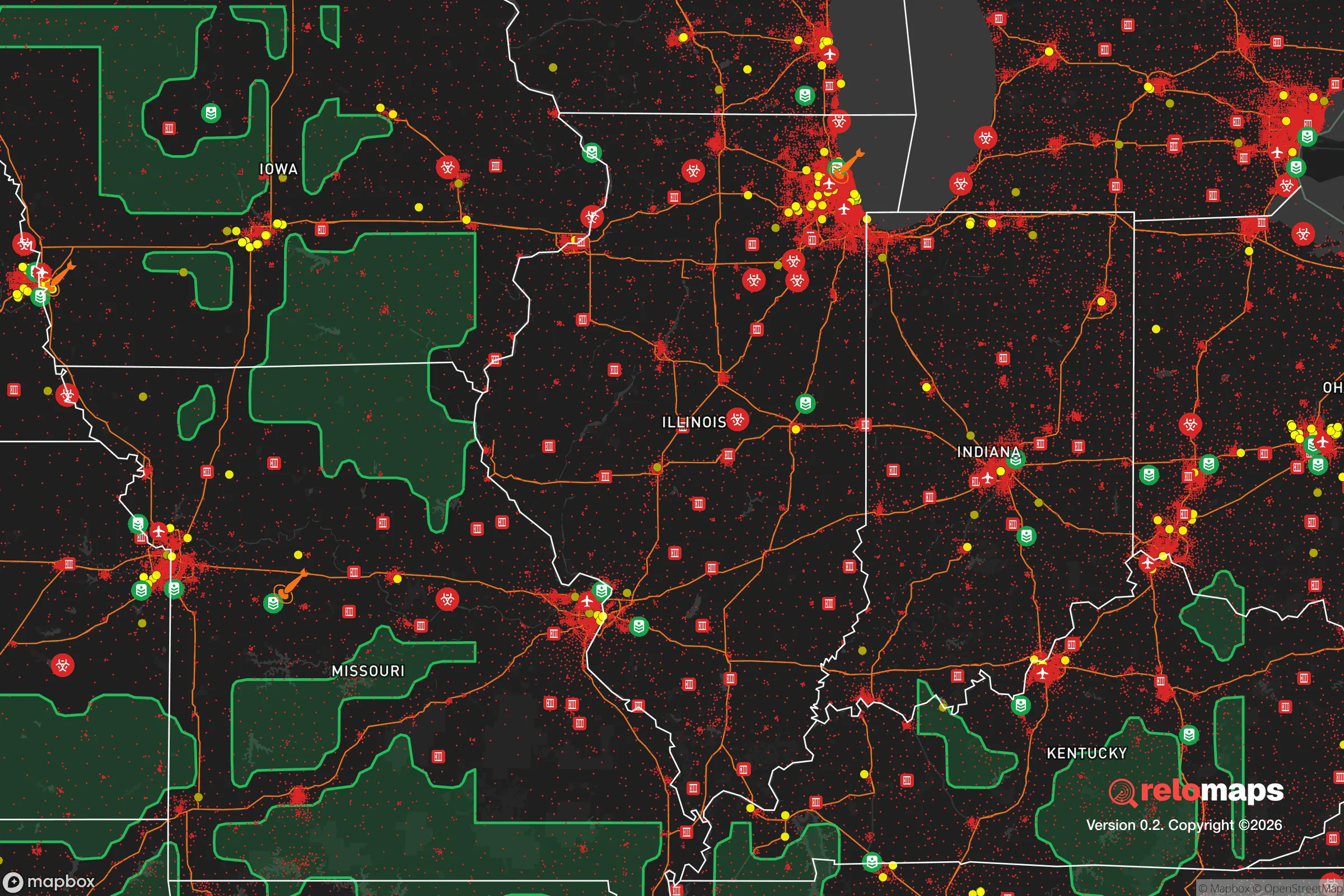


Important Note: For informational purposes only. This does not mean nothing bad ever happens in the green zones. Please use common sense. This is based on public data and modeled with AI. We tried to take a conservative approach but mistakes happen. We update this regularly as new information becomes available.
Solar Generator Recommendations
Backup power matters more here than in safer locations. We've picked three solar generators across budgets and capacity tiers — start with the budget unit if you only need a few essentials, or step up if you want to run a fridge and HVAC for days at a time.

Jackery Portable Power Station Explorer 300
Budget OptionPower on the Go: Weighing only 11 lbs, it's convenient to set up and store with book-sized foldable solar panels

BLUETTI Portable Power Station AC180
Designed for both indoor and outdoor scenarios, AC180 is highly capable as it has a robost capacity and continuous output power.

EF ECOFLOW DELTA Pro Ultra Power Station
Upgraded PickEcoFlow DELTA Pro Ultra is a whole-home energy system designed to grow with your family. Integrated with the Smart Home Panel 2, it scales to meet your evolving energy needs — keeping your home powered, intelligent, and secure through every stage of life.
We earn a commission, at no additional cost to you.
Strategic Assessment Analysis
Bartlett, Illinois, offers a surprisingly resilient position for those prioritizing strategic relocation, balancing proximity to Chicago’s resources with a buffer from its most acute risks. Located roughly 35 miles northwest of the Loop, this village of about 41,000 sits at the intersection of major transport corridors—Interstate 90 and Route 59—while maintaining a semi-rural feel with ample green space and low population density compared to inner suburbs. For a conservative-leaning prepper or survivalist, Bartlett’s key advantage is its ability to leverage urban infrastructure without being swallowed by it, though its location near a major metropolitan area introduces distinct vulnerabilities that demand careful consideration.
Geographic position and natural advantages for long-term security
Bartlett’s geography provides a mix of defensive and logistical benefits that are rare in the Chicago metro area. The village is situated on the edge of the Fox River Valley, with the Fox River itself running about 10 miles west, offering a natural water source and a potential barrier to east-west movement during unrest. The surrounding landscape is a patchwork of forest preserves—such as the 1,500-acre Pratt’s Wayne Woods and the 800-acre Brewster Creek Forest Preserve—which provide cover, wildlife for foraging, and routes for discreet travel. The area’s elevation is modest but slightly higher than the flood-prone Des Plaines River basin to the east, reducing risks from major flooding events. Bartlett’s position also places it within a 30-minute drive of O’Hare International Airport, a double-edged sword: it offers potential evacuation or supply routes by air, but also makes the area a target for any disruption targeting critical infrastructure. The village’s grid of suburban streets, interspersed with agricultural land and horse farms, creates a decentralized layout that could complicate large-scale crowd control or surveillance, a subtle advantage for those seeking to maintain low visibility during societal stress.
Risks, exposures, and proximity to fallout-relevant landmarks
The most significant strategic drawback of Bartlett is its proximity to Chicago and its associated fallout dangers. The village lies within 40 miles of the city’s core, placing it in the potential blast and thermal radius of a nuclear detonation targeting downtown, though likely outside the immediate fireball zone. More concerning is the fallout plume risk: prevailing westerly winds would carry radioactive debris from a Chicago strike directly over Bartlett, as the village is east-northeast of the city. The area is also near several high-value targets: O’Hare (a major logistics hub), the Fermi National Accelerator Laboratory in Batavia (15 miles southwest), and the Argonne National Laboratory (25 miles southeast). Any of these could be primary or secondary targets in a conflict, with Bartlett lying in the fallout corridor for both. Additionally, the village is crisscrossed by high-voltage power lines and natural gas pipelines feeding the metro area, making it a potential chokepoint for energy disruptions. During civil unrest, Bartlett’s position along Route 59 and I-90 could become a funnel for displaced populations fleeing Chicago, leading to resource strain and security challenges. The 2020 riots in nearby suburbs like Naperville and Aurora demonstrated that even affluent exurbs are not immune to spillover violence, and Bartlett’s relative affluence (median household income around $100,000) could make it a target for looting or organized crime during a breakdown of order.
Practical resilience for a relocator: food, water, energy, and defensibility
For a relocator focused on self-sufficiency, Bartlett presents a mixed picture that requires proactive investment. The village’s water supply comes from Lake Michigan via the Chicago water system, a centralized source vulnerable to contamination or disruption. However, many homes in the area have private wells—especially on the western fringes near Wayne and South Elgin—offering a decentralized alternative. The Fox River is a reliable surface water source, but it requires filtration and carries industrial runoff risks. Food security is more promising: the surrounding farmland produces corn, soybeans, and livestock, and there are several local farms (e.g., the 100-acre Kline Creek Farm in West Chicago) that could serve as barter or supply nodes. Bartlett itself has a robust network of grocery stores and big-box retailers, but these would be stripped within hours of a major event. A prepper should plan for at least 90 days of stored food and water, given the area’s dependence on just-in-time logistics. Energy resilience is a bright spot: many homes in Bartlett have natural gas hookups, which can power generators indefinitely if the grid fails, and solar installations are increasingly common, though the region’s cloudy winters limit output. Defensibility is moderate—the village’s suburban layout with cul-de-sacs and tree-lined streets provides natural chokepoints, but the lack of natural barriers (mountains, rivers) means a determined group could approach from multiple directions. The local police force is well-funded (Bartlett PD has about 60 sworn officers) but would be overwhelmed in a widespread crisis, so a relocator should prioritize a home with a basement (for fallout shelter) and a location on a dead-end street or near forest preserve access for escape routes. The presence of multiple gun ranges and sporting goods stores in the area (e.g., GAT Guns in East Dundee) indicates a local culture of firearm ownership, which can be a force multiplier for community defense if organized properly.
Overall, Bartlett offers a strategic sweet spot for the conservative prepper who wants to stay within striking distance of Chicago’s resources—medical centers, supply chains, and transport hubs—while maintaining a buffer from its worst-case scenarios. The village’s semi-rural character, access to natural water and farmland, and relatively low crime rate (violent crime is about 60% below the national average) make it a viable base for a long-term resilience plan. However, the risks from fallout, civil unrest spillover, and infrastructure dependency are real and require a disciplined approach to preparation. A relocator should invest in a well-equipped basement shelter, a reliable off-grid water source, and a network of like-minded neighbors in the surrounding forest preserve communities. Bartlett is not a bug-out location—it’s a hold-and-build location, where the goal is to ride out the initial shocks and then leverage the area’s agricultural and logistical advantages for long-term survival. For those willing to put in the work, it’s a solid choice in an increasingly uncertain landscape.

* Values derived from national, state, county, city and local statistics and may differ in a specific area. Last updated: 2026-04-30T00:16:39.000Z
Narrative content on this page is AI-generated and may contain mistakes. Verify any details that matter before acting on them.
ReloMaps may earn a commission from affiliate links at no extra cost to you.

