 Popular
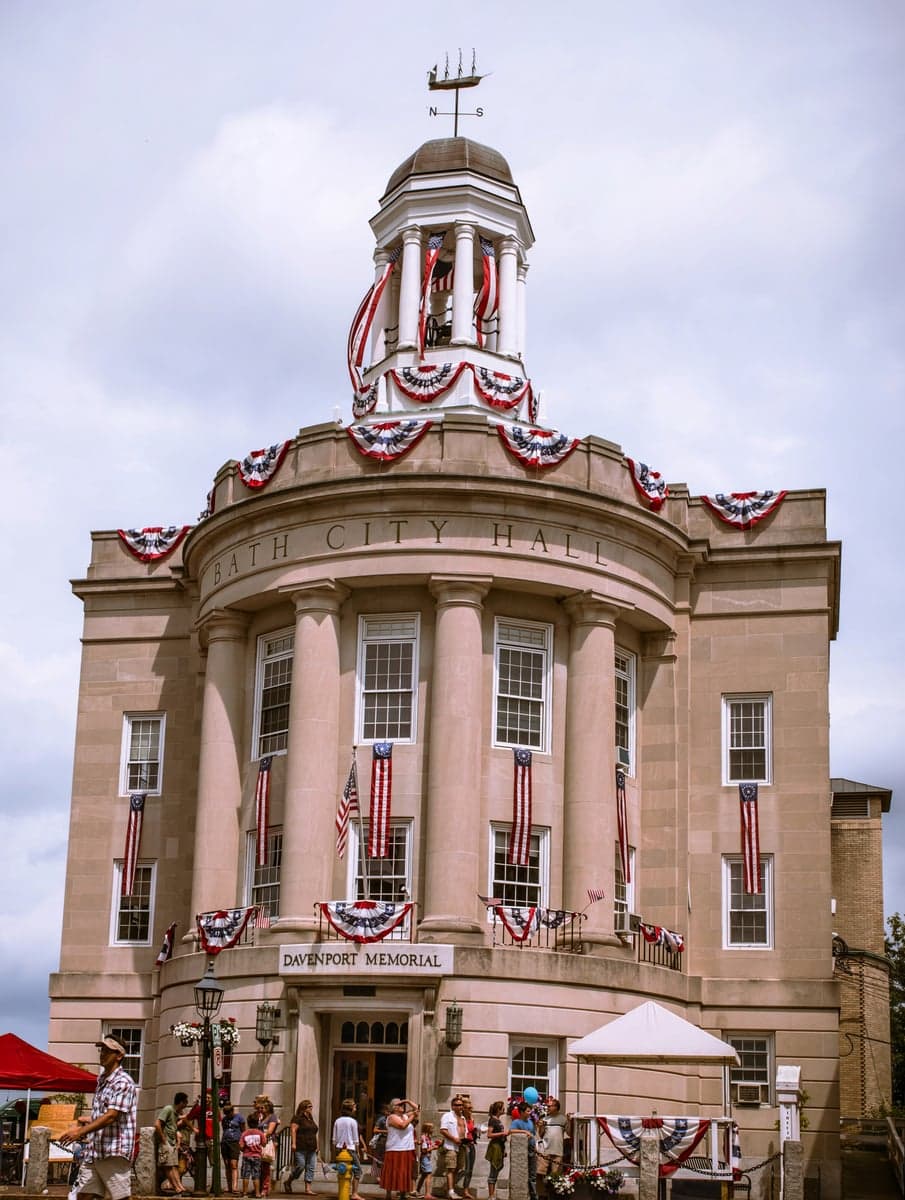
Photo: Wikipedia
Demographics of Bath, ME
Affluence Level in Bath, ME
A middle-class area roughly in line with national averages across income, home values, education, and employment.
People of Bath, ME
The people of Bath, Maine today form a predominantly white, well-educated, and stable community of 8,801 residents, with a foreign-born population of just 1.3% and a college attainment rate of 39.6%. The city is notably homogeneous: 94.7% white, with tiny Asian (0.6%) and Black (0.5%) populations, and no recorded Hispanic or Indian-subcontinent residents. Bath’s identity is shaped by its historic shipbuilding economy, a strong sense of local continuity, and a population that has remained remarkably demographically consistent over decades.
How the city was settled and grew
Bath was settled in the early 1600s by English colonists drawn to the Kennebec River’s deep-water harbor and abundant timber for shipbuilding. The original population clustered along the riverfront in what is now the Historic District, a neighborhood of Federal and Greek Revival homes built by ship captains and merchants. By the mid-1800s, Bath was one of the largest shipbuilding centers in the United States, attracting skilled craftsmen—mostly of English, Scottish, and Irish descent—who settled in the South End near the shipyards. A smaller wave of French-Canadian laborers arrived in the late 1800s to work in the mills and yards, forming a tight-knit community in the North End around Centre Street. The city’s population peaked at around 10,000 in the early 20th century, then stabilized as shipbuilding consolidated around the Bath Iron Works (BIW), the dominant employer since 1884.
Modern era (post-1965)
After the 1965 Hart-Cellar Act, Bath saw virtually no new immigration—its foreign-born share remains below 2%. Instead, the modern era has been defined by domestic in-migration of white-collar workers and military-affiliated families drawn to BIW’s defense contracts and the nearby Brunswick Naval Air Station (closed in 2011). These newcomers have concentrated in the Woolwich Road corridor and newer subdivisions like Highland Avenue, where single-family homes on larger lots replaced older infill patterns. The city’s racial composition has barely shifted: the white share dropped only from 97% in 1990 to 94.7% today, with the small Asian population (0.6%) largely tied to BIW’s engineering and technical hires. The Historic District has seen some gentrification by out-of-state retirees and remote workers, but Bath remains overwhelmingly a city of native-born Mainers, with strong multigenerational ties to the shipyard.
The future
Bath’s population is projected to remain stable or decline slightly, as the city lacks the housing stock or economic diversification to attract large new waves of residents. The foreign-born share is unlikely to grow significantly—Maine’s refugee resettlement programs have bypassed Bath in favor of Portland and Lewiston. The small Asian and Black populations are expected to plateau, concentrated among BIW’s professional staff rather than forming distinct ethnic enclaves. The city is not tribalizing into separate neighborhoods; instead, it is homogenizing further as younger locals leave for jobs elsewhere and are replaced by older, whiter retirees. The South End and North End remain working-class and largely white, while the Historic District is becoming more affluent but no more diverse.
For someone moving in now, Bath is a stable, safe, and culturally cohesive community—but one with little demographic dynamism. The city’s future is one of slow aging and gradual thinning, not growth or transformation. New residents will find a place where the population’s character has changed little in a century, and where the shipyard remains the anchor of both the economy and the social fabric.

* Values derived from national, state, county, city and local statistics and may differ in a specific area. Last updated: 2026-05-01T07:13:09.000Z
Narrative content on this page is AI-generated and may contain mistakes. Verify any details that matter before acting on them.
ReloMaps may earn a commission from affiliate links at no extra cost to you.

