Demographics of Baxter Village, SC
Historical data isn't available for Baxter Village, SC. Trends shown are for York County, SC.
Affluence Level in Baxter Village, SC
An upper-middle-class area. Household wealth, education levels, and homeownership run ahead of national benchmarks.
People of Baxter Village, SC
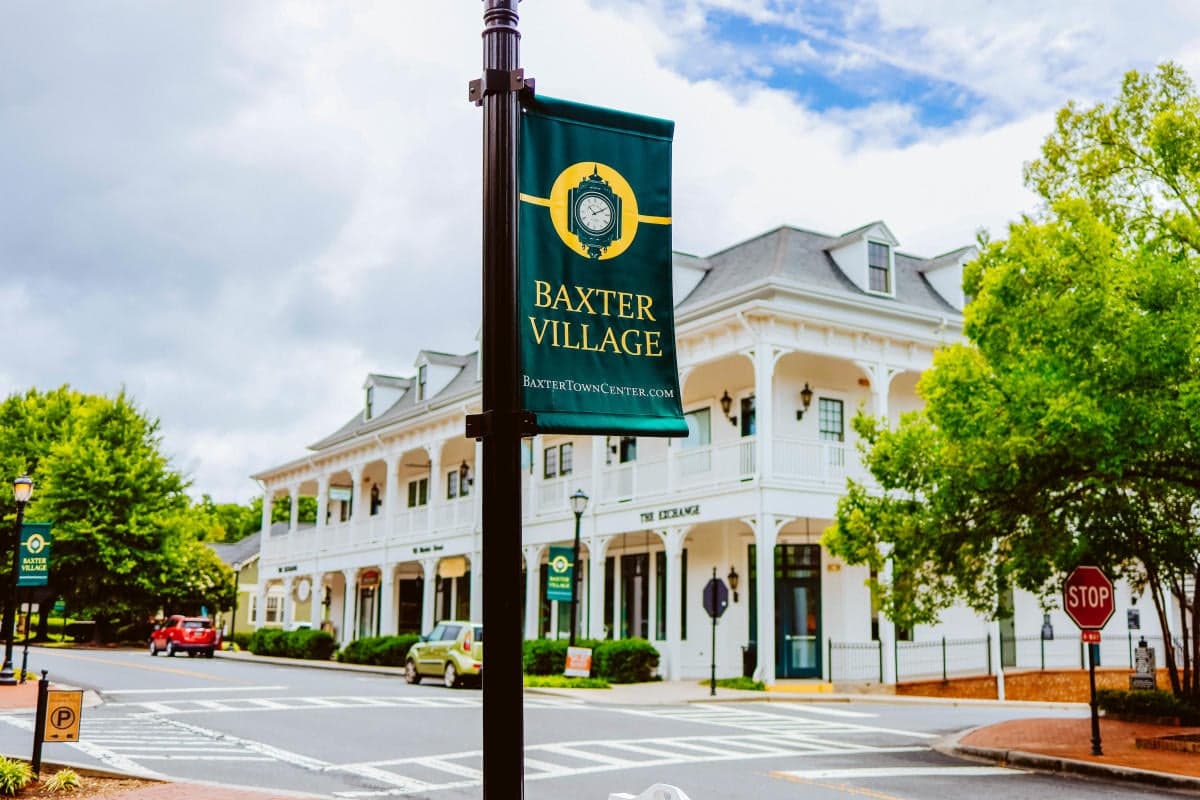
Baxter Village, South Carolina, is a master-planned community of 4,355 residents that is overwhelmingly white (93.8%) and highly educated (71.1% hold a bachelor’s degree or higher). With a foreign-born population of just 0.7% and a Black population of 0.0%, it is one of the most ethnically homogeneous and affluent enclaves in the Charlotte metro area. The community’s identity is defined by its intentional design as a walkable, traditional neighborhood development (TND) that attracts families and professionals seeking a curated small-town feel within commuting distance of Charlotte.
How the city was settled and grew
Unlike most Southern towns, Baxter Village has no pre-20th-century history. The land was part of the rural Fort Mill Township in York County, dominated by cotton fields and scattered farmsteads until the late 1990s. The community was conceived in 1999 by the D.R. Horton development company as a New Urbanist project, drawing inspiration from historic Southern mill villages but built from scratch for a modern, car-dependent region. The first wave of residents—mostly white professionals and executives relocating from Charlotte and the Northeast—arrived between 2000 and 2005. They settled in the Village Center district, the original phase featuring the town green, retail shops, and the Baxter YMCA. A second wave of families with school-age children followed between 2005 and 2015, filling the Baxter Commons and Baxter Gardens neighborhoods, which offered larger single-family homes and proximity to the award-winning Fort Mill School District. No historic immigrant or minority enclaves exist because the community was built as a greenfield development with no prior settlement.
Modern era (post-1965)
The post-1965 immigration reforms that reshaped many American suburbs had virtually no impact on Baxter Village. The community’s 0.7% foreign-born rate is a fraction of the national average (13.7%) and even below York County’s 5.2%. The small Indian-subcontinent population (1.1%) and East/Southeast Asian population (0.2%) are almost entirely professionals employed in Charlotte’s banking and tech sectors, living in the newer Baxter Ridge and Baxter Lake sections built after 2015. The Hispanic share (2.3%) is slightly higher than the Black share (0.0%), reflecting the broader trend of Hispanic workers in construction and landscaping services, though they do not form a distinct neighborhood. The community’s racial homogeneity is not a product of historical exclusion but of market positioning: Baxter Village’s home prices (median $650,000+ in 2025) and HOA covenants effectively filter for high-income buyers, who in the Charlotte region are disproportionately white and Asian. The Baxter Townhomes district, a denser, lower-price-point section built in 2018, has attracted slightly more diverse renters, but the overall demographic profile has remained static since the 2010 census.
The future
Baxter Village’s population trajectory points toward continued homogenization rather than diversification. The community is built out—no major new phases remain—so future growth will come from resales and generational turnover. The 71.1% college-educated rate suggests that new buyers will continue to be drawn from the same professional-class pool. The Indian-subcontinent and East/Southeast Asian populations may grow modestly as Charlotte’s tech sector expands, but they will likely assimilate into the existing white-majority neighborhoods rather than forming ethnic enclaves. The Hispanic population is expected to plateau or decline as construction labor shifts to cheaper outlying areas. The most significant demographic change may be an aging population: as original buyers retire, some will downsize to the Baxter Village Lofts above retail, while younger families replace them in the single-family districts. No tribalization into distinct enclaves is occurring—the community’s design and HOA rules actively discourage ethnic clustering.
For a conservative-leaning mover considering Baxter Village, the bottom line is clear: this is a stable, high-amenity, racially homogeneous community that is unlikely to change character in the next decade. It offers predictable schools, low crime, and a curated lifestyle, but virtually no ethnic or socioeconomic diversity. New residents should expect to join a community where 93.8% of neighbors share the same racial background and where the foreign-born presence is negligible. If demographic stability and educational outcomes are priorities, Baxter Village delivers; if exposure to a broader cross-section of America matters, it does not.

* Values derived from national, state, county, city and local statistics and may differ in a specific area. Last updated: 2026-04-23T03:17:42.000Z
Narrative content on this page is AI-generated and may contain mistakes. Verify any details that matter before acting on them.
ReloMaps may earn a commission from affiliate links at no extra cost to you.

