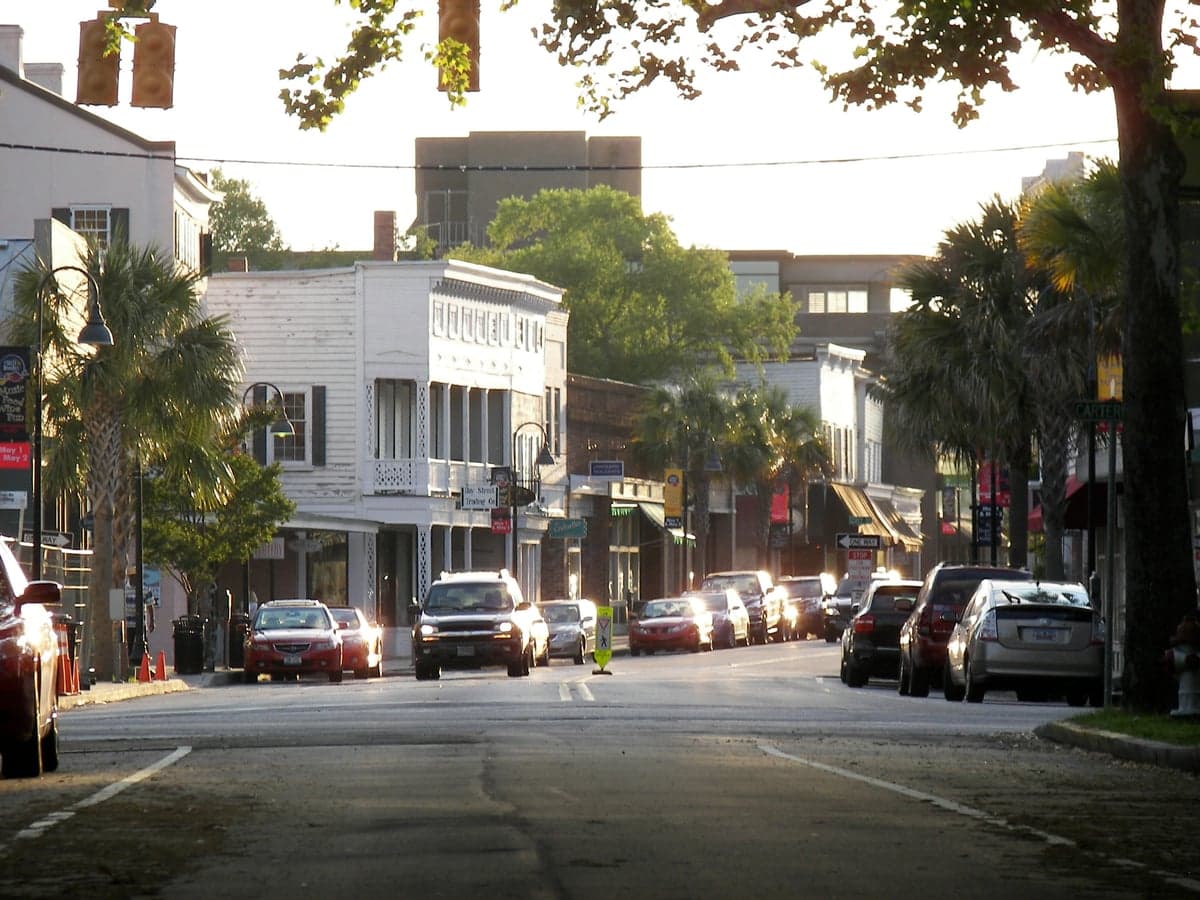
Photo: Wikipedia
Demographics of Beaufort, SC
Affluence Level in Beaufort, SC
A below-average socioeconomic profile. Incomes, home values, and educational attainment trail the U.S., with higher poverty and unemployment.
People of Beaufort, SC
The people of Beaufort, SC today number 13,660, forming a compact, historically layered community where 61.5% of residents identify as White, 27.5% as Black, 6.3% as Hispanic, and 0.8% as East or Southeast Asian. The city carries a distinctive Lowcountry character—a blend of antebellum architecture, a strong military presence from nearby Marine Corps Recruit Depot Parris Island, and a growing population of retirees and remote workers drawn to the waterfront. With 38.1% of adults holding a college degree, Beaufort is more educated than the surrounding rural counties, yet its foreign-born share of just 1.7% marks it as one of the least immigrant-diverse cities in coastal South Carolina.
How the city was settled and grew
Beaufort was founded in 1711 as a port town on Port Royal Island, part of the Carolina colony's plantation economy. The original European settlers were English and Scottish planters who received land grants along the Beaufort River, establishing rice and indigo plantations worked by enslaved Africans. By the early 19th century, the enslaved Black population outnumbered whites roughly 3-to-1, and their descendants formed the core of what is now the city's historic Old Point neighborhood, where many free and enslaved Black families lived in the shadow of the grand antebellum homes. After the Civil War, the Port Royal Experiment brought Northern missionaries and freedmen to the area, and the Northwest Quadrant (also called "The Bottom") became a predominantly Black residential district where Gullah Geechee culture—descended from West African rice-growing peoples—remained strong through the Jim Crow era. The arrival of the U.S. Marine Corps at Parris Island in 1915 and the Naval Hospital in the 1940s drew a new wave of white military families, many of whom settled in the Pigeon Point neighborhood, a mid-century suburban development of ranch homes and oak-lined streets.
Modern era (post-1965)
The 1965 Hart-Cellar Act had minimal direct effect on Beaufort—its foreign-born population remains tiny—but the post-1965 era reshaped the city through domestic migration. The desegregation of schools and public spaces in the 1970s opened the Old Point and downtown areas to white residents who had previously lived in segregated suburbs, while Black families began moving into formerly white neighborhoods like Spanish Moss Trail and Burton. The 1980s and 1990s saw an influx of retirees from the Northeast and Midwest, drawn by Beaufort's historic charm and temperate winters; many bought second homes in the Beaufort Historic District or gated communities along the river. The Hispanic population, now 6.3%, grew primarily through labor migration to the region's construction and landscaping industries, with families settling in the Boundary Street corridor and the unincorporated area of Shell Point. The East/Southeast Asian share (0.8%) remains small and is largely composed of military-affiliated families stationed at Parris Island or the Marine Corps Air Station, living in base housing or the Lady's Island suburbs. The Indian-subcontinent population is effectively zero, reflecting Beaufort's lack of tech or medical sectors that typically attract that group.
The future
Beaufort's population is trending older and whiter, with the 65+ cohort growing faster than the national average as retirees continue to buy in. The Black share (27.5%) is stable but aging, while younger Black residents often move to larger cities like Charleston or Atlanta for employment. The Hispanic share is likely to grow modestly as service-sector jobs expand, but Beaufort lacks the industrial or agricultural base that drives rapid Hispanic growth elsewhere in the South. The East/Southeast Asian population will remain tied to military rotations, fluctuating with base assignments. The city is not homogenizing into a single culture; rather, it is tribalizing into distinct enclaves: the Historic District and Old Point for affluent whites and retirees, the Northwest Quadrant and Burton for Black families with deep local roots, and the Boundary Street area for Hispanic and working-class residents. The next 10-20 years will likely see continued infill development on Lady's Island and along the Spanish Moss Trail, but Beaufort's historic preservation laws and limited land area will keep growth slow and the population relatively small.
For someone moving in now, Beaufort offers a stable, low-diversity community where the dominant culture is white, Southern, and military-adjacent, with a significant and historically rooted Black minority. The city is becoming more of a retirement and second-home destination, meaning younger families and singles may find a limited peer group unless they are connected to the base. The lack of immigrant diversity and the plateauing of the Black population suggest Beaufort will remain a bicultural city—white and Black—rather than evolving into a multi-ethnic hub, making it a predictable choice for those seeking a traditional Lowcountry environment with minimal demographic flux.

* Values derived from national, state, county, city and local statistics and may differ in a specific area. Last updated: 2026-04-29T20:30:20.000Z
Narrative content on this page is AI-generated and may contain mistakes. Verify any details that matter before acting on them.
ReloMaps may earn a commission from affiliate links at no extra cost to you.

