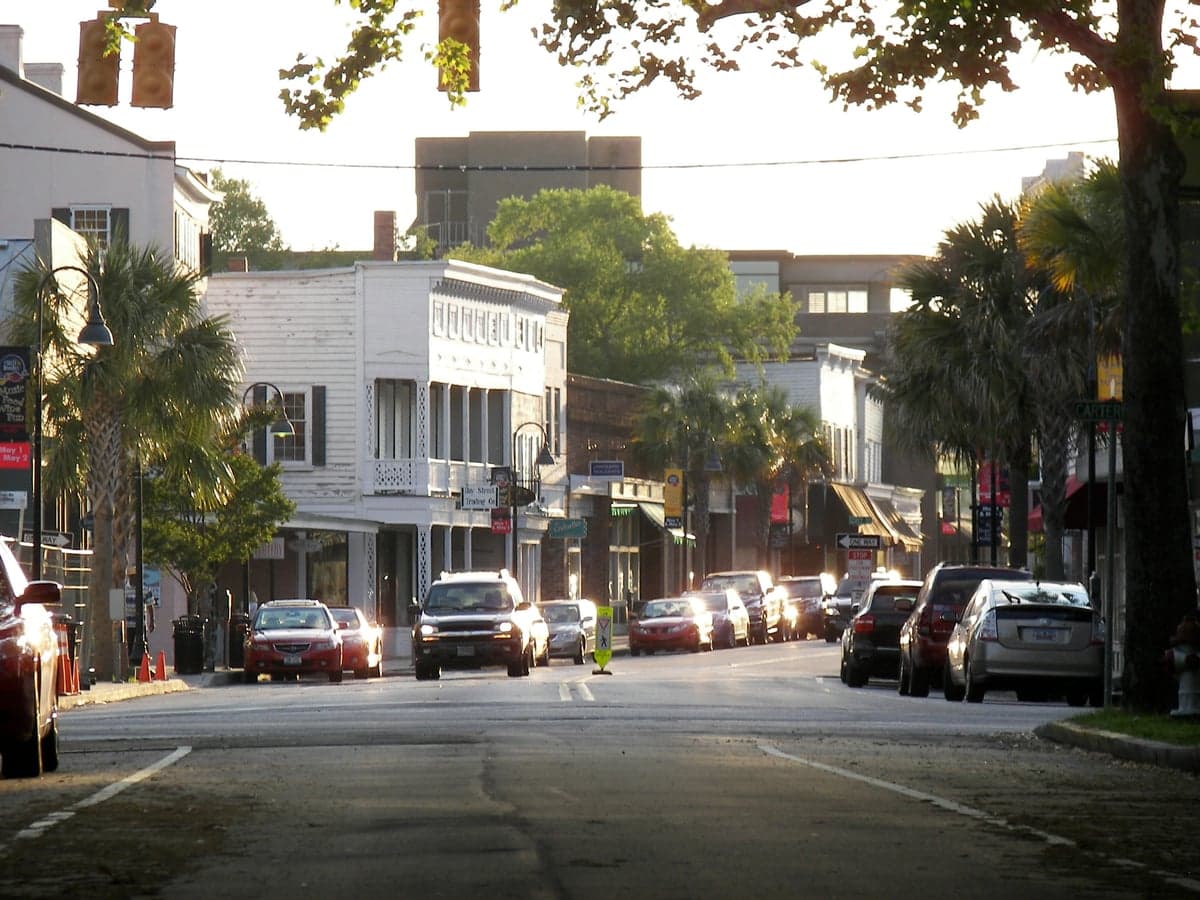
Photo: Wikipedia
Strategic Assessment of Beaufort, SC
Meaningful friction. Expect exposure to either population pressure, blast zones, or natural disaster risk. Consider buying a retreat property.
What does the Strategic Assessment tell us?
Our Strategic Assessment grades tactical survivability of an area. Major population centers, military targets, fallout zones, natural disasters, and border exposure all drive risk — lower exposure means a more defensible position in a crisis.
This is heavily inspired by Joel Skousen's Strategic Relocation book. Highly recommended you checkout the book ($)What does this tell us?
Our Strategic Assessment grades tactical survivability of an area. Major population centers, military targets, fallout zones, natural disasters, and border exposure all drive risk — lower exposure means a more defensible position in a crisis.
This is heavily inspired by Joel Skousen's Strategic Relocation book. Highly recommended you checkout the book ($)Strategic Pillars

Key Distances
Regional Safe Places
Below is our recommended "safe zones" in South Carolina and the surrounding area based on our strategic heuristics. For most people, it's unrealistic to live in a “safe zone” full-time due to work, family or other personal reasons. They tend to be more rural. However, many of these areas are perfect for second homes and retreat properties that double as a vacation home or even a short-term rental.
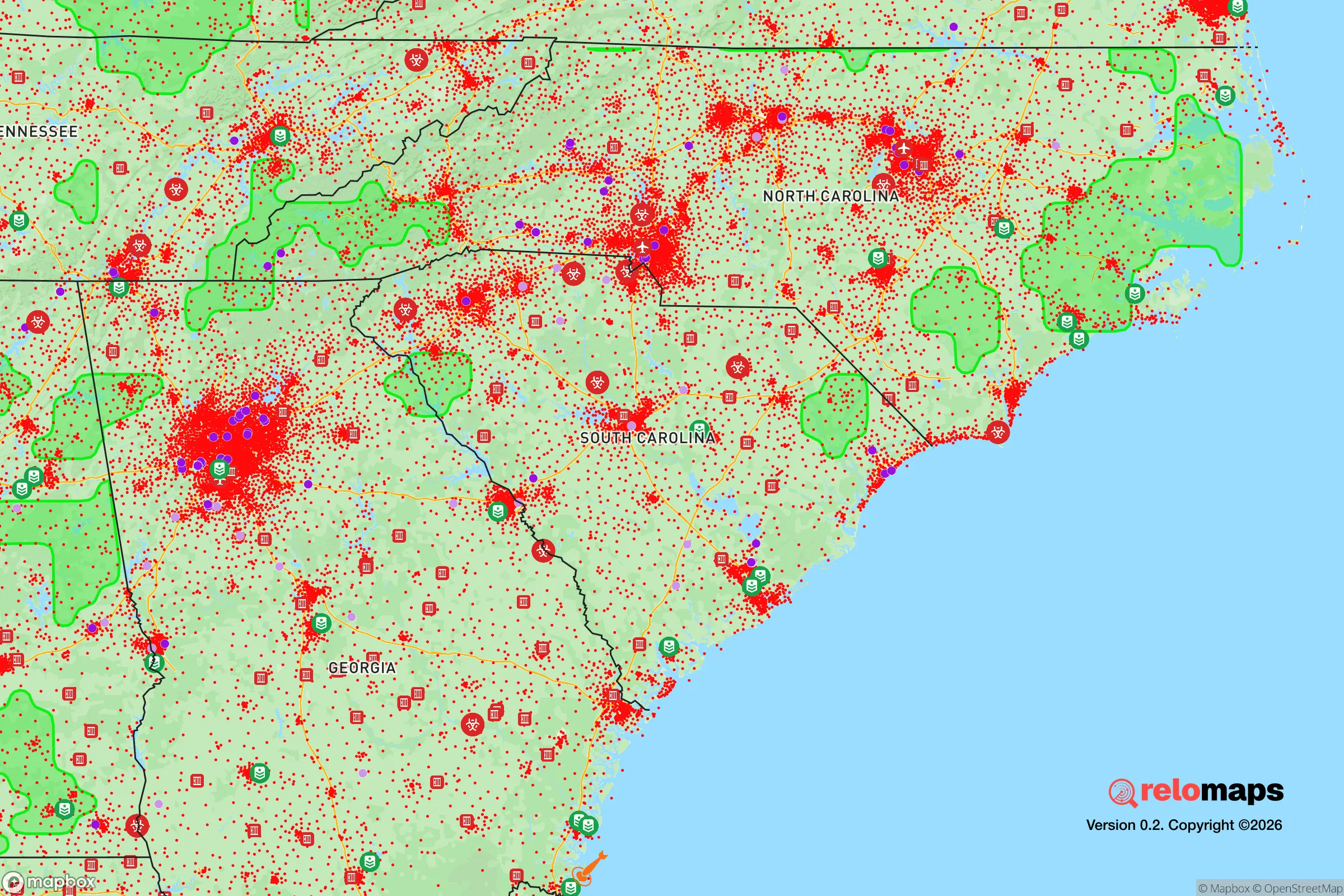
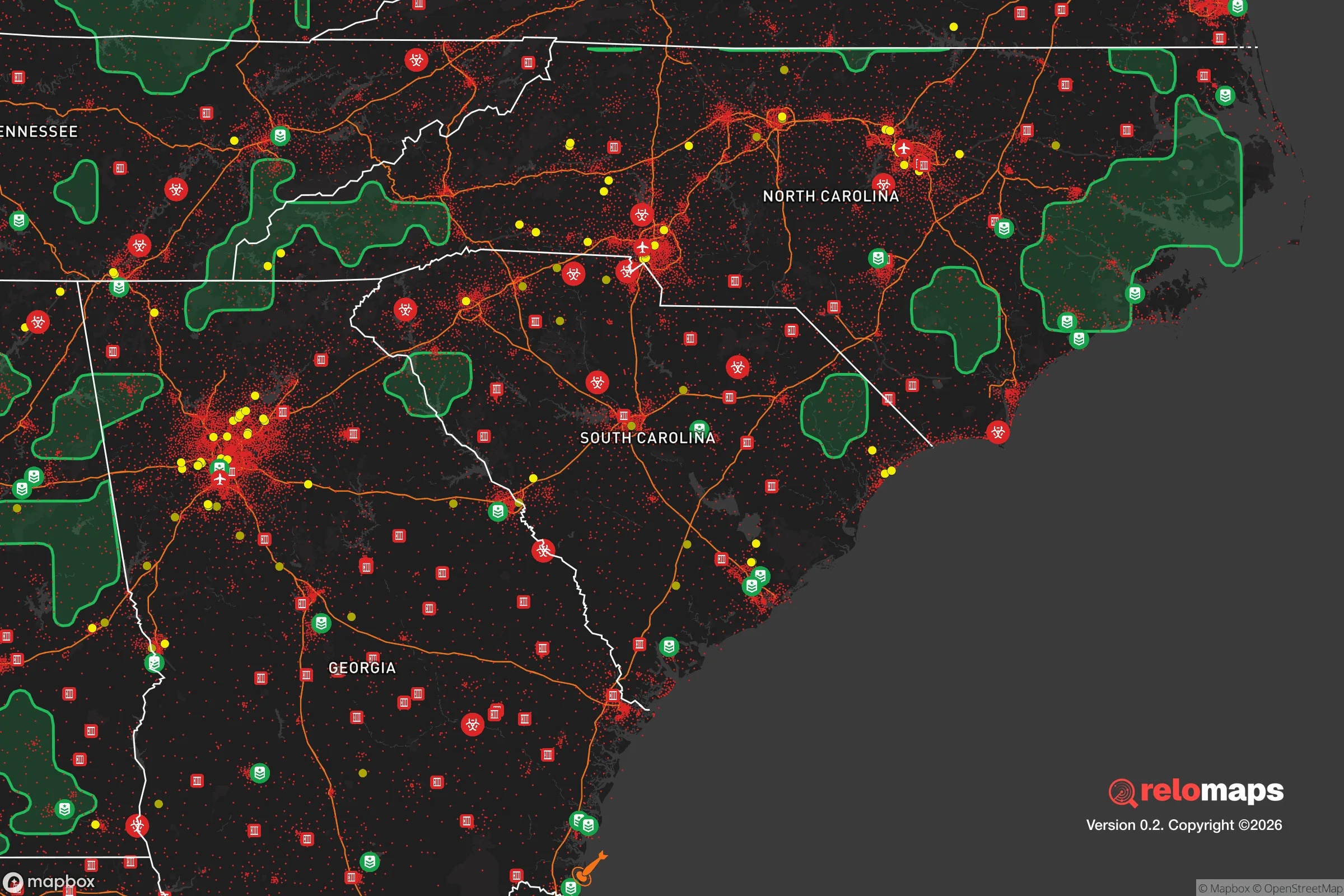


Important Note: For informational purposes only. This does not mean nothing bad ever happens in the green zones. Please use common sense. This is based on public data and modeled with AI. We tried to take a conservative approach but mistakes happen. We update this regularly as new information becomes available.
Solar Generator Recommendations
Backup power matters more here than in safer locations. We've picked three solar generators across budgets and capacity tiers — start with the budget unit if you only need a few essentials, or step up if you want to run a fridge and HVAC for days at a time.

Jackery Portable Power Station Explorer 300
Budget OptionPower on the Go: Weighing only 11 lbs, it's convenient to set up and store with book-sized foldable solar panels

BLUETTI Portable Power Station AC180
Designed for both indoor and outdoor scenarios, AC180 is highly capable as it has a robost capacity and continuous output power.

EF ECOFLOW DELTA Pro Ultra Power Station
Upgraded PickEcoFlow DELTA Pro Ultra is a whole-home energy system designed to grow with your family. Integrated with the Smart Home Panel 2, it scales to meet your evolving energy needs — keeping your home powered, intelligent, and secure through every stage of life.
We earn a commission, at no additional cost to you.
Strategic Assessment Analysis
Beaufort, South Carolina, offers a compelling strategic position for those prioritizing resilience and self-sufficiency, but it is not a fortress. Its location on the Atlantic coast provides significant natural advantages—abundant water, a long growing season, and relative isolation from major interstate corridors—while also introducing distinct vulnerabilities. For a relocator with a prepper mindset, the key is understanding that Beaufort’s value lies in its balance of access and buffer: close enough to supply chains and medical hubs, yet far enough from the immediate blast zones of major population centers to offer a realistic survival window. This analysis treats Beaufort as a potential base of operations, not a guaranteed safe haven, and weighs its assets against its exposures.
Geographic position and natural advantages for long-term survival
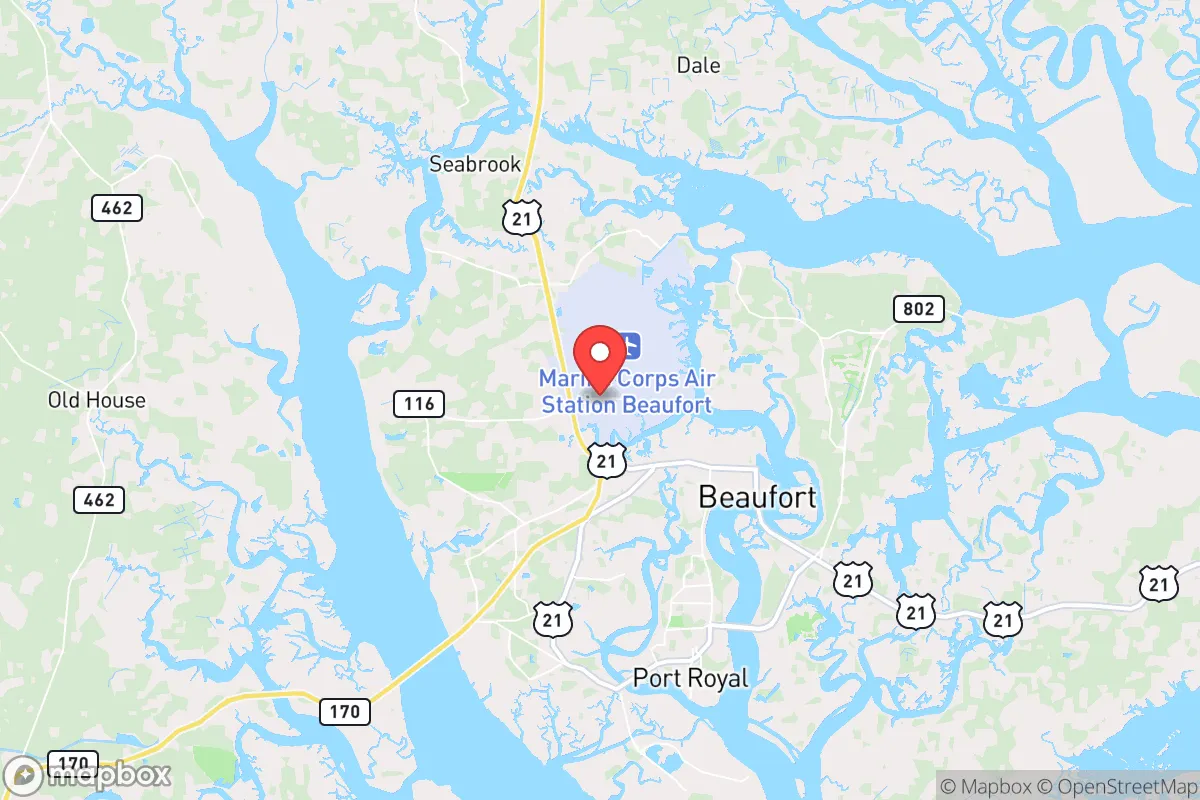
Beaufort sits on Port Royal Island, part of the Sea Islands chain, roughly 70 miles southwest of Charleston and 35 miles northeast of Savannah. This coastal position gives you direct access to the Atlantic Ocean and the Intracoastal Waterway, which are critical for both transportation and food sourcing in a grid-down scenario. The area’s tidal creeks, marshes, and rivers—including the Beaufort River and the Broad River—provide ample opportunities for fishing, crabbing, and shrimping, with species like red drum, flounder, and blue crab available year-round. The subtropical climate means a growing season of roughly 280 days, allowing for three-season vegetable production and the possibility of winter cover crops. Rainfall averages about 48 inches per year, so surface water is plentiful, though you’ll need to treat it for pathogens. The terrain is low-lying, with elevations rarely exceeding 20 feet, which limits defensible high ground but also means the water table is shallow—good for well drilling if you can secure a property with enough acreage. The surrounding Lowcountry is sparsely populated compared to the Upstate or the coastal corridor from Charleston to Jacksonville, giving you a buffer of rural and forested land that complicates any large-scale movement of people or vehicles. For a prepper, this translates to a slower timeline for societal collapse to reach you, provided you’re not on a main evacuation route.
Risks, exposures, and proximity to fallout-relevant landmarks
The most significant strategic drawback of Beaufort is its proximity to two major military installations: Marine Corps Recruit Depot Parris Island (directly adjacent to the city) and Marine Corps Air Station Beaufort (about 5 miles north). In a national emergency or conflict scenario, these bases become high-value targets for kinetic or cyber attack. Parris Island alone processes roughly 20,000 recruits annually, and the air station hosts F-35B Lightning II squadrons. Any strike on these facilities—conventional, nuclear, or electromagnetic—would produce immediate fallout, both literal and figurative. The prevailing winds in the region are from the southwest, meaning fallout from a strike on Parris Island would drift over Beaufort proper. Additionally, the city lies within 100 miles of the Savannah River Site, a nuclear weapons facility and waste storage complex near Aiken, SC. A catastrophic event there—whether accident or sabotage—could render large portions of the Lowcountry uninhabitable for decades. On the civilian side, Beaufort is less than 40 miles from the Port of Savannah, one of the busiest container ports on the East Coast. In a scenario involving supply chain disruption, civil unrest, or mass evacuation, that port becomes a chokepoint and a magnet for desperate populations. The city itself sits on U.S. Highway 21, a two-lane road that is the only direct route onto and off the island for most residents. In a mass evacuation, that road would gridlock within hours, turning Beaufort into a trap. Flooding from hurricanes—particularly storm surge—is a recurring natural risk, with the National Hurricane Center’s SLOSH model showing much of the city’s downtown and waterfront areas inundated by a Category 2 storm. For a prepper, these factors mean you cannot rely on Beaufort as a standalone retreat; it must be part of a layered plan with a secondary location inland.
Practical resilience for a relocator: food, water, energy, and defensibility
For daily life and long-term sustainability, Beaufort offers a mixed bag. Water is abundant but not clean—the city’s municipal supply comes from the Savannah River and is treated, but in a grid-down scenario, you’ll need to rely on rainwater catchment, surface water from the rivers, or a private well. The shallow aquifer (the Floridan aquifer system) is accessible at depths of 100-300 feet, but saltwater intrusion is a growing concern due to coastal pumping. For food, the local agricultural scene is dominated by row crops (corn, soybeans, cotton) and timber, not small-scale vegetable farming. You’ll need to establish your own garden or network with the few small farms in the area, like those in nearby Ridgeland or Yemassee. Hunting is possible on public lands like the Savannah National Wildlife Refuge (about 20 miles south), but competition will spike after a collapse. The climate supports year-round foraging for wild greens, mushrooms, and berries, but you’ll need to learn the local species. Energy resilience is a bright spot: the region has strong solar potential, with an average of 218 sunny days per year, and net metering policies from Dominion Energy and Palmetto Electric Cooperative allow for grid-tied solar with battery backup. Propane is widely available for backup generators, and the area’s many marinas and boatyards mean you can source marine-grade batteries and inverters. Defensibility is the weak link. Beaufort is flat, heavily wooded, and intersected by waterways, making it hard to secure a perimeter. The island geography means there are only a few road chokepoints—the bridges on U.S. 21 and S.C. 170—but those are also your escape routes. A better approach is to buy property on the mainland side of the Broad River, in areas like Sheldon or Dale, where you have more acreage, better well water, and multiple egress options. For a single individual or family, the ideal setup is a 5-10 acre parcel with a well, septic, solar panels, and a defensible structure set back from the road, within 30 minutes of Beaufort for supply runs but not dependent on the island for survival.
The overall strategic picture for Beaufort is one of calculated risk. It offers genuine advantages in water, climate, and isolation from the worst of the East Coast megalopolis, but those are offset by its proximity to military targets, a major port, and a nuclear facility. For a conservative-leaning relocator who values self-reliance and community cohesion, Beaufort’s small-town character—with a population around 13,000 and a strong military retiree presence—means you’ll find like-minded neighbors who understand preparedness. The local gun culture is robust, with several ranges and gun shops, and the county sheriff’s office is generally supportive of Second Amendment rights. However, the area is not a bug-out location; it’s a live-in location that requires active planning for evacuation to a more secure inland property if the situation deteriorates. If you’re willing to invest in off-grid infrastructure and maintain a low profile, Beaufort can serve as a viable base for weathering moderate disruptions. For a full societal collapse or nuclear event, you’ll want to be further inland, toward the Upstate or the mountains. Treat Beaufort as a first-line position—good for now, but not forever.

* Values derived from national, state, county, city and local statistics and may differ in a specific area. Last updated: 2026-04-29T20:30:20.000Z
Narrative content on this page is AI-generated and may contain mistakes. Verify any details that matter before acting on them.
ReloMaps may earn a commission from affiliate links at no extra cost to you.

