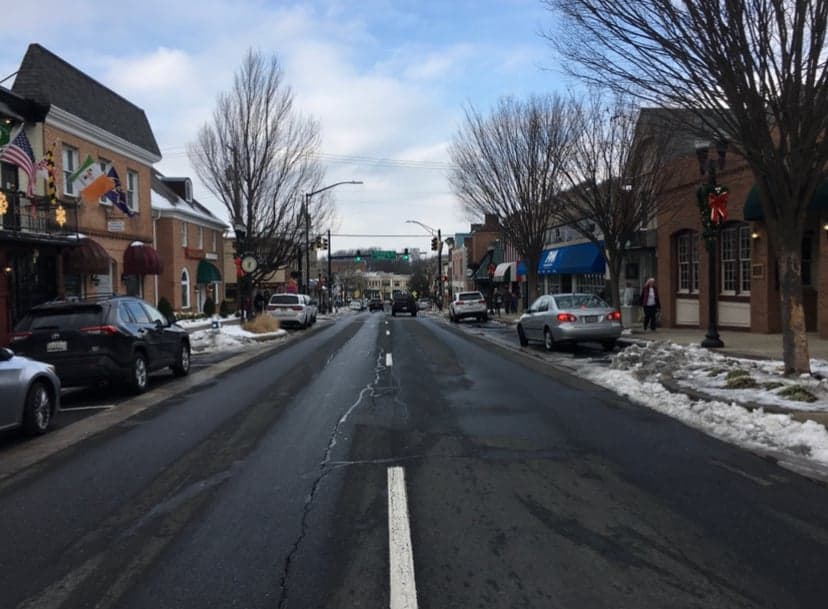
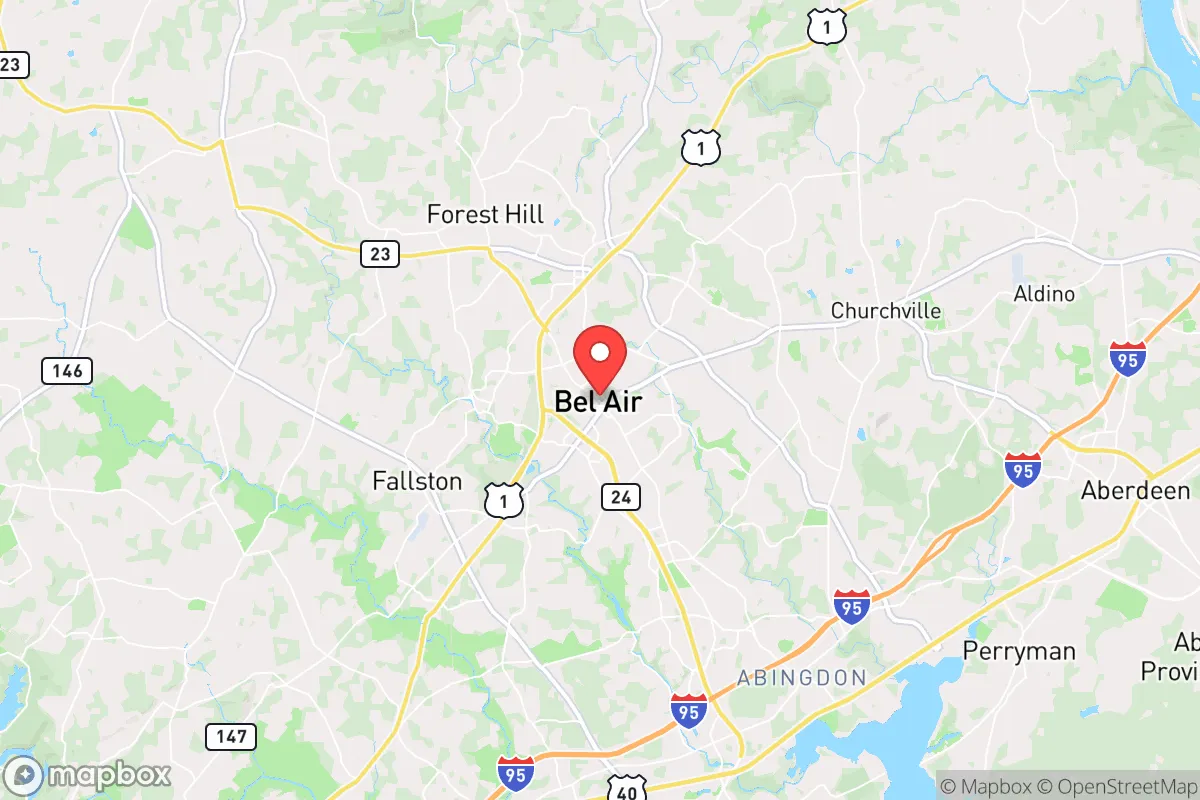
Photo: Wikipedia
Demographics of Bel Air, MD
Affluence Level in Bel Air, MD
A middle-class area roughly in line with national averages across income, home values, education, and employment.
People of Bel Air, MD
The people of Bel Air, Maryland, today form a small, predominantly white, and notably homogenous community of roughly 1,900 residents. With 88.1% of the population identifying as white and a foreign-born share of just 2.0%, the city retains a character shaped by deep local roots and limited recent immigration. Distinct from the more diverse surrounding Harford County, Bel Air's population is marked by a high proportion of college-educated residents (25.1%) and a near-total absence of Black or Hispanic residents, creating a demographic profile that is both stable and unusually uniform for a Maryland municipality.
How the city was settled and grew
Bel Air's human history begins in the late 18th century as a small crossroads settlement serving the agricultural estates of the Susquehanna River valley. The town was formally established in 1782 as the county seat of Harford County, a role that drew a population of lawyers, merchants, and government clerks rather than industrial workers. The original core, now known as Historic Downtown Bel Air, was built by families of English and German descent who operated the courthouse, taverns, and general stores. Through the 19th century, the population remained overwhelmingly native-born white, with the 1850 census recording fewer than 20 foreign-born residents in the entire county. The arrival of the Philadelphia, Wilmington and Baltimore Railroad in the 1830s spurred modest growth, but Bel Air remained a sleepy county seat until the mid-20th century. The Williamsburg neighborhood, developed in the 1920s and 1930s, housed the families of local professionals and merchants, while the Greenbrier area remained farmland until after World War II. No significant wave of European immigration ever reached Bel Air; the town's population grew almost entirely through natural increase and domestic migration from surrounding rural areas.
Modern era (post-1965)
The post-1965 period brought suburbanization rather than immigration to Bel Air. The 1960s and 1970s saw the development of planned subdivisions such as Forest Hill and Churchville, which attracted white families moving from Baltimore City and northeastern Maryland. These neighborhoods were built on former farmland and offered larger lots and newer schools, drawing a population that was almost entirely white and middle-class. The 1980 census recorded Bel Air's population as 97.6% white, a figure that has only slightly shifted to 88.1% by the most recent data. The small East/Southeast Asian community (3.7%) is concentrated in newer developments like Brierwood and Hickory Hills, where professional families—many employed at Aberdeen Proving Ground or local hospitals—settled in the 1990s and 2000s. The Indian-subcontinent population is recorded at 0.0%, and the Black and Hispanic shares are also 0.0%, making Bel Air one of the most racially homogeneous municipalities in the Baltimore metropolitan area. The foreign-born share of 2.0% is far below the Maryland state average of 15.5%, reflecting the city's limited role as a destination for international migration.
The future
Bel Air's population is projected to remain stable and demographically narrow over the next 10–20 years. The city is effectively built out, with little undeveloped land for new housing, and its zoning policies favor single-family homes that appeal to families rather than rental apartments that might attract a more diverse population. The East/Southeast Asian community, while small, is likely to grow modestly as professional families continue to be drawn to the area's schools and proximity to federal employers. However, the near-total absence of Black, Hispanic, and Indian-subcontinent residents suggests that Bel Air is not experiencing the diversification seen in nearby towns like Aberdeen or Edgewood. The population is aging slowly, with a median age of 42.5, and younger residents often leave for college and careers in Baltimore or Washington, D.C., returning later to raise families. The city is homogenizing rather than tribalizing into distinct enclaves; the few non-white residents are dispersed across neighborhoods like Brierwood and Hickory Hills rather than forming concentrated ethnic communities.
For someone moving to Bel Air today, the city offers a stable, low-diversity environment where the population is overwhelmingly white, native-born, and college-educated. The community is becoming slightly more Asian but remains largely unchanged in its racial and ethnic composition. This is a place where demographic continuity, not change, defines the experience—a deliberate choice for those seeking a homogenous, family-oriented suburb with strong local institutions and limited exposure to the broader trends reshaping much of Maryland.

* Values derived from national, state, county, city and local statistics and may differ in a specific area. Last updated: 2026-04-22T00:59:38.000Z
Narrative content on this page is AI-generated and may contain mistakes. Verify any details that matter before acting on them.
ReloMaps may earn a commission from affiliate links at no extra cost to you.

