
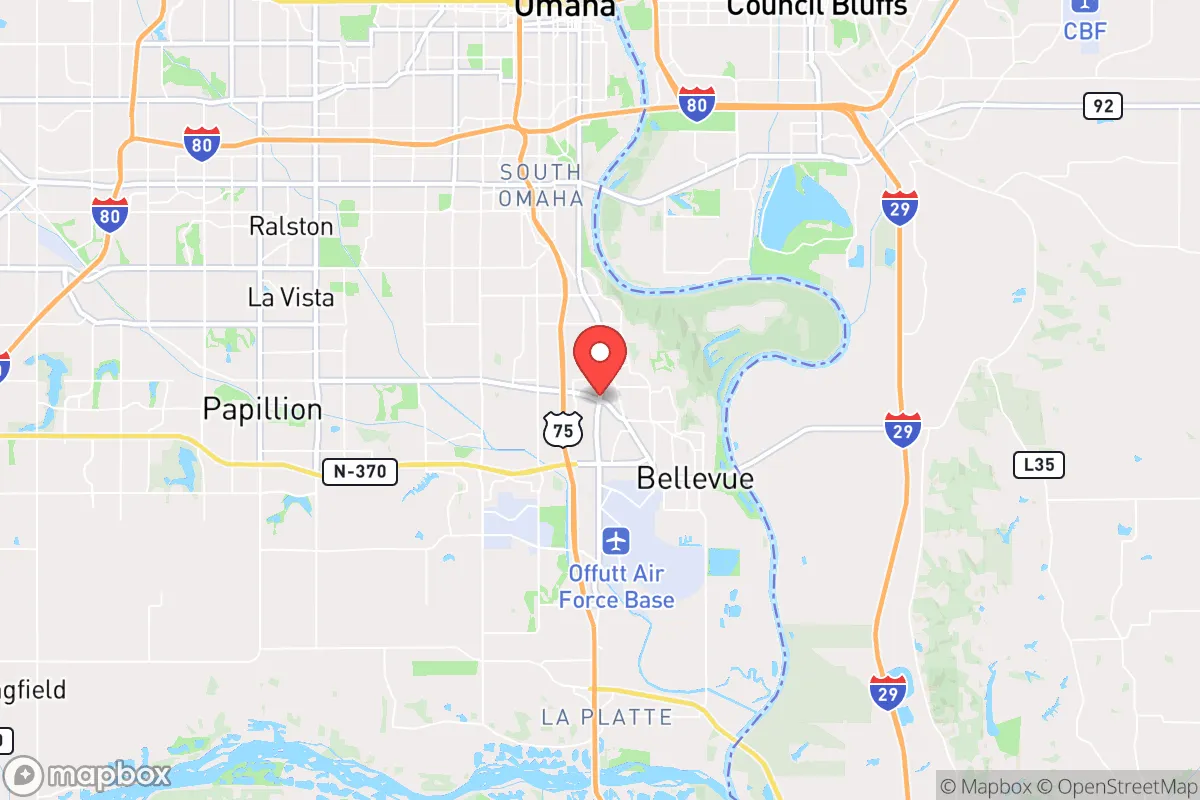
Photo: Wikipedia
Personal Sovereignty in Bellevue, NE
Viable for self-reliance. Generally workable, though some barriers may limit total independence.
What does Personal Sovereignty tell us?
Personal Sovereignty measures your capacity for self-reliance and independence with minimal government friction. Higher scores mean fewer barriers between you and the way you want to live... but it assumes you have the space you need and good neighbors.
What does this tell us?
Personal Sovereignty measures your capacity for self-reliance and independence with minimal government friction. Higher scores mean fewer barriers between you and the way you want to live... but it assumes you have the space you need and good neighbors.
State Policy
Energy independence: Importer (35% of energy produced in-state)
Personal Liberty
Homesteading

Personal Liberty Analysis
For the individualist or prepper evaluating Bellevue, Nebraska, personal sovereignty here is a mixed bag — the state’s constitutional carry law and low property taxes offer genuine breathing room, but proximity to Offutt Air Force Base and Omaha’s regulatory gravity means you’re never fully off the grid. Bellevue sits in Sarpy County, a conservative-leaning pocket where local officials generally resist the kind of overreach seen in blue metros, yet you’re still subject to Nebraska’s state-level mandates on everything from building codes to health orders. The bottom line: Bellevue provides a solid foundation for self-reliant living, but you’ll need to navigate some bureaucratic friction if you want to truly homestead or opt out of the system.
Tax burden and regulatory posture for self-reliant living
Nebraska’s tax climate is a double-edged sword for the sovereignty-minded. On the plus side, Sarpy County’s property tax rate is among the state’s lowest — around 1.5% of assessed value — and Nebraska has no inheritance tax, which matters if you’re passing land or assets to the next generation. However, the state’s income tax is a drag: a flat 5.84% rate on most earnings, with no local income tax in Bellevue itself. For a prepper running a side business or earning from remote work, that bite cuts into your ability to stockpile or invest in self-sufficiency. Regulatory posture is generally light-touch: Bellevue’s zoning code is less restrictive than Omaha’s, but you’ll still face building permits for any new structure, and the city enforces standard health codes for things like septic systems and wells. The state’s business climate is ranked middle-of-the-pack by groups like the Tax Foundation, meaning you won’t face California-level red tape, but you’re not in a free-market paradise either. For the survivalist, the key takeaway is that Bellevue’s tax burden is manageable if you keep your income low and your property modest, but don’t expect to escape the taxman entirely.
Self-defense rights and gun law specifics in Bellevue
This is where Bellevue shines for the armed citizen. Nebraska is a constitutional carry state as of 2023, meaning any law-abiding adult 21 or older can carry a concealed handgun without a permit — no training requirement, no fee, no government permission slip. Open carry is also legal without a permit, though local ordinances in Bellevue don’t restrict it further. For the prepper, this means you can keep a sidearm on your hip while running errands or working on your property without worrying about arbitrary gun-free zones. The state preempts local gun laws, so Bellevue cannot ban carry in parks or businesses (though private property owners can post signs). Stand-your-ground laws are in effect — no duty to retreat if you’re lawfully present — and Nebraska’s castle doctrine covers your home, vehicle, and occupied structure. Magazine capacity is unrestricted, and there’s no state-level assault weapons ban. The only hiccup: Nebraska requires a permit to purchase a handgun (a background check through local law enforcement), which adds a bureaucratic step but is rarely denied for clean records. For the survivalist, this legal framework means you can defend yourself, your family, and your supplies without fear of prosecution, as long as you stay within the lines of justified force.
Self-reliance and homesteading viability in Bellevue
Bellevue’s suburban character limits full-blown homesteading, but there are pockets where self-reliance is feasible. Most residential lots in the city are one-quarter to one-half acre, with some larger parcels near the Platte River or in unincorporated Sarpy County. Zoning in Bellevue allows for backyard chickens (up to six hens, no roosters) and small-scale vegetable gardens, but livestock like goats or pigs are prohibited within city limits. For the prepper wanting a more serious setup — say, a root cellar, rainwater catchment, or a workshop for reloading ammunition — you’ll need to look at properties just outside Bellevue, in areas like Springfield or rural Sarpy County, where zoning is looser and lot sizes can exceed five acres. Off-grid living is technically possible but practically difficult: Nebraska’s building codes require connection to municipal water and sewer if available, and solar panels are allowed but must meet utility interconnection standards. The state has no right-to-dry law, so clotheslines could be restricted by HOA covenants in newer subdivisions. For the self-reliant individual, Bellevue offers a decent starting point for urban homesteading, but true independence — well water, septic, solar, and livestock — requires moving to the county’s unincorporated areas, where you’ll also face fewer property tax assessments.
Personal liberties: parental rights, medical autonomy, and property
Nebraska has a strong track record on parental rights, which matters for families looking to opt out of government overreach. The state’s Parental Bill of Rights (enacted in 2023) gives parents explicit authority over their children’s education, healthcare, and moral upbringing — including the right to opt out of school curricula or medical treatments they find objectionable. Homeschooling is legal with minimal regulation: no state approval required, no standardized testing mandates, and no home visits. For the prepper parent, this means you can teach your kids survival skills, firearms safety, and self-reliance without interference. Medical autonomy is more limited: Nebraska has no state-level right-to-try law for terminally ill patients, and vaccine mandates for schoolchildren are enforced (though religious exemptions are available). The state did not impose lockdowns or mask mandates during the pandemic with the same severity as coastal states, but local health departments in Sarpy County did issue some orders. Property rights are generally strong: Nebraska is a “Dillon’s Rule” state, meaning local governments have only the powers explicitly granted by the state, which limits municipal overreach on land use. Eminent domain is used sparingly, and there’s no statewide rent control. For the sovereignty-minded individual, Bellevue offers a legal environment where you can largely live as you see fit, provided you don’t run afoul of basic health and safety codes.
Overall, Bellevue ranks as a moderate-to-strong location for personal sovereignty compared to other midsized American cities. It lacks the extreme libertarian lean of places like rural Idaho or New Hampshire’s “Free State” project, but it also avoids the heavy-handed regulation of blue-state metros like Portland or Denver. The constitutional carry law, low property taxes, and parental rights protections give you real leverage to live on your own terms. The trade-offs are the state income tax, suburban zoning limits, and the ever-present shadow of Offutt Air Force Base (which could become a target in a major conflict). For the strategic prepper, Bellevue works best as a base camp — a place to build skills, store supplies, and network with like-minded individuals — while keeping an eye on rural Sarpy County or neighboring Cass County for a more permanent retreat. It’s not a sovereign citizen’s paradise, but it’s a solid, defensible position in an increasingly uncertain world.

* Values derived from national, state, county, city and local statistics and may differ in a specific area. Last updated: 2026-05-03T20:29:35.000Z
Narrative content on this page is AI-generated and may contain mistakes. Verify any details that matter before acting on them.
ReloMaps may earn a commission from affiliate links at no extra cost to you.

