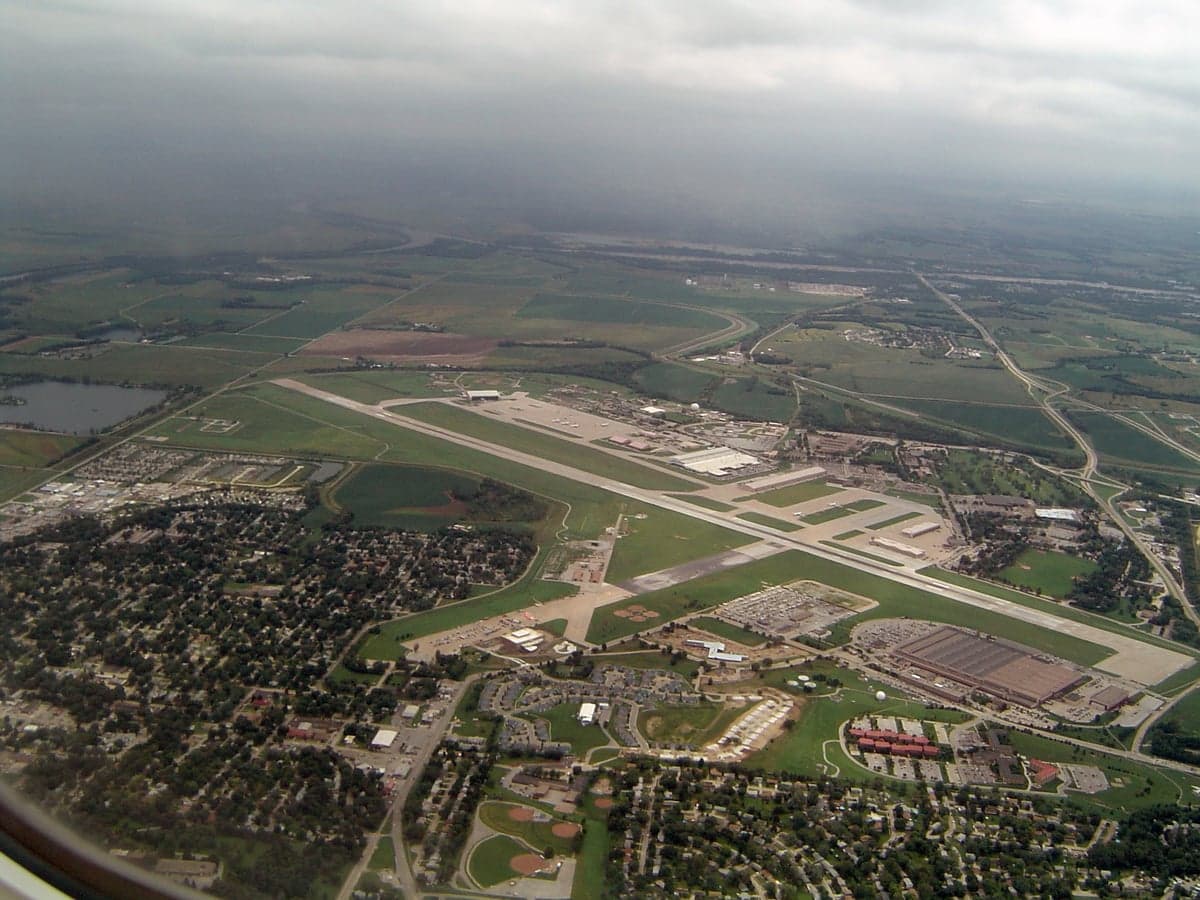
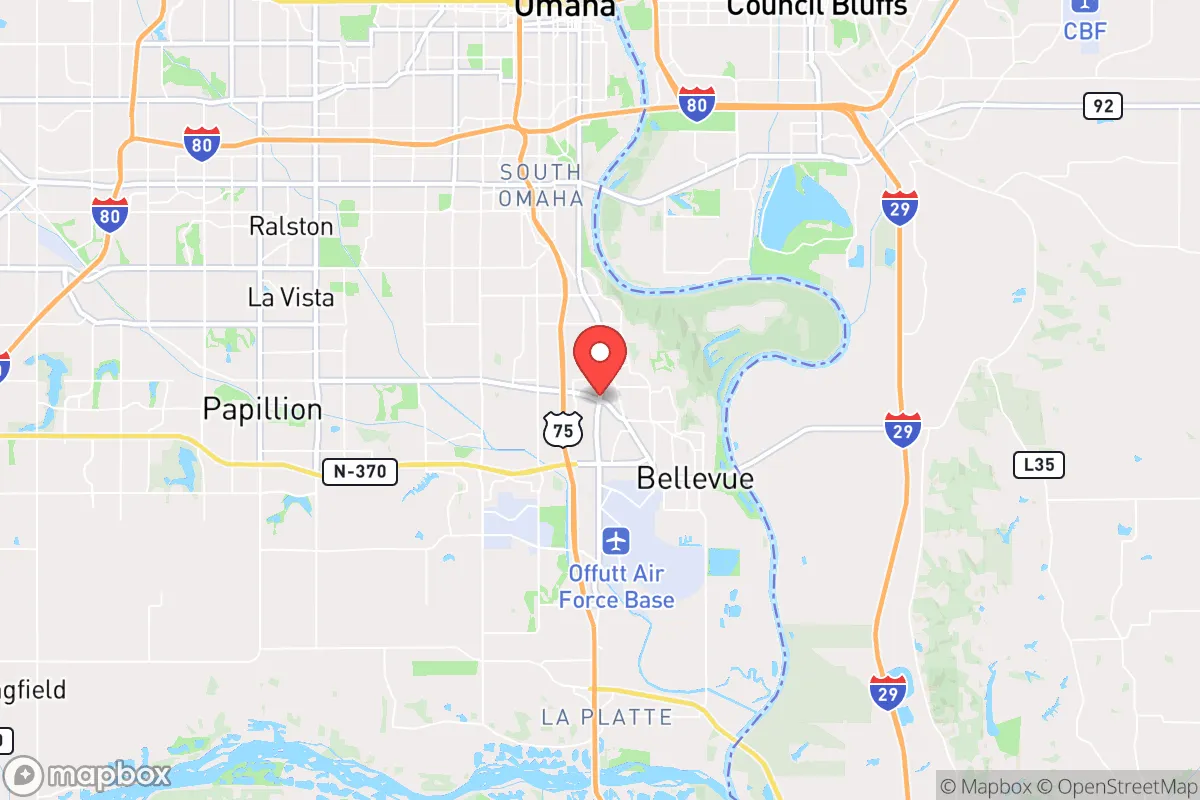
Photo: Wikipedia
Political ClimatePolitical Climate in Bellevue, NE
District shown is the primary district for this city’s centroid. Cities may span multiple districts.
Local Political AnalysisPolitical Analysis of Bellevue, NE
Bellevue, Nebraska, has long been a solidly conservative community, and that hasn't changed much. The Cook PVI rating of R+6 tells you the baseline: this is a place where Republican candidates can generally count on a comfortable win, but it's not a deep-red stronghold like some of the rural counties further west. The real story here is the slow, steady pressure from the Omaha metro area's growing influence, which is starting to nudge the local political temperature in a direction that has a lot of longtime residents watching closely.
How it compares
To get a feel for Bellevue's politics, you have to look at the neighbors. Drive ten minutes north into Omaha proper, and you're in a blue-leaning city, especially in the urban core and midtown. That's where you see the progressive energy on things like zoning, public transit, and social programs. Head west to places like Elkhorn or Gretna, and you're in deep-red territory, where the R+6 of Bellevue looks almost moderate. Bellevue sits right in that suburban buffer zone. It's more conservative than the city, but it's not as insulated from those urban cultural shifts as the towns further out. You see it in local school board races and city council debates — the old guard, who remember when Bellevue was a quiet Air Force town, are now facing candidates who bring ideas from Omaha about "equity" initiatives and denser housing development. That's the front line of the political shift, and it's where the rubber meets the road for a lot of folks.
What this means for residents
For the average person living here, the political climate means your rights and local autonomy are generally respected, but you have to stay vigilant. The city council and county board are still majority conservative, which has kept property taxes relatively in check compared to Douglas County and has prevented any serious overreach on things like business mandates or gun restrictions. You can still run a small business without a mountain of red tape, and the local schools, while not perfect, haven't been taken over by the kind of progressive curriculum battles you see in Lincoln or Omaha. The biggest concern for the future is the slow creep of Omaha's influence — as more people move out from the city for cheaper housing, they bring their voting habits and their expectations for more government involvement in daily life. If you value personal freedom and local control, the next few election cycles in Sarpy County are going to be critical. The long-term trajectory depends on whether the new arrivals assimilate to the local culture or try to remake Bellevue in Omaha's image.
Culturally, Bellevue still feels like a place where people mind their own business. The Offutt Air Force Base presence keeps a steady flow of military families who tend to be patriotic and self-reliant, which reinforces the conservative backbone. There's no real push for the kind of "sanctuary city" nonsense you see on the coasts, and the Second Amendment is still treated as a given, not a debate topic. The one policy distinction that stands out is the local resistance to county-wide mask and vaccine mandates that some neighboring jurisdictions flirted with — Bellevue's leadership largely let individuals make their own choices, which is exactly how it should be. That said, you can feel the pressure building. The local paper and social media are getting more heated with each election cycle, and the quiet consensus that used to define this town is getting harder to maintain. If you're looking for a place that still believes in limited government and personal responsibility, Bellevue is still a good bet — but don't take it for granted. Keep your ear to the ground and vote in every local election, because that's where the real fight for the soul of this community is happening.

State Political ClimatePolitical Climate in Nebraska
State Political AnalysisPolitical Environment in the State
Nebraska has long been a reliably conservative state, but its political landscape is more nuanced than a simple red-state label suggests. The state has voted Republican in every presidential election since 1968, and Donald Trump carried it by 19 points in 2024, yet its unique unicameral legislature and split electoral vote system reveal a place where pragmatism often tempers ideology. Over the past 20 years, the dominant coalition has been a mix of rural conservatives, agricultural interests, and a growing suburban base, but recent in-migration into the Omaha and Lincoln metros has begun to shift the balance, creating a slow but noticeable leftward drift in the state’s most populous counties.
Urban vs. rural divide
The political map of Nebraska is a textbook example of the urban-rural split. Douglas County (Omaha) and Lancaster County (Lincoln) are the state’s Democratic strongholds, with Omaha’s 2nd Congressional District flipping blue in 2020 and 2024, delivering one electoral vote to Joe Biden and then Kamala Harris. Lincoln, home to the University of Nebraska, has trended leftward as younger professionals and academics have moved in. Meanwhile, the rest of the state is deeply red. Scotts Bluff County in the Panhandle and Buffalo County (Kearney) in central Nebraska routinely vote 70%+ Republican. The rural counties along the Platte River and in the Sandhills are among the most conservative in the nation, driven by agricultural economics, gun culture, and a strong distrust of federal oversight. The divide is stark: drive 20 minutes outside Omaha or Lincoln, and you’re in country where Trump signs still dot the fields and local officials openly mock state mandates.
Policy environment
Nebraska’s policy environment is generally favorable for conservatives, but with some notable exceptions. The state has no income tax on Social Security benefits and a flat individual income tax rate of 5.58% (set to drop to 3.99% by 2027 under LB 754). Property taxes are high—among the top 10 in the nation—which is a constant source of frustration for homeowners and farmers alike. The unicameral legislature, officially nonpartisan, often produces odd coalitions; for example, in 2023, a conservative filibuster killed a bill that would have banned abortion after 12 weeks, while a separate bill banning gender-affirming care for minors passed with bipartisan support. School choice is a live issue: in 2024, the legislature passed LB 1402, creating a $10 million school voucher program, but it was immediately challenged by a referendum that will appear on the 2026 ballot. Election laws are moderately restrictive—voter ID is required (passed in 2023), and same-day registration is not allowed. Healthcare policy is mixed: the state expanded Medicaid under the Affordable Care Act in 2020 via a ballot initiative, but it also passed a 12-week abortion ban in 2023, with exceptions for rape, incest, and medical emergencies. For a conservative, the policy environment is a mixed bag—good on taxes and guns, frustrating on property taxes and some social issues.
Trajectory & freedom
Over the past five years, Nebraska has moved in a mixed direction on personal freedom. On the positive side for conservatives, constitutional carry became law in 2023 (LB 77), allowing permitless concealed carry for anyone 21 or older. The same bill preempted local gun ordinances, preventing Omaha and Lincoln from enacting their own restrictions. Parental rights were strengthened in 2024 with LB 1382, which requires schools to notify parents of any changes to a student’s health or well-being, including gender identity. On the concerning side, the state’s COVID-era emergency powers were used by Governor Pete Ricketts to impose business closures and mask mandates in 2020, which sparked a backlash that led to the 2021 passage of LB 783, limiting a governor’s ability to declare a public health emergency without legislative approval. Property rights remain strong, with no statewide rent control and minimal zoning reform, though Omaha’s city council has flirted with inclusionary zoning policies. The trajectory is cautiously positive: the legislature has been chipping away at tax burdens and expanding gun rights, but the growing influence of Omaha’s progressive wing—especially on social issues—is a real concern for those who value limited government.
Civil unrest & political movements
Nebraska has seen relatively little civil unrest compared to coastal states, but there have been flashpoints. In 2020, Omaha experienced several nights of protests and some property damage following George Floyd’s death, with the city’s progressive mayor, Jean Stothert, facing criticism from both sides for her response. The 2023 abortion debate drew large, peaceful rallies at the state capitol, with both pro-life and pro-choice groups turning out. More recently, the school choice referendum has energized grassroots activists on both sides, with the Nebraska Federation of Teachers leading the opposition and the Platte Institute backing the voucher program. Immigration politics are relatively quiet, though the state has no sanctuary policies and local law enforcement in Grand Island and South Sioux City have cooperated with ICE. Election integrity has been a minor issue: the 2020 election saw no major controversies, but the 2023 voter ID law was passed in response to broader national concerns. Overall, the political climate is civil but increasingly polarized, with the urban-rural divide creating two distinct political worlds within the same state.
Projection
Looking ahead 5-10 years, Nebraska is likely to become more politically competitive, but not necessarily more liberal. The Omaha metro is growing—Douglas County added about 50,000 residents between 2020 and 2025—and many of those new arrivals are younger, more diverse, and more progressive. Lincoln is also trending left, driven by university expansion and tech sector growth. However, the rural counties are not shrinking as fast as in other Plains states, thanks to strong agricultural prices and a stable population base. The key battleground will be the 2nd Congressional District, which could become reliably blue within a decade if current trends hold. Statewide, the Republican majority in the legislature is likely to hold, but the margin may narrow, forcing more compromise on issues like property tax relief and school funding. For a conservative moving in now, expect to see more cultural fights in Omaha and Lincoln—over library books, drag shows, and school curriculum—while the rest of the state remains a bastion of traditional values. The unicameral system will continue to produce unpredictable outcomes, as nonpartisan labels often lead to cross-party alliances.
Bottom line for a new resident: Nebraska offers a high degree of personal freedom on guns, taxes, and parental rights, but you’ll need to pick your county carefully. If you want a conservative environment, stick to the rural areas or smaller cities like Kearney or Norfolk. If you’re moving to Omaha or Lincoln, be prepared for a more progressive local government that may clash with state law. Property taxes will be your biggest headache, but the overall cost of living is low, and the state’s political trajectory is stable enough that you won’t see radical changes overnight. Just keep an eye on the 2nd District—it’s the canary in the coal mine for Nebraska’s political future.
* Values derived from national, state, county, city and local statistics and may differ in a specific area. Last updated: 2026-05-03T20:29:35.000Z
Narrative content on this page is AI-generated and may contain mistakes. Verify any details that matter before acting on them.
ReloMaps may earn a commission from affiliate links at no extra cost to you.

