
Photo: Wikipedia
Political ClimatePolitical Climate in Belton, MO
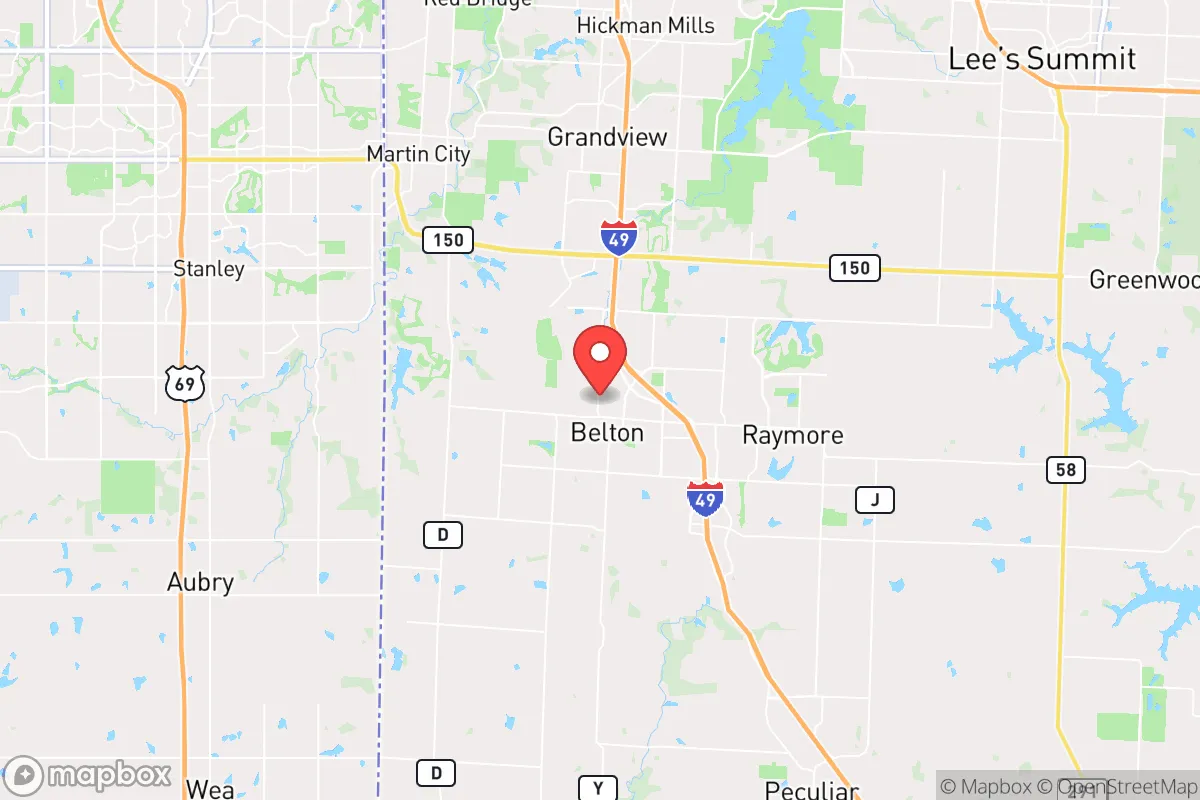
District shown is the primary district for this city’s centroid. Cities may span multiple districts.
Local Political AnalysisPolitical Analysis of Belton, MO
Belton, Missouri, sits squarely in deep-red Cass County, and with a Cook PVI of R+21, it’s about as reliably conservative as any town in the Kansas City metro area. That number means the district votes roughly 21 points more Republican than the national average, and in practice, that translates to a place where folks still believe in local control, the Second Amendment, and keeping government out of their backyards. For a long time, that was just the way things were—neighbors knew each other, the county commission kept taxes low, and you didn’t see much fuss about progressive policies creeping in from the city. But over the last decade or so, you’ve started to feel a shift, especially as the KC suburbs push further south. It’s not that Belton has flipped—far from it—but the political temperature is changing, and it’s worth keeping an eye on.
How it compares
Drive ten miles north up I-49, and you hit Grandview, which leans more purple, with a noticeable Democratic tilt in local elections. Head east to Raymore, and you’ll find a similar conservative vibe to Belton, but with a younger, more suburban crowd that sometimes votes a little softer on social issues. The real contrast is Kansas City itself, where the county government has pushed things like mask mandates, property tax hikes for transit projects, and even talk of defunding police—stuff that would never fly in Belton. Cass County as a whole voted over 65% for Trump in 2020, and the local school board and city council races here still tend to be won by candidates who run on fiscal restraint and parental rights. But you can see the pressure building: more people moving in from Johnson County or the northland, bringing with them ideas about zoning changes, diversity initiatives, and “equity” programs that sound a lot like government overreach to those of us who’ve been here a while.
What this means for residents
For the average Belton resident, the political climate means you can still live your life without a lot of bureaucratic nonsense. Property taxes are reasonable, there’s no city income tax, and the county sheriff’s office isn’t interested in enforcing federal gun laws that don’t exist in Missouri. The school district, Belton 124, has managed to avoid the worst of the culture wars, though there have been some heated school board meetings over library books and curriculum transparency. The real concern for the future is whether the county commission and city council can hold the line as the metro area’s population spreads south. If you look at what happened in Lee’s Summit or Blue Springs over the last twenty years—both once solidly red, now trending purple—you can see the pattern. More development brings more people who don’t share the same values, and that can lead to zoning restrictions, higher fees, and a slow erosion of the personal freedoms that make living here worth it.
One cultural distinction that still sets Belton apart is the strong sense of local identity—the annual Belton Fall Festival, the active VFW post, and the fact that most people still wave at you on back roads. There’s no push for a sanctuary city status here, no talk of removing historical monuments, and the county commission has been vocal about opposing any state-level red flag laws. That said, the long-term trajectory depends on who moves in next. If the growth stays mostly single-family homes with families who value low taxes and local control, Belton will stay the same. But if the developers start building apartments and the transplants start demanding “more services,” you can bet the political climate will shift, and not in a way that respects the rights of the people who built this town. For now, it’s still a good place to raise a family without the government looking over your shoulder—but you’d better pay attention at the ballot box.

State Political ClimatePolitical Climate in Missouri
State Political AnalysisPolitical Environment in the State
Missouri has long been a bellwether state, but over the past 20 years it has shifted from a classic purple swing state to a solidly red one, with a Republican trifecta controlling the governorship and both legislative chambers since 2017. The state voted for Donald Trump by 15 points in 2020 and by an even wider margin in 2024, driven by a powerful coalition of rural conservatives, suburban families fleeing St. Louis and Kansas City, and a growing exurban population. The trajectory is unmistakable: Missouri is becoming more conservative, more culturally aligned with the South, and more skeptical of federal overreach, though the major metro areas remain stubbornly blue.
Urban vs. rural divide
The political map of Missouri is a study in stark contrasts. The two major metros — St. Louis and Kansas City — are deep blue islands in a sea of red. St. Louis County and Jackson County (Kansas City) reliably deliver 60-70% of their votes to Democrats, powered by union households, university faculty, and a growing minority population. But drive 30 minutes outside either city and the landscape flips completely. St. Charles County, just west of St. Louis, is now one of the most reliably Republican suburban counties in the nation, having flipped from purple to deep red in the 2010s as families fled city crime and school policies. Greene County (Springfield) is the conservative anchor of the southwest, while Boone County (Columbia) is a liberal outlier thanks to the University of Missouri. The rural counties — Phelps, Texas, Howell, Dunklin — vote 75-80% Republican, and their turnout is the engine of statewide wins. The divide isn't just political; it's cultural, with rural Missourians viewing the cities as out of touch with their values on guns, family, and faith.
Policy environment
Missouri's policy environment is aggressively pro-business and pro-freedom by any standard. The state has a flat income tax rate of 4.95% (down from 5.4% in 2022, with further cuts triggered by revenue triggers), no estate tax, and a low corporate tax rate of 4%. Sales taxes are high locally — often 8-9% in cities — but the state has no tax on Social Security benefits and a generous retirement income deduction. Education policy is a mixed bag: Missouri has a robust charter school law (mostly limited to St. Louis and Kansas City) and a growing school choice movement, but the state still funds public schools primarily through local property taxes, creating disparities between wealthy suburbs and poor rural districts. Healthcare is a flashpoint: Missouri rejected Medicaid expansion for years before a 2020 ballot initiative forced it through, but the state still has some of the most restrictive abortion laws in the country (a near-total ban with no exceptions for rape or incest, only medical emergencies). Election laws have tightened: voter ID is required, absentee voting is limited to specific excuses, and the state purged over 100,000 inactive voters in 2023. Gun laws are among the most permissive nationally — permitless carry, no duty to retreat, and a 2021 law (HB 85) that purports to nullify federal gun restrictions, though it's been tied up in court.
Trajectory & freedom
Missouri is moving decisively in the direction of expanded personal liberty, at least for conservatives. The 2021 Second Amendment Preservation Act (HB 85) was a direct challenge to federal authority, declaring any federal law that infringes on the right to keep and bear arms "null and void" in Missouri. It's been partially blocked by federal courts, but the political signal is clear. In 2023, the legislature passed a Parents' Bill of Rights (SB 34), requiring schools to notify parents of any curriculum involving sexual orientation or gender identity and to get parental consent before students can change their names or pronouns. The same year, the state banned transgender athletes from girls' sports (HB 1506) and prohibited gender-affirming care for minors (SB 49), overriding a gubernatorial veto. On taxation, the 2022 income tax cuts were paired with a phase-out of the corporate franchise tax, and further cuts are triggered automatically if revenue exceeds projections. The state also expanded school choice in 2024 with a new education savings account program for low-income families. The trajectory is unmistakably toward smaller government, more parental control, and stronger Second Amendment protections — though critics note that the state's heavy reliance on sales taxes and local property taxes still leaves a lot of government overhead in place.
Civil unrest & political movements
Missouri has been a flashpoint for political conflict, particularly around race and policing. The 2014 Ferguson protests after the Michael Brown shooting were a national watershed, and the city of Ferguson (a St. Louis suburb) remains a symbol of racial tension and police reform battles. Since then, the state has seen periodic protests in St. Louis over police shootings and Confederate monument removals, but the intensity has faded as the political center of gravity has shifted right. On the right, the Missouri Freedom Caucus has become a powerful force in the legislature, pushing for even more aggressive nullification measures, school choice expansion, and anti-abortion laws. Immigration politics are relatively quiet compared to border states, but there's a growing grassroots movement in rural counties to declare themselves "Second Amendment sanctuaries" and resist any federal gun control. Election integrity remains a hot topic: the 2020 election saw Trump win Missouri easily, but activists on the right continue to push for hand-counting ballots and paper-only voting, and several counties have adopted hand-counting pilot programs. A new resident won't see daily protests, but they will see a state where political signs are ubiquitous, where county-level politics are fiercely contested, and where the culture war is fought in school board meetings and county commission chambers.
Projection
Over the next 5-10 years, Missouri is likely to become even more conservative, driven by two demographic trends. First, the exurban sprawl from St. Louis and Kansas City into counties like St. Charles, Lincoln, and Cass is bringing families who are fleeing city crime, high taxes, and progressive school policies — they're voting Republican in ever-higher numbers. Second, the rural population is aging and shrinking, but those who remain are becoming more politically active and more radicalized against federal authority. The state's in-migration is coming from Illinois, California, and other blue states, and these newcomers are generally conservative-leaning, drawn by lower taxes and gun-friendly laws. The Democratic strongholds in St. Louis and Kansas City are losing population and political influence, and the state's legislative maps are gerrymandered to protect Republican supermajorities. Expect more nullification laws, more school choice expansion, and a continued push to lower taxes. The wildcard is the federal courts: if HB 85 is ultimately struck down, it could trigger a backlash that accelerates the state's drift toward outright defiance of federal authority. A new resident moving in now should expect to find a state that is increasingly self-confident in its conservative identity, less willing to compromise with urban interests, and more willing to test the limits of state sovereignty.
For a conservative family or individual considering relocation, Missouri offers a policy environment that is broadly aligned with traditional values: low taxes, strong gun rights, parental control in education, and a culture that respects personal responsibility. The trade-offs are real — the major cities are politically hostile to conservative values, the infrastructure outside the I-70 corridor is thin, and the state's reliance on sales taxes means that local tax burdens can be high in certain counties. But for someone who wants to live in a state that is actively pushing back against federal overreach and progressive cultural trends, Missouri is one of the most promising destinations in the Midwest. The key is choosing the right county: St. Charles for suburban comfort, Greene for a strong conservative community, or a rural county like Phelps for maximum freedom and minimal government interference.
* Values derived from national, state, county, city and local statistics and may differ in a specific area. Last updated: 2026-04-29T20:35:49.000Z
Narrative content on this page is AI-generated and may contain mistakes. Verify any details that matter before acting on them.
ReloMaps may earn a commission from affiliate links at no extra cost to you.

