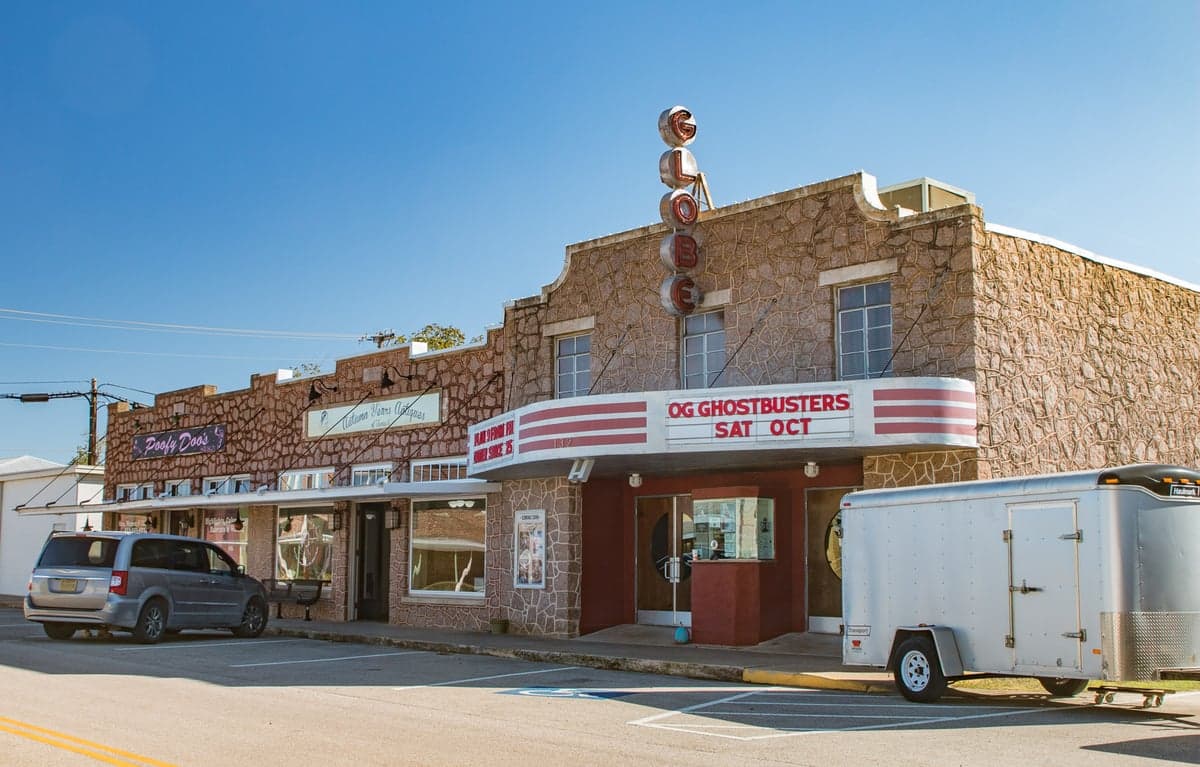
Photo: Wikipedia
Demographics of Bertram, TX
Affluence Level in Bertram, TX
A middle-class area roughly in line with national averages across income, home values, education, and employment.
People of Bertram, TX
Bertram, Texas, is a small, historically rooted community of 1,998 residents where a predominantly White (59.9%) and Hispanic (28.5%) population lives in a quiet, rural setting. The city retains a strong sense of place, with a low foreign-born share of just 3.7% and a modest college-educated rate of 18.2%, reflecting its working-class agricultural and railroad origins. Its character is defined by a mix of longtime families and newer residents seeking affordable land within commuting distance of the Austin metro area, creating a slow-growth, family-oriented atmosphere.
How the city was settled and grew
Bertram’s human history begins with its founding in the 1880s as a railroad stop on the Austin and Northwestern line. The original population was drawn by land grants and the promise of cotton farming, with early settlers being primarily Anglo-American farmers from the Deep South and Central Texas. These families built the original core of the town around what is now Old Town Bertram, a historic district centered on the intersection of Highway 29 and Farm-to-Market Road 258. The railroad depot, now a community landmark, anchored the first wave of commerce. By the early 1900s, a small number of German and Czech immigrant families arrived, settling on farms to the north and east in what became known as the Prairie View area, named for the open grasslands they cultivated. The town’s population remained small and overwhelmingly White through the mid-20th century, with cotton and later cattle ranching as the economic backbone. No significant Black or Hispanic communities formed during this period, as the area’s agricultural economy did not attract large-scale labor migration.
Modern era (post-1965)
The post-1965 period brought gradual demographic change, driven primarily by domestic in-migration rather than international immigration. The most notable shift has been the growth of the Hispanic population, which now stands at 28.5%. This wave began in the 1970s and 1980s as Mexican-American families moved from South Texas and the Rio Grande Valley seeking work in construction and service industries tied to the expanding Austin metro. These families concentrated in the South Bertram neighborhood, a lower-density area along Farm-to-Market Road 258 south of the railroad tracks, where modest homes and mobile homes are common. The White population, while still the majority at 59.9%, has seen a slight decline in share as newer Anglo residents—often retirees or remote workers—have moved into newer subdivisions like Bertram Acres, a small development of custom homes on acre lots built since 2000. The Black population remains minimal at 2.2%, with no distinct neighborhood concentration. East/Southeast Asian residents make up just 0.2%, and there are no recorded Indian-subcontinent residents. The foreign-born share of 3.7% is low, indicating that almost all population growth has come from domestic moves, not immigration.
The future
Bertram’s population is likely to continue growing slowly, driven by spillover from the Austin metro’s housing market. The city’s character is trending toward a more homogenized, family-oriented suburb rather than a tribalized enclave. Hispanic and White residents are not strongly segregated by neighborhood; instead, both groups are dispersed across the Old Town and South Bertram areas, with newer subdivisions like Bertram Acres attracting a mix of Anglo and Hispanic families. The immigrant community is small and plateauing, with no signs of a new wave from abroad. The college-educated share, at 18.2%, is low but may rise slowly as more remote workers and retirees from Austin move in. Over the next 10 to 20 years, Bertram is expected to remain a predominantly White and Hispanic, working-to-middle-class town, with gradual infill development along Highway 29 and around the Bertram Municipal Park area, but no major demographic disruption.
For someone moving in now, Bertram offers a stable, slow-growing community where the population is largely native-born, family-oriented, and rooted in the area’s agricultural and railroad history. The city is becoming a quieter, more affordable alternative to the Austin suburbs, with a demographic profile that is unlikely to shift dramatically in the near future. New residents will find a place where longtime families still dominate, and where the pace of change is measured in decades, not years.

* Values derived from national, state, county, city and local statistics and may differ in a specific area. Last updated: 2026-05-09T22:55:17.000Z
Narrative content on this page is AI-generated and may contain mistakes. Verify any details that matter before acting on them.
ReloMaps may earn a commission from affiliate links at no extra cost to you.

