
Photo: Wikipedia
Political ClimatePolitical Climate in Bertram, TX
District shown is the primary district for this city’s centroid. Cities may span multiple districts.
Local Political AnalysisPolitical Analysis of Bertram, TX
Bertram, Texas, is about as solidly conservative as small-town Texas gets, and it’s been that way for as long as anyone can remember. The Cook PVI here sits at R+11, which is a full seven points more Republican than the state of Texas as a whole (R+4). That’s not just a number on a map—it means in local elections, you’re looking at margins that often push 70-80% for conservative candidates. The political lean here isn’t just a preference; it’s a way of life that’s deeply tied to personal responsibility, limited government, and a healthy skepticism of anyone telling you how to live from Austin or Washington. If you’re looking for a place where the old-school Texas values of minding your own business and keeping the government out of your backyard still hold strong, Bertram is it.
How it compares
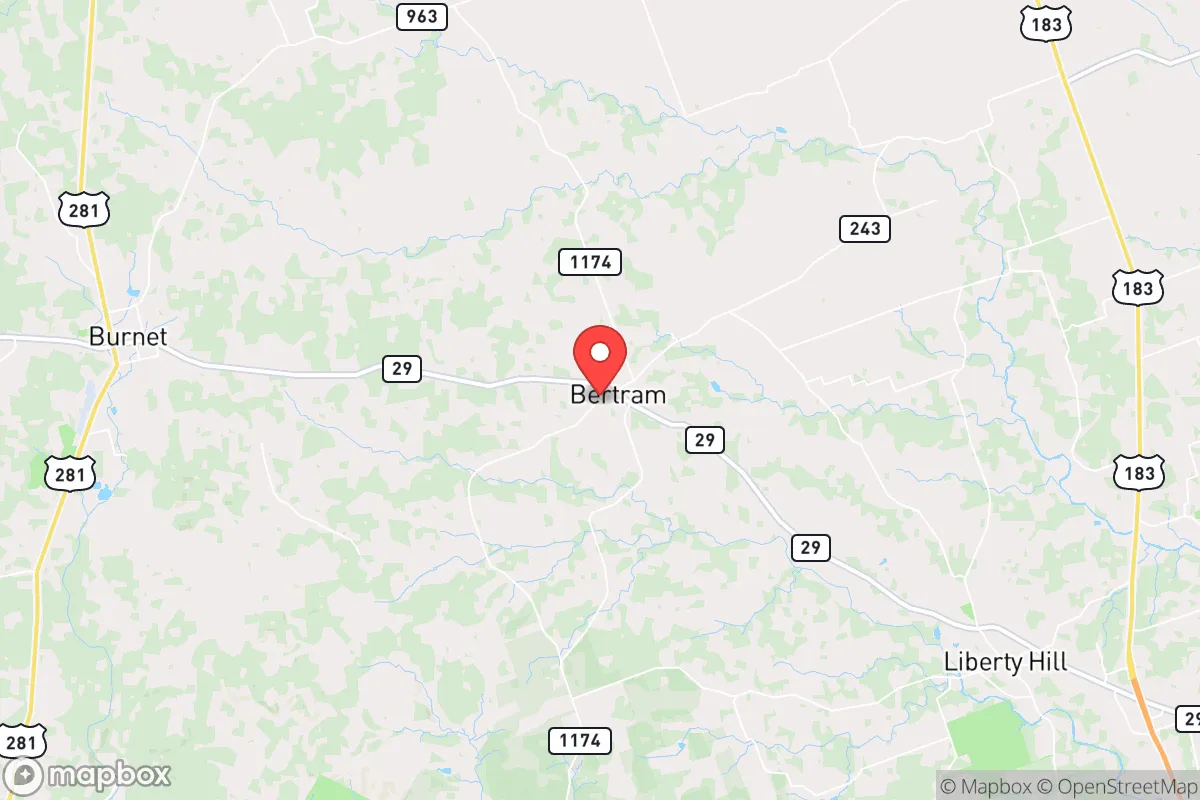
Compared to the rest of Texas, Bertram is a conservative stronghold in a state that’s already pretty red. The R+11 PVI means this area votes Republican by a much wider margin than the statewide average. Drive 20 minutes south to Liberty Hill, and you’ll start seeing a different story—that area has been flooded with folks from California and the Northeast, and you can feel the political vibe shift toward more progressive leanings, especially in local school board and city council races. Head west to Burnet, and it’s still conservative, but not quite as rock-ribbed as Bertram. The real contrast is with Austin, about 45 minutes southeast, where the politics are practically a different country. In Bertram, you don’t hear much talk about defunding the police or green new deals—people here are more concerned with property taxes, water rights, and making sure the county doesn’t start telling you what kind of fence you can put up. The trajectory I see is that Bertram is holding the line, but the pressure from the growing suburban sprawl is real. If you value your Second Amendment rights and don’t want to see mask mandates or vaccine passports show up at the local diner, this is still a safe haven—for now.
What this means for residents
For folks living here, the political climate means a lot of things are just simpler. You don’t have to worry about your kids coming home with critical race theory worksheets from school, and the local sheriff isn’t going to enforce any federal gun grab. Property taxes are still a pain—that’s Texas-wide—but there’s no city income tax or heavy-handed zoning that tells you what you can do with your land. The downside? If you’re hoping for a lot of government services or public transit, you’re in the wrong place. The county keeps things lean, and that’s how most residents like it. The biggest concern I hear from neighbors is that as more people move in from blue states, they bring their voting habits with them. We’ve already seen it in nearby Georgetown and Round Rock—once those progressive transplants hit a critical mass, the school boards and city councils start shifting. In Bertram, we’re still a few years away from that tipping point, but it’s something to keep an eye on.
The cultural distinction here is that Bertram hasn’t lost its rural, self-reliant character. You won’t find a Whole Foods or a bike lane, but you will find a community that shows up for church potlucks and volunteer fire department fundraisers. Policy-wise, the county commission fights hard to keep state and federal overreach at bay—whether it’s water regulations, land use restrictions, or energy mandates. If you’re the kind of person who thinks the government should stay out of your garage, your church, and your gun safe, Bertram is still a place where that’s the norm. Just don’t expect it to stay that way forever if the growth keeps coming.

State Political ClimatePolitical Climate in Texas
State Political AnalysisPolitical Environment in the State
Texas has been a reliably Republican state for decades, with a Cook PVI of R+4, but the coalition holding that majority is shifting under your feet. The dominant political force remains a blend of suburban conservatives, rural traditionalists, and business-oriented libertarians, but the 10-20 year arc shows a slow, uneven drift toward competitiveness. In 2024, Donald Trump won the state by roughly 9 points, down from 11 in 2020 and 16 in 2016, driven largely by explosive growth in the blue-leaning suburbs of Dallas, Houston, and Austin, while the rural and exurban vote has held firm or even hardened.
Urban vs. rural divide
The political map of Texas is a story of three distinct worlds. The major metros — Austin (Travis County), Dallas (Dallas County), Houston (Harris County), and El Paso (El Paso County) — are solidly Democratic, with Harris County flipping blue in 2018 and staying there. Austin is the state's progressive anchor, with Travis County routinely voting 70%+ Democratic. Meanwhile, the vast rural expanse — the Panhandle around Lubbock, the Piney Woods near Tyler, and the South Texas ranching country — votes 70-80% Republican. The real battleground is the suburban ring: Collin County (north of Dallas), Denton County, Fort Bend County (southwest of Houston), and Williamson County (north of Austin). These once-reliable red suburbs have shifted purple. Collin County, which voted 57% for Romney in 2012, went 52% for Trump in 2024. Williamson County, a former GOP stronghold, is now a true swing county. The 2024 results showed that while Trump still won Texas, the margins in these suburban counties continue to erode, a trend that alarms conservatives who see the state's future hinging on whether these areas can be held or won back.
Policy environment
Texas's policy environment is a mixed bag for a conservative. On the plus side, there is no state income tax, which is a massive draw for individuals and families. The regulatory posture remains light-touch, especially for energy and construction. Property taxes are high — among the highest in the nation — because the state funds services locally. Education policy has been a flashpoint: the 2023 school voucher battle (SB 8, which failed in the House) showed deep divides within the GOP itself, with rural Republicans joining Democrats to kill it. The 2025 session saw a revived voucher-like program pass, but it's still limited. Healthcare is a sore spot: Texas has the highest uninsured rate in the country, and the state has refused Medicaid expansion under Obamacare. Election laws tightened after 2020 with SB 1 (2021), which added ID requirements for mail-in ballots and limited drive-through voting. For a conservative, the policy environment is broadly friendly on taxes and regulation, but the property tax burden and the ongoing voucher fight are real concerns.
Trajectory & freedom
The trajectory on personal freedom is a tug-of-war. On the positive side for conservatives, Texas has expanded gun rights significantly: permitless carry (HB 1927, 2021) allows most adults to carry a handgun without a license. Parental rights in education were strengthened with HB 900 (2023), which restricts sexually explicit content in school libraries, and the "Save Women's Sports" Act (SB 15, 2021) bans transgender athletes from female sports. Abortion is effectively banned after the 2021 "Heartbeat Act" (SB 8) and the 2023 trigger law. Medical autonomy took a hit with the 2023 ban on gender-affirming care for minors (SB 14). On the concerning side, property rights have been eroded by the use of eminent domain for private infrastructure projects, and the state's heavy-handed approach to border security (Operation Lone Star) has led to civil liberties complaints, including warrantless arrests. The 2023 law making it a state crime to enter Texas illegally (SB 4) is currently tied up in court. Overall, Texas is becoming more free on cultural and Second Amendment issues, but less free on medical choice and property rights — a mixed record that a conservative should watch closely.
Civil unrest & political movements
Texas has seen its share of political heat. The 2020 Black Lives Matter protests in Austin and Houston were large and occasionally violent, leading to a backlash that helped fuel the 2021 "defund the police" repeal in Austin. The 2022 Uvalde school shooting sparked a renewed gun control push, but the legislature instead focused on school safety funding. Immigration politics are the dominant flashpoint: the border crisis has led to a massive state-led operation (Operation Lone Star), with thousands of National Guard troops deployed and busloads of migrants sent to northern cities. This has created a visible, ongoing tension in border towns like El Paso and Brownsville, where local officials often clash with the state. The "Texas Independence" movement (Texit) remains a fringe but vocal presence, with a few Republican county parties passing resolutions. Election integrity remains a hot-button issue: the 2020 and 2024 cycles saw lawsuits over mail-in ballots and voter roll purges, with the state aggressively defending its new laws. A new resident will notice the heavy law enforcement presence at the border and the constant political ads about immigration.
Projection
Over the next 5-10 years, Texas is likely to become a true swing state. The in-migration from California and the Northeast is accelerating, and these newcomers tend to be more moderate or liberal, especially on cultural issues. The suburban counties that flipped blue in 2020 are not flipping back. The GOP is responding by doubling down on rural and exurban turnout, and by pushing culturally conservative legislation that fires up the base. The 2026 and 2028 cycles will be brutal. If the GOP can hold the suburbs, Texas stays red; if not, it becomes a battleground like Georgia or Arizona. The state's growing Hispanic population, long a GOP target, is not moving reliably toward either party — younger Hispanic voters lean left, while older ones remain split. A conservative moving to Texas now should expect a state that is still broadly friendly to their values, but where the political climate is heating up fast. The days of easy Republican dominance are numbered.
For a new resident, the bottom line is this: Texas is still a good bet for a conservative family or individual, but it's not the lock it was 20 years ago. You'll find low taxes, strong gun rights, and a culture that values personal responsibility. But you'll also find high property taxes, a growing blue vote in the suburbs, and a political environment that is increasingly polarized. If you're moving here, pick your county carefully — a place like Collin County or Denton County still offers a conservative-friendly environment, while Travis County or Harris County will feel like a different state entirely. The freedom you're seeking is still here, but you'll have to work to keep it.
* Values derived from national, state, county, city and local statistics and may differ in a specific area. Last updated: 2026-05-09T22:55:17.000Z
Narrative content on this page is AI-generated and may contain mistakes. Verify any details that matter before acting on them.
ReloMaps may earn a commission from affiliate links at no extra cost to you.

