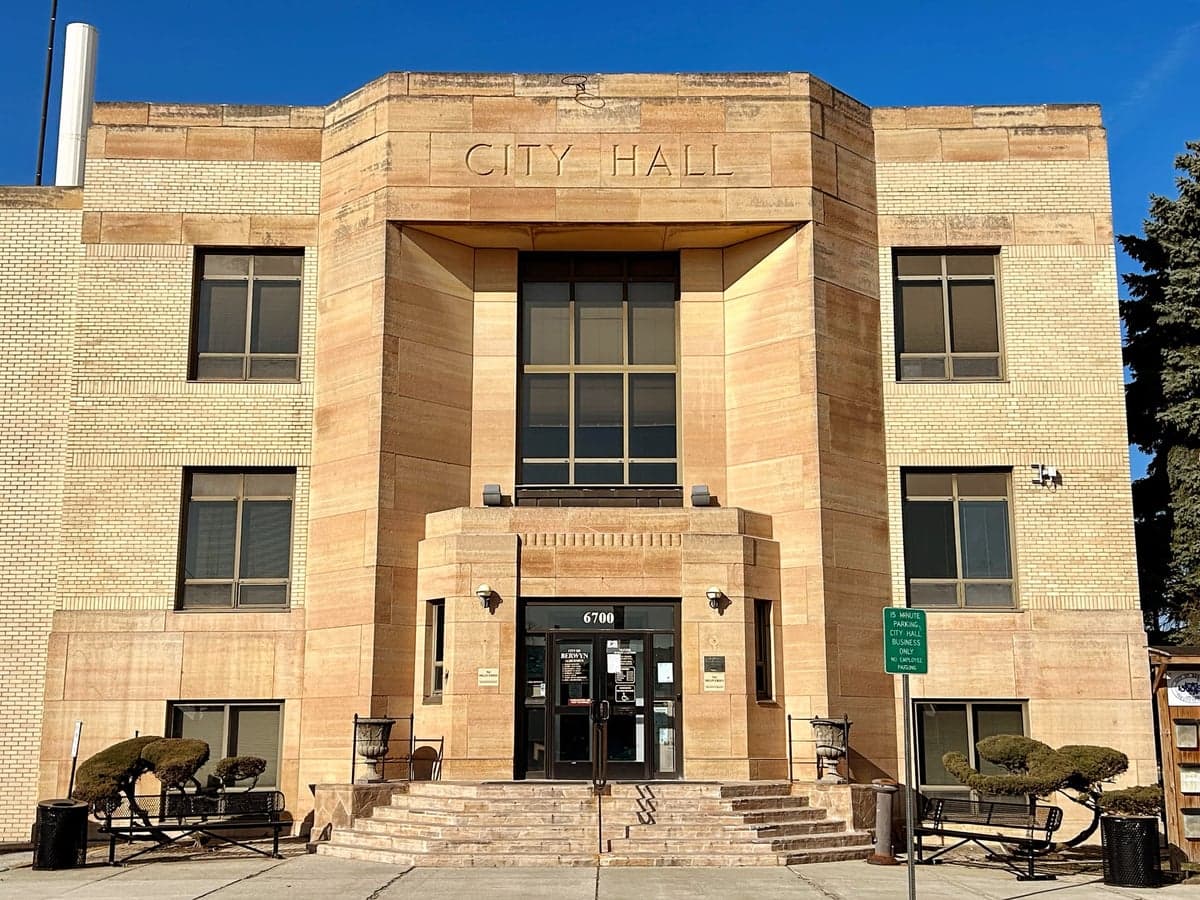
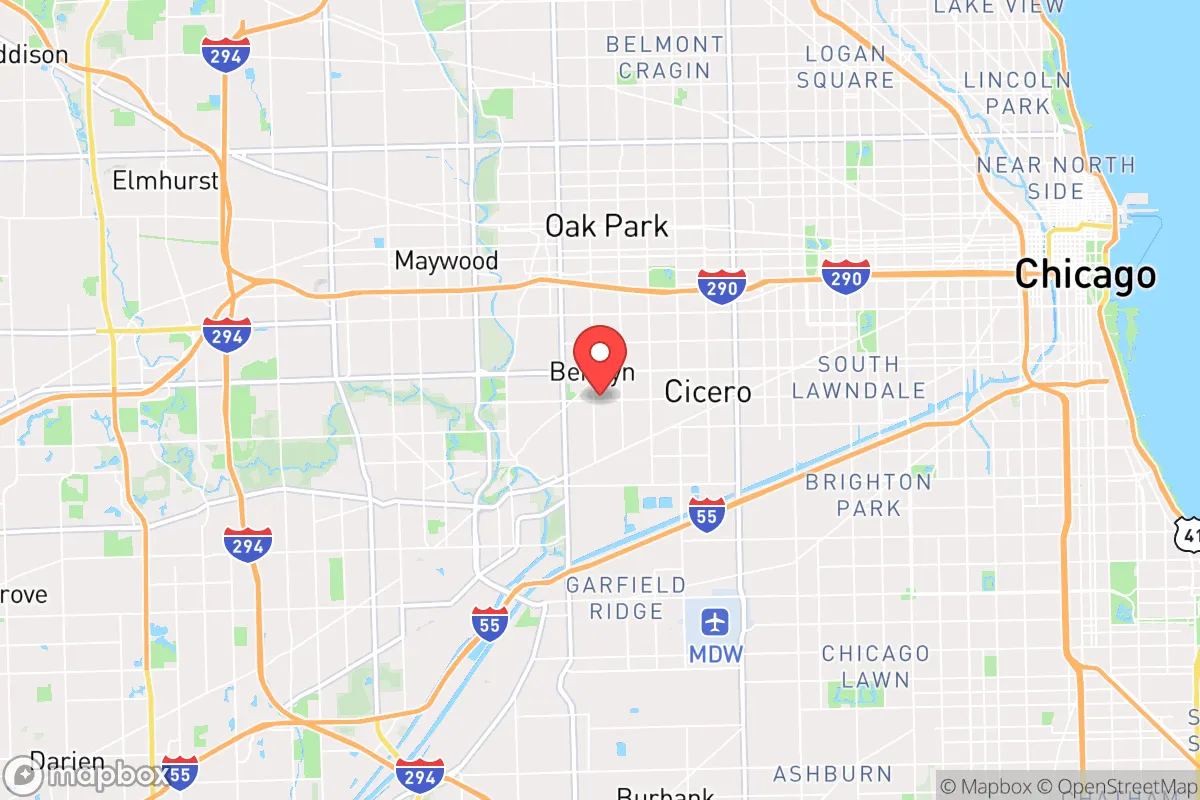
Photo: Wikipedia
Demographics of Berwyn, IL
Affluence Level in Berwyn, IL
A middle-class area roughly in line with national averages across income, home values, education, and employment.
People of Berwyn, IL
Berwyn, Illinois, is a dense, inner-ring suburb of 55,888 residents that has transformed from a white ethnic stronghold into a predominantly Hispanic city, with 60.2% of the population identifying as Hispanic. The city is characterized by its tight bungalow-lined blocks, a strong sense of local identity distinct from neighboring Chicago, and a working-to-middle-class character that is increasingly family-oriented. Today, Berwyn is one of the most Hispanic cities in the Chicago suburbs, a shift that has reshaped its politics, schools, and commercial corridors over the past half-century.
How the city was settled and grew
Berwyn’s growth began in earnest after the Great Chicago Fire of 1871, when the city was platted as a streetcar suburb along the Chicago, Burlington & Quincy Railroad. The original settlers were largely German, Irish, and Czech immigrants and their descendants, drawn by affordable land and the promise of a short commute to Chicago’s factories and stockyards. The city’s iconic Berwyn Bungalow neighborhoods—concentrated in the historic South Berwyn district and along the Depot District near the train station—were built in the 1910s and 1920s to house these waves of European workers. By 1930, Berwyn was nearly 100% white, overwhelmingly Catholic, and politically Democratic, with a dense, walkable grid of homes and corner taverns. The post-World War II era saw a second wave of European ethnics, particularly Italians and Poles, moving into the North Berwyn neighborhoods north of Cermak Road, where larger homes and newer construction attracted upwardly mobile families.
Modern era (post-1965)
The 1965 Hart-Cellar Immigration Act opened the door for a demographic revolution that reached Berwyn in the 1980s and 1990s. Mexican and Puerto Rican families began moving west from Chicago’s Pilsen and Little Village neighborhoods, drawn by Berwyn’s affordable bungalows and proximity to industrial jobs in Cicero and the western suburbs. This migration accelerated through the 1990s and 2000s, as white ethnic families aged out or moved farther out to exurbs like Plainfield and Yorkville. Today, the Hispanic share of Berwyn’s population stands at 60.2%, with the largest concentrations in the South Berwyn and Depot District neighborhoods, where Mexican-owned bakeries, taquerias, and bodegas now line Cermak Road and 26th Street. The white population has fallen to 26.3%, concentrated in the North Berwyn neighborhoods north of Roosevelt Road, where older Polish and Italian residents remain in the bungalows they bought decades ago. The Black population, at 8.2%, is dispersed but has a small cluster in the Mid-Berwyn area near the Eisenhower Expressway. East and Southeast Asian communities (3.3%) and Indian-subcontinent residents (0.8%) are small but growing, with a notable presence in the newer apartment complexes near the Berwyn Metra station. The foreign-born share is 11.5%, a figure that has stabilized as second-generation Hispanic families age into homeownership.
The future
Berwyn’s population is plateauing—it has hovered around 55,000 for two decades—but the composition is still shifting. The Hispanic share is likely to continue growing slowly, driven by natural increase rather than new immigration, as the city’s housing stock is nearly built out. The white population, now largely elderly, will continue to decline as older residents pass away or sell to Hispanic families. The Black and Asian shares are small but stable, with no signs of a rapid influx. The city is not tribalizing into hostile enclaves; rather, it is homogenizing into a predominantly Hispanic, working-to-middle-class suburb with a strong sense of local identity. The key trend to watch is educational attainment: only 25.4% of adults hold a bachelor’s degree, a figure that lags the Chicago metro average and limits the city’s appeal to white-collar professionals. For a conservative-leaning family moving in, Berwyn offers a dense, walkable, family-oriented environment with a strong Catholic and civic tradition, but the schools and tax base reflect a community that is still climbing the economic ladder.
Berwyn is becoming a stable, majority-Hispanic, middle-class suburb with a distinct blue-collar character and a fading European ethnic past. For a new resident, the city offers affordable bungalows, a strong sense of neighborhood, and proximity to Chicago, but the demographic trajectory means that the schools, churches, and commercial life will continue to reflect the city’s Hispanic majority. It is a place where the old ethnic enclaves are giving way to a new, unified identity—but one that remains firmly working-class and family-centered.

* Values derived from national, state, county, city and local statistics and may differ in a specific area. Last updated: 2026-04-30T07:03:34.000Z
Narrative content on this page is AI-generated and may contain mistakes. Verify any details that matter before acting on them.
ReloMaps may earn a commission from affiliate links at no extra cost to you.

