
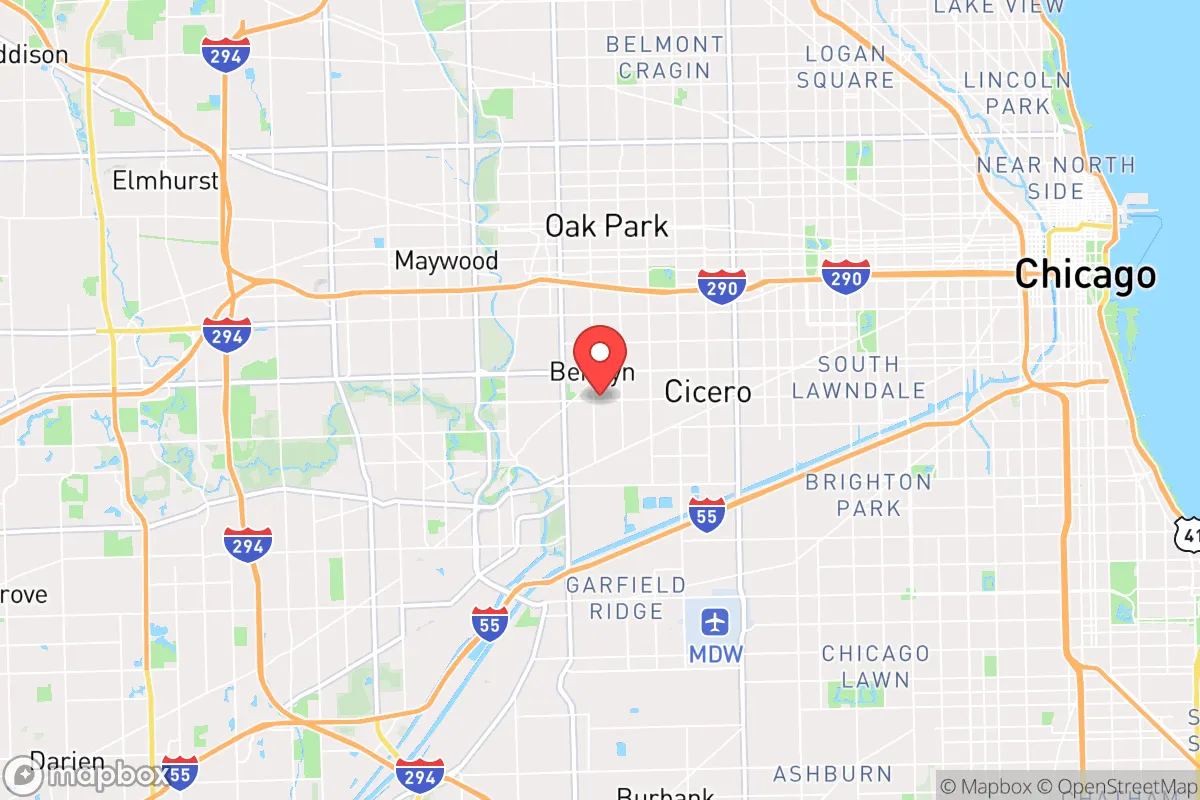
Photo: Wikipedia
Political ClimatePolitical Climate in Berwyn, IL
District shown is the primary district for this city’s centroid. Cities may span multiple districts.
Local Political AnalysisPolitical Analysis of Berwyn, IL
Berwyn, Illinois, has been a reliably Democratic stronghold for decades, and that hasn't changed much. The Cook Partisan Voting Index (PVI) for the area sits at D+17, meaning it leans about 17 points more Democratic than the national average. If you've lived here as long as I have, you've watched the local politics shift from a more moderate, working-class machine to a much more progressive, activist-driven scene. It's not just about party registration anymore; it's about a whole different set of priorities that feel less about local concerns and more about national ideological battles.
How it compares
To really understand Berwyn's politics, you have to look at the neighbors. Head west a few miles to Cicero, and you'll find a much more conservative, blue-collar, and family-first atmosphere. Cicero's politics are still very much about jobs, public safety, and keeping taxes in check. Drive north to Oak Park, and you're in a hyper-progressive bubble where every new policy seems to be a social experiment. Berwyn sits right in the middle, but the pull is definitely toward Oak Park's direction now. The old-timers who remember when Berwyn was a quiet, safe, and affordable place to raise a family are being outnumbered by newcomers who see the city as a blank canvas for progressive policies. The contrast with Cicero is stark—you can practically feel the difference in the air when you cross the border.
What this means for residents
For the average resident who just wants to live their life without government getting in the way, the trend is concerning. The local government has become more willing to impose new regulations on small businesses, push for higher property taxes to fund social programs, and embrace a "sanctuary city" stance that prioritizes non-citizens over long-term residents. Property taxes in Berwyn are already among the highest in Cook County, and the appetite for new spending shows no sign of slowing down. If you own a home or run a small shop, you're feeling the squeeze. The school board and city council are increasingly filled with activists who see every issue through a political lens, rather than a practical one. Personal freedoms like the right to choose your own healthcare, the right to keep and bear arms, and the right to send your kids to a school that aligns with your values are all under constant pressure from the local progressive majority.
What daily life is like for families
If you're a conservative or even a moderate, you learn to keep your head down. It's not that you can't speak your mind, but you'll quickly find yourself on the outside of the local social circles. The neighborhood block parties and school events are dominated by people who assume everyone shares their political views. Many families I know are quietly looking at moving to DuPage County or even Will County where the tax burden is lower and the government is less intrusive. The long-term trajectory is clear: Berwyn is doubling down on a progressive agenda that prioritizes ideological conformity over the practical needs of its residents. If this trend continues, the city will become less affordable, less safe, and less free for anyone who doesn't march in lockstep with the new orthodoxy. It's a shame, because the bones of this town are still good—great architecture, solid housing stock, and a central location. But the politics are driving the life out of it.

State Political ClimatePolitical Climate in Illinois
State Political AnalysisPolitical Environment in the State
Illinois has been a reliably blue state in presidential elections since 1992, but that label hides a deep and growing internal divide. The Democratic coalition is powered almost entirely by Chicago and its inner suburbs, while the rest of the state—downstate, the collar counties, and the rural west—has shifted sharply Republican over the past two decades. The result is a state where a single metro area dictates policy for everyone else, and where the political trajectory has become increasingly concerning for anyone who values fiscal restraint, gun rights, or local control.
Urban vs. rural divide
The political map of Illinois is a study in extremes. Cook County, home to Chicago, casts roughly 40% of the state’s vote and delivers margins of 75-80% for Democrats. The city itself is the engine: Mayor Brandon Johnson’s administration has pushed progressive tax hikes, defund-the-police rhetoric, and sanctuary city policies. Surrounding suburban counties like DuPage and Lake, once reliably Republican, have flipped blue in recent cycles—DuPage went for Biden by 6 points in 2020 after voting for Trump in 2016. Meanwhile, downstate counties like Williamson, Jefferson, and Effingham vote Republican by 60-70% margins. The collar counties of McHenry and Kendall remain red-leaning but are under demographic pressure from Chicago exurban sprawl. The divide is so stark that some downstate counties have passed symbolic resolutions calling for secession from Illinois, though none have legal force.
Policy environment
Illinois’s policy environment is a case study in progressive governance run amok. The state has the second-highest property tax burden in the nation, with effective rates averaging 2.1%—double the national median. The income tax is a flat 4.95%, but a 2020 ballot measure to switch to a progressive rate (the "Fair Tax") was rejected by voters, a rare win for fiscal conservatives. The state’s pension system is underfunded by over $140 billion, driving annual budget crises. On education, Illinois mandates a "culturally responsive" teaching framework that critics say prioritizes activism over academics. Healthcare policy includes a state-level individual mandate and taxpayer-funded abortion coverage. Election laws are among the most permissive in the country: no voter ID requirement, automatic voter registration, and universal mail-in ballots—a system that has drawn scrutiny for ballot harvesting in downstate races. The state also has a "sanctuary state" law (the TRUST Act) that limits cooperation with federal immigration enforcement.
Trajectory & freedom
Over the past decade, Illinois has become less free across multiple dimensions. On gun rights, the 2023 "Protect Illinois Communities Act" banned the sale of many semi-automatic firearms and standard-capacity magazines, a direct infringement on Second Amendment rights that has sparked lawsuits and a massive surge in downstate gun sales. On parental rights, the state passed a law in 2021 requiring schools to adopt "inclusive" curriculum that includes LGBTQ+ topics, with no opt-out for parents. On medical freedom, Illinois mandates COVID-19 vaccines for healthcare workers and school staff, and has no religious exemption for school vaccine requirements. Property rights are under assault via a 2021 law that limits local zoning control over affordable housing projects. The only bright spot for liberty was the 2020 rejection of the progressive income tax, but that was a defensive win—the legislature keeps trying. The state’s trajectory is clearly toward more centralized control, less local autonomy, and fewer individual exemptions.
Civil unrest & political movements
Illinois has seen its share of political flashpoints. The 2020 George Floyd protests in Chicago turned violent, with looting and arson in the Loop and along Michigan Avenue, leading to a $45 million settlement for property damage. The city’s response—a soft-on-crime approach from State’s Attorney Kim Foxx—has fueled a suburban exodus. On the right, the "Illinois Freedom Caucus" in the state legislature has grown from 3 to 12 members since 2021, pushing back on gun bans and school mandates. Downstate counties like Effingham have passed "Second Amendment sanctuary" resolutions. Immigration politics are a constant tension: Chicago’s sanctuary status has drawn thousands of migrants from the southern border since 2022, overwhelming city services and sparking backlash in working-class neighborhoods. Election integrity remains a hot-button issue: the 2022 governor’s race saw allegations of ballot harvesting in downstate counties, though no major prosecutions followed. The most visible flashpoint for a new resident would be the stark contrast between Chicago’s progressive activism and the "live and let live" culture of rural Illinois.
Projection
Over the next 5-10 years, Illinois is likely to become more blue and more divided. Demographic trends favor Democrats: Chicago’s population is stabilizing after a decade of loss, while the collar counties continue to diversify and shift left. Downstate counties are losing population and political clout, meaning their Republican votes matter less in statewide races. The state’s fiscal trajectory is unsustainable—pension costs will crowd out spending on roads, schools, and public safety, likely forcing either massive tax hikes or service cuts. The gun ban will likely survive legal challenges at the state level, but may be overturned by the Supreme Court. In-migration patterns are negative: Illinois lost over 100,000 residents per year from 2020-2024, mostly to Florida, Texas, and Indiana. Those who stay will face higher taxes, less personal freedom, and a political system that increasingly ignores the concerns of anyone outside Cook County. A new resident moving in now should expect a state where the government is actively expanding its reach into daily life, and where the only real check on that power is the ballot box—which, given the demographic math, is unlikely to flip anytime soon.
Bottom line for a new resident: If you value low taxes, gun rights, school choice, and local control, Illinois is a tough place to live. The state’s political trajectory is toward more progressive governance, higher costs, and less individual freedom. The best you can do is pick a red-leaning suburb like McHenry or Yorkville, or a downstate town like Effingham or Marion, where local culture still pushes back against Springfield’s overreach. But even there, state law will override local preferences on guns, education, and taxes. For a conservative-leaning family or individual, Illinois is a state to approach with eyes wide open—and a strong exit strategy.
* Values derived from national, state, county, city and local statistics and may differ in a specific area. Last updated: 2026-04-30T07:03:34.000Z
Narrative content on this page is AI-generated and may contain mistakes. Verify any details that matter before acting on them.
ReloMaps may earn a commission from affiliate links at no extra cost to you.

