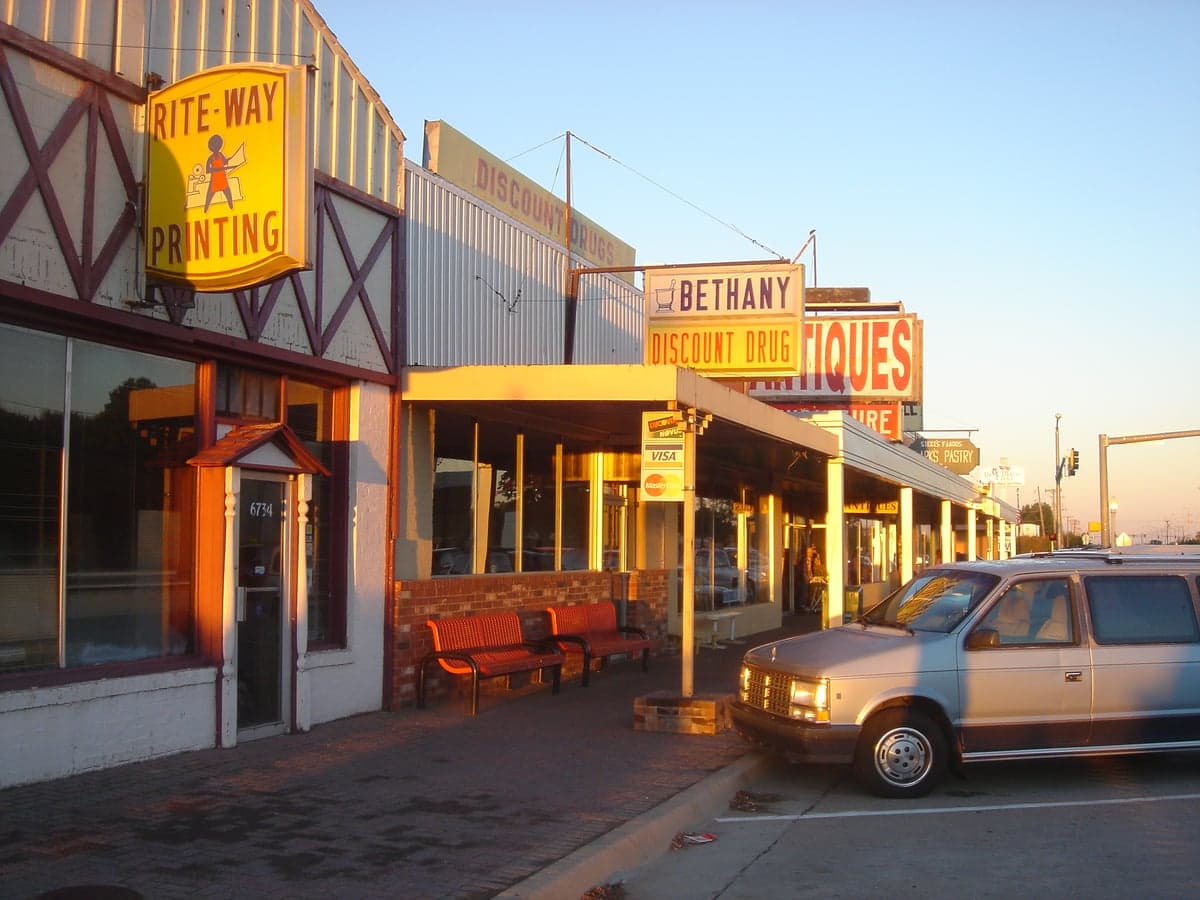
Photo: Wikipedia
Demographics of Bethany, OK
Affluence Level in Bethany, OK
A below-average socioeconomic profile. Incomes, home values, and educational attainment trail the U.S., with higher poverty and unemployment.
People of Bethany, OK
The people of Bethany, Oklahoma, today number 20,606 and form a compact, family-oriented community with a distinctly conservative character. The city is notably denser than its suburban peers, with a population that is 56.6% White, 21.6% Hispanic, 10.9% Black, and 5.4% foreign-born, creating a working-to-middle-class mosaic anchored by Southern Nazarene University. Bethany’s identity is shaped by its historic role as a religious college town and a post-war bedroom community for Oklahoma City, giving it a stable, church-centered social fabric that contrasts with the faster growth of nearby suburbs.
How the city was settled and grew
Bethany was founded in 1909 as a planned community around the Nazarene Church’s Bethany-Peniel College (now Southern Nazarene University), drawing its first wave of residents from devout Protestant families across the Plains and Midwest. The original settlers were overwhelmingly White, native-born Oklahomans and transplants from Kansas, Missouri, and Texas who came for religious education and affordable land. The historic College Hill neighborhood, centered on NW 39th Street and College Avenue, became the heart of this early community, with faculty homes and student boarding houses lining the tree-shaded blocks. A second wave arrived during the 1930s Dust Bowl and Great Depression, when displaced farmers from western Oklahoma and the Texas Panhandle moved into modest homes in the Central Park area, seeking work in Oklahoma City’s growing oil and manufacturing sectors. By 1950, Bethany’s population had reached roughly 5,000, almost entirely White and native-born, with a strong Nazarene cultural influence that discouraged alcohol sales and shaped local ordinances still on the books today.
Modern era (post-1965)
The post-1965 immigration reforms had a modest direct effect on Bethany, but the city’s real demographic shift came from domestic migration and suburban expansion. The 1970s and 1980s saw the construction of affordable ranch-style homes in the Westwood and Lake Overholser neighborhoods, attracting young families from Oklahoma City’s inner core who sought lower taxes and better schools. These areas remain predominantly White and middle-class today. The most significant change began in the 1990s, when Hispanic families—many from Texas and Mexico—moved into the Briarwood and Village Green apartment complexes and older housing stock near NW 23rd Street. By 2020, the Hispanic share had risen to 21.6%, making Bethany one of the most Hispanic cities in the Oklahoma City metro outside of the capital itself. The Black population, now 10.9%, grew more slowly, concentrated in the Sunset Hills area and the eastern edge of town near Meridian Avenue, drawn by affordable rentals and proximity to Oklahoma City’s employment centers. The foreign-born share (5.4%) is notably lower than the national average, and the Asian population (0.6%) remains very small, with no significant Indian subcontinent community recorded.
The future
Bethany’s population is slowly homogenizing in some respects while diversifying in others. The White share has declined from roughly 80% in 1990 to 56.6% today, but the city is not tribalizing into stark enclaves—Hispanic and Black residents are dispersed across most neighborhoods, with only College Hill remaining heavily White and college-affiliated. The Hispanic community is growing steadily through both immigration and higher birth rates, but it is also assimilating: second-generation Hispanic residents are increasingly English-dominant and integrated into local churches and civic life. The Black population appears stable, with no major in-migration from other states. The Asian and Indian populations are negligible and unlikely to grow significantly given the lack of high-tech employment or university research facilities. Over the next 10–20 years, Bethany will likely see continued Hispanic growth to perhaps 30–35% of the population, while the White share settles around 50%. The city’s density and limited land for new construction mean it will not explode in size like Mustang or Yukon; instead, it will become a more diverse, still conservative, and increasingly Hispanic small city.
For someone moving in now, Bethany offers a stable, family-oriented community with a clear religious and conservative identity, where demographic change is gradual and largely assimilative. The city is becoming more Hispanic and more diverse, but it is not fragmenting into polarized enclaves—newcomers will find a place where church membership, school involvement, and neighborly familiarity still define daily life. The trade-off is limited growth and limited economic dynamism; Bethany is a place to settle, not to strike out in a new industry.

* Values derived from national, state, county, city and local statistics and may differ in a specific area. Last updated: 2026-04-25T13:50:27.000Z
Narrative content on this page is AI-generated and may contain mistakes. Verify any details that matter before acting on them.
ReloMaps may earn a commission from affiliate links at no extra cost to you.

