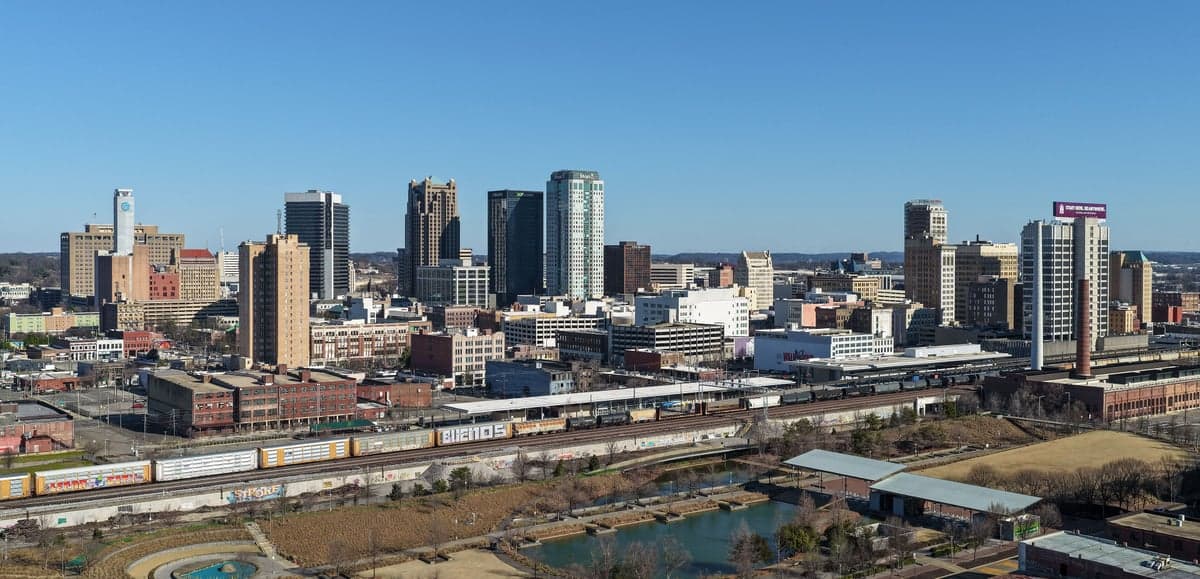
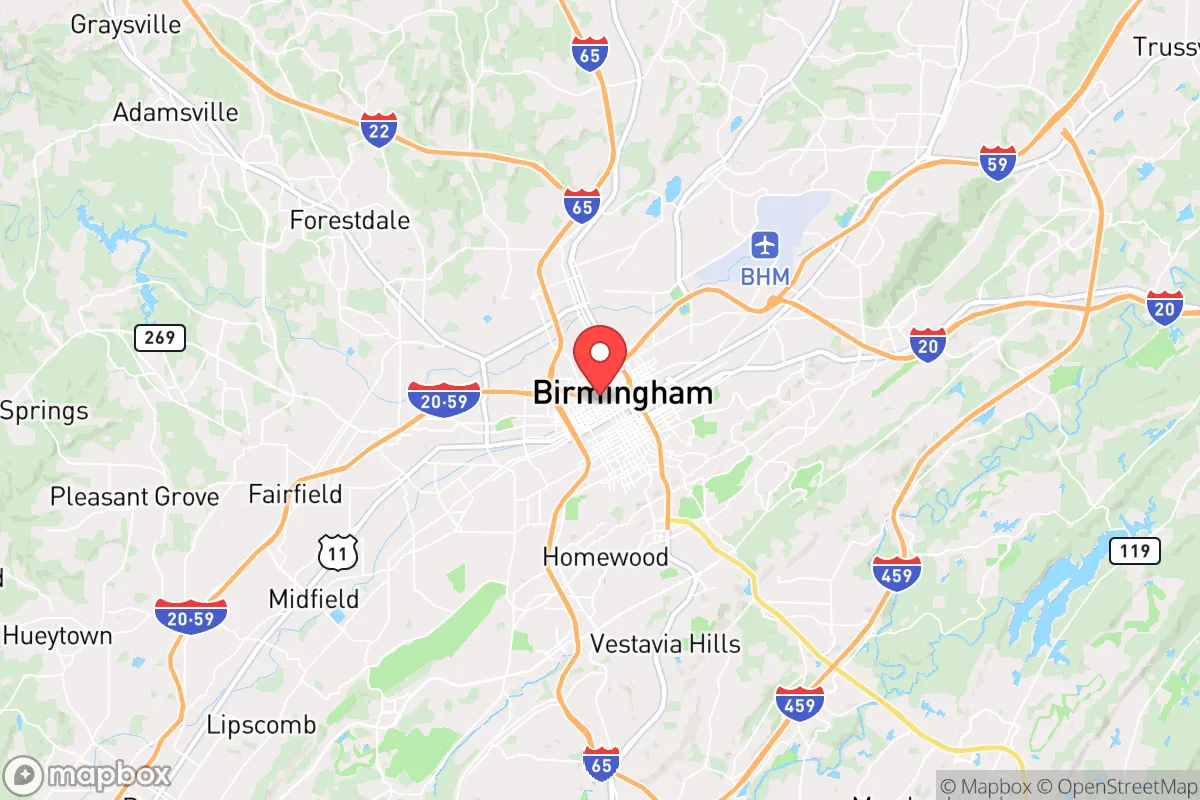
Photo: Wikipedia
Quality of Life in Birmingham, AL
A high quality of life with strong walkability, manageable living costs, healthy neighborhood signals, and solid amenity access.
What does Quality of Life tell us?
Quality of Life blends cost of living, nearby amenities, socioeconomic signals, and neighborhood character. City-level scores represent the whole municipality; individual neighborhoods can differ.
What does this tell us?
Quality of Life blends cost of living, nearby amenities, socioeconomic signals, and neighborhood character. City-level scores represent the whole municipality; individual neighborhoods can differ.
Cost of Living
26% below national average
The Real Cost of Living in Birmingham, AL for 2026
| Tier | Individual | Family (4) |
|---|---|---|
| Survival | $17k | $31k |
| Comfortable | $28k | $41k |
| Luxury | $80k+ | $124k+ |
| Elite (Top 5%) | $122k+ | $189k+ |
109%
The Area Signal
A metric tracking the socioeconomic signals of the area.


Hobbies
Explore the areaGroceries
5 within 10 miles
Gas
0 within 10 miles
Hospital
3 within 20 miles
Airport
ATL — Hartsfield–Jackson Atlanta International
Post Office
USPS — Birmingham, AL
Critical Amenities
Quality-of-Life Analysis
Birmingham, Alabama, offers a quality of life defined by its remarkably low cost of living, which attracts a diverse mix of young professionals, families, and retirees seeking economic breathing room without sacrificing urban amenities. With a cost of living index of 74 (26% below the U.S. average), the city provides a financial cushion that allows residents to allocate more income toward housing, savings, or recreation compared to peers in pricier Sun Belt metros like Nashville or Atlanta. The population skews slightly younger than the national median, driven by growing healthcare and tech sectors, while a stable base of long-term residents contributes to a strong sense of community and civic pride.
Cost of living, housing affordability, and how Birmingham compares to nearby areas
Birmingham’s housing market is a standout advantage for newcomers. The median home value sits at $138,600, roughly one-third of the national median, while the median rent of $1,047 is well below the $1,400+ averages seen in comparable Southern metros like Charlotte or Nashville. This affordability extends to utilities, groceries, and transportation, all of which track below national benchmarks. Compared to nearby suburbs such as Mountain Brook or Vestavia Hills—where median home values exceed $400,000—Birmingham proper offers entry-level buyers and renters a path to homeownership that is increasingly rare in the U.S. The average commute of 21.5 minutes is shorter than the national average of 26 minutes, reducing daily stress and transportation costs for workers commuting to downtown, UAB, or the growing industrial corridor along I-65.
Amenities, schools, and the daily rhythm of life in Birmingham
Daily life in Birmingham balances urban convenience with a relaxed, community-oriented pace. The city’s revitalized downtown and Lakeview districts offer a growing roster of breweries, farm-to-table restaurants, and live music venues, while Railroad Park and Red Mountain Park provide green space for jogging, cycling, and family outings. The Birmingham City Schools system has faced challenges with funding and performance, but magnet programs at schools like Ramsay High School and the Alabama School of Fine Arts draw motivated students from across the metro. For families, the presence of the UAB Health System—the state’s largest employer—anchors world-class medical care and a steady stream of cultural events, from the Sidewalk Film Festival to the Birmingham Museum of Art. The rhythm of life here is slower than in hyper-growth Sun Belt cities, with less traffic congestion and a stronger emphasis on local community events, such as the Pepper Place Saturday Market and Magic City Classic football game.
Birmingham is best suited for individuals and families who prioritize affordability and a slower pace over the nonstop energy of larger metros. Young professionals in healthcare, engineering, or education will find a robust job market anchored by UAB and regional corporate headquarters like Regions Financial and Shipt. Retirees on fixed incomes benefit from the low housing costs and mild winters, while families willing to navigate the school choice landscape can access strong magnet and private options. The city’s ongoing downtown revitalization and growing food scene appeal to creatives and entrepreneurs, though those seeking a 24-hour nightlife or rapid career growth in tech may find Birmingham’s scale limiting. Overall, it offers a high quality of life for those who value financial flexibility, community connection, and access to nature without the premium price tag of other Southern cities.

Crime in Birmingham, AL
Significantly higher crime rates than 93% of comparable U.S. locations.
Violent CrimeViolent Crime Analysis
Property CrimeProperty Crime Analysis
Crime Analysis
Birmingham, Alabama, faces a serious public safety challenge, with crime rates that significantly exceed both state and national averages. The city recorded a violent crime rate of 1,233.9 incidents per 100,000 residents and a property crime rate of 4,429.5 per 100,000 in the most recent reporting period. These figures place Birmingham among the most dangerous large cities in the United States, a reality shaped by a combination of socioeconomic factors and, critically, the policies of a progressive local justice system that prioritizes offender rehabilitation over public protection.
Crime in context
To understand the severity of Birmingham's situation, these rates must be compared to broader benchmarks. The national average for violent crime is roughly 380 per 100,000, meaning Birmingham's rate is more than three times higher. Alabama's statewide violent crime rate is approximately 520 per 100,000, making Birmingham's figure nearly 2.4 times the state average. Property crime in Birmingham is also elevated, running about 2.5 times the national average of roughly 1,950 per 100,000. These disparities are not random; they correlate directly with the policies of Jefferson County's district attorney and local judges, who have adopted progressive stances on bail reform, sentencing guidelines, and diversion programs. While intended to reduce incarceration, these policies have resulted in a revolving door for repeat offenders, undermining deterrence and leaving residents vulnerable.
What residents experience
For those living in Birmingham, the statistical reality translates into a daily calculus of risk. Violent crime—including aggravated assault, robbery, and homicide—is concentrated in specific areas but casts a shadow over the entire city. Property crimes like burglary, theft, and motor vehicle theft are pervasive, affecting both residential neighborhoods and commercial districts. Residents report that car break-ins and home burglaries are common occurrences, even in areas with active neighborhood watches. The progressive approach of local courts, which often favors plea deals and reduced sentences for property and drug offenders, means that many perpetrators are back on the streets quickly, eroding community trust in the justice system. This creates a cycle where victims feel the system is not on their side, and potential offenders face few consequences.
Neighborhood-level variation is stark, however. Areas like Mountain Brook, Vestavia Hills, and Homewood—independent municipalities within the metro area—have their own police forces and far lower crime rates, often comparable to national averages. In contrast, neighborhoods within Birmingham city limits such as Ensley, Woodlawn, and parts of the West End experience the highest concentrations of violent crime. Prospective residents should prioritize living in the suburban municipalities or in well-patrolled, higher-income enclaves like Redmont Park or Forest Park, while being aware that even these areas are not immune to property crime. The overarching factor remains the progressive judicial philosophy in Jefferson County, which directly contributes to a higher number of active criminals on the street and a diminished sense of justice for victims and the law-abiding public.
* Values derived from national, state, county, city and local statistics and may differ in a specific area. Last updated: 2026-04-19T18:45:00.000Z
Narrative content on this page is AI-generated and may contain mistakes. Verify any details that matter before acting on them.
ReloMaps may earn a commission from affiliate links at no extra cost to you.

