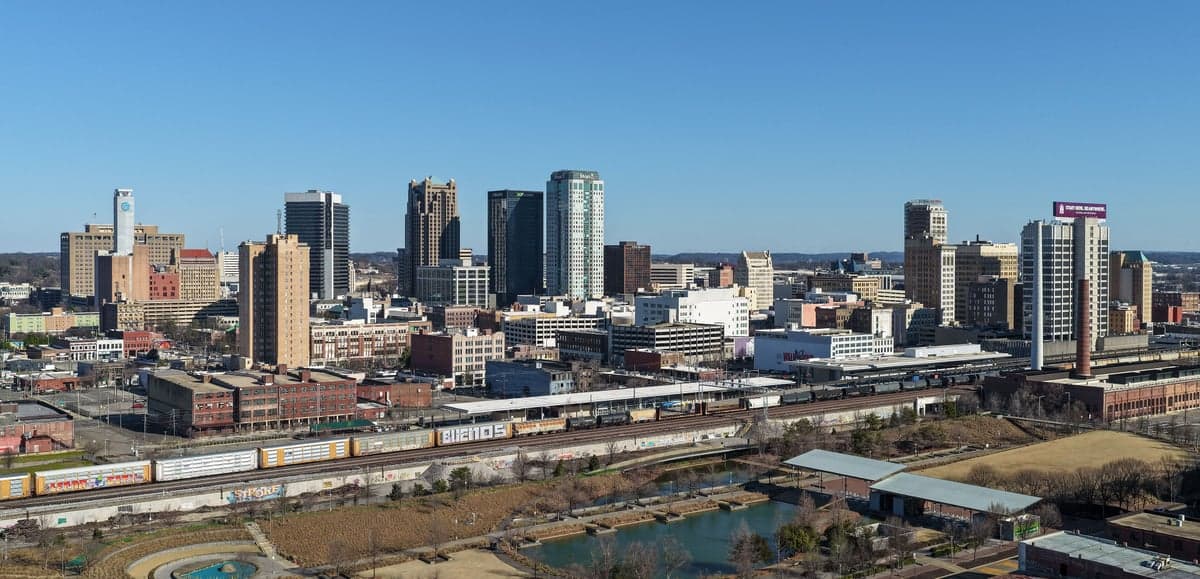
Photo: Wikipedia
Political ClimatePolitical Climate in Birmingham, AL
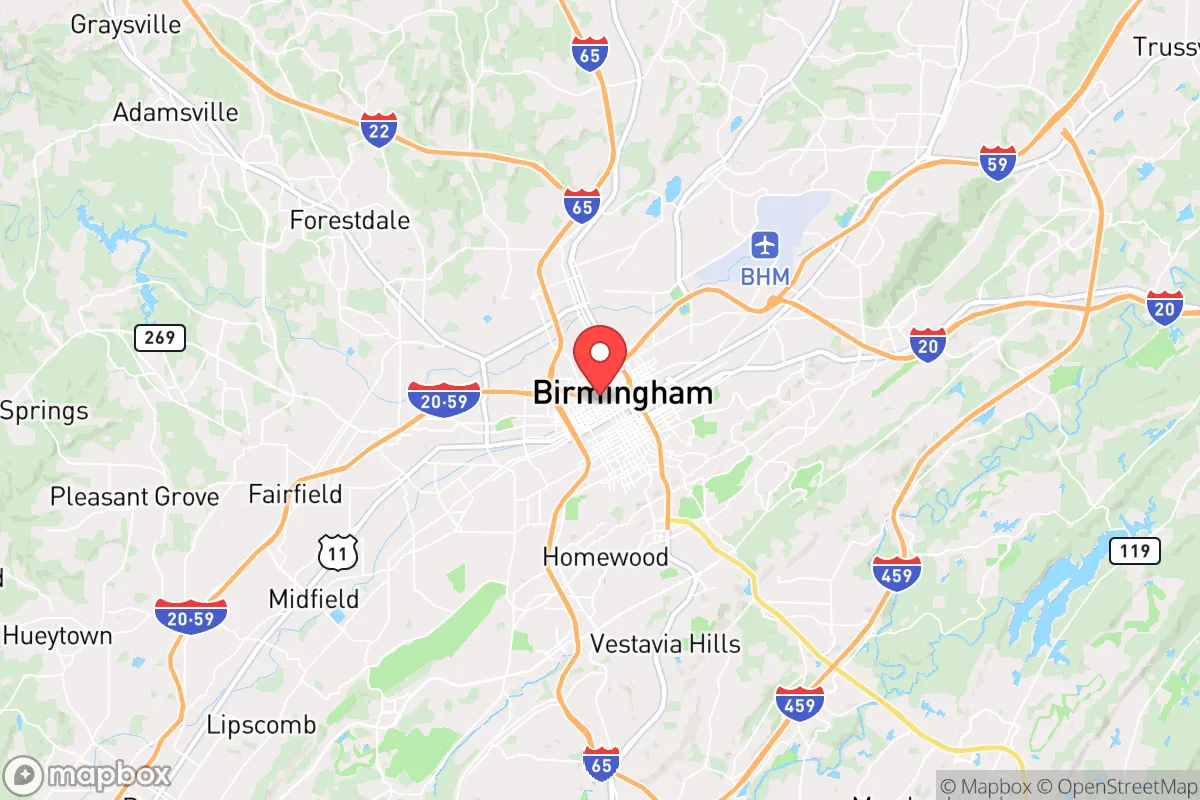
District shown is the primary district for this city’s centroid. Cities may span multiple districts.
Local Political AnalysisPolitical Analysis of Birmingham, AL
Birmingham, Alabama, has a Cook PVI of D+13, meaning it votes about 13 points more Democratic than the national average, and that lean has only gotten stronger over the last decade. If you’ve been around here long enough, you remember when the city had a more moderate, business-friendly Democratic streak—folks who were conservative on social issues but voted blue out of habit. Now, it’s a different animal. The local government and county commission have shifted hard toward progressive policies, and the surrounding suburbs—places like Hoover, Vestavia Hills, and Mountain Brook—are where you’ll find the reliably red votes that balance out the state. But inside the city limits, it’s a one-party show, and that’s where the rubber meets the road for anyone who values personal freedoms and limited government.
How it compares
Drive 15 minutes south to Hoover or 20 minutes east to Trussville, and you’re in a completely different political world. Those suburbs vote +20 to +30 Republican in most elections, and their city councils tend to focus on low taxes, public safety, and keeping regulations light. Birmingham itself, by contrast, has a city council that’s increasingly comfortable with government overreach—think mask mandates that lasted longer than the state allowed, business closure orders that hit small shops harder than big chains, and a general attitude that the city knows better than you do. The contrast is stark: you can live in a red suburb, work in the city, and feel like you’re crossing a border every time you drive in. The state legislature in Montgomery often has to step in to rein in Birmingham’s more aggressive local ordinances, which tells you everything about the tension between the city’s progressive drift and the rest of Alabama’s conservative values.
What this means for residents
For a family or a small business owner, the political climate here means you need to stay sharp. Property taxes in Birmingham are higher than in the suburbs, and the city has a habit of adding fees and regulations that make it harder to just run your life without asking permission. The school system is a mess—underfunded and overregulated—which is why so many families with kids either go private or move to Shelby County. If you value your Second Amendment rights, you’ll notice the city council has floated gun control measures that would never fly in the rest of the state. And on the cultural front, the city government has pushed hard on things like renaming streets and removing monuments, which feels less like progress and more like a distraction from real problems like crime and potholes. The long-term trend is concerning: each election cycle brings in younger, more progressive candidates who see government as the solution to everything, not a necessary evil to be kept in check.
One thing that hasn’t changed is the city’s deep-rooted civil rights history, but the way it’s used today feels different. Back in the day, the fight was about equal treatment under the law—a conservative principle at its core. Now, the same language is used to push policies that pick winners and losers, often at the expense of small businesses and individual choice. If you’re thinking about moving here, my honest advice is to look hard at the suburbs unless you’re absolutely set on being in the urban core. The city’s trajectory is toward more government control, not less, and that’s a hard road for anyone who believes in personal responsibility and limited interference from City Hall.

State Political ClimatePolitical Climate in Alabama
State Political AnalysisPolitical Environment in the State
Alabama is a deeply conservative state, with Republicans holding every statewide elected office and supermajorities in both legislative chambers, a position they’ve solidified over the past two decades. The state voted for Donald Trump by a margin of +25 points in 2024, a slight tightening from the +26-point spread in 2020, but still among the most Republican-leaning states in the nation. The dominant coalition is a mix of rural and suburban voters, evangelical Christians, and a growing number of conservative-leaning transplants from blue states, though a persistent Democratic stronghold in the Black Belt and parts of Jefferson County keeps the map from being a total monolith.
Urban vs. rural divide
The political map of Alabama is starkly divided between its few urban centers and the vast rural and suburban expanse. The Birmingham metro area, anchored by Jefferson County, is the state’s most Democratic-leaning region, with the city of Birmingham itself consistently voting over 70% Democratic. However, the surrounding suburbs—places like Hoover, Vestavia Hills, and Mountain Brook—are reliably Republican, though they’ve shown slight softening in recent cycles as educated professionals drift toward more moderate positions. The Huntsville metro, driven by the defense and aerospace industries, is a fascinating exception: it’s a growing, high-skill area that leans Republican but with a libertarian streak—think lower taxes, less regulation, and a live-and-let-live attitude that attracts engineers and entrepreneurs. Mobile and Montgomery are more mixed; Mobile County has trended redder as the city’s white working-class voters have shifted right, while Montgomery County remains a Democratic hold due to its large Black population. The rural Black Belt—counties like Lowndes, Wilcox, and Greene—votes overwhelmingly Democratic, but these areas are depopulating and have little political influence outside of legislative districts. The rest of the state—places like Cullman, Baldwin County (Fairhope, Daphne), and the Wiregrass (Dothan)—is deep red, with Republican margins often exceeding 40 points. The divide isn’t just urban vs. rural; it’s also cultural, with the coastal areas and Huntsville feeling more economically dynamic and open, while the rural interior is more culturally traditional and wary of outside influence.
Policy environment
Alabama’s policy environment is a mixed bag for a conservative audience. On the plus side, the state has no state-level property tax (only local), and the combined state and local tax burden is among the lowest in the nation—around 8.4% of income, according to the Tax Foundation. There’s no tax on Social Security benefits, and the state is gradually phasing out its income tax on retirement income, making it attractive for retirees. The regulatory posture is generally business-friendly, with a right-to-work law and minimal zoning restrictions outside of major cities. However, the state’s education policy is a sore spot: Alabama ranks near the bottom nationally in K-12 outcomes, and the school choice movement has made only incremental gains, with a limited charter school law and a modest Education Savings Account program passed in 2024 that covers only special-needs students and low-income families. Healthcare is another concern—Alabama did not expand Medicaid under the Affordable Care Act, leaving a coverage gap for about 200,000 low-income adults, and rural hospitals have been closing at an alarming rate. Election laws are solidly conservative: voter ID is required, early voting is limited to a single day (absentee only), and there are no same-day registration or automatic voter registration provisions. The state also passed a 2021 law restricting ballot drop boxes and curbside voting, which has held up in court.
Trajectory & freedom
On the trajectory of freedom, Alabama has been moving in a decidedly positive direction for conservatives over the past five years, though there are warning signs. The state passed a permitless carry law in 2022, allowing any law-abiding adult to carry a concealed firearm without a license—a clear expansion of Second Amendment rights. In 2023, the legislature passed the “Alabama Parental Rights Protection Act,” which requires schools to notify parents of any medical or counseling services provided to their children and prohibits instruction on sexual orientation or gender identity in K-5 classrooms. This was followed in 2024 by a law banning transgender athletes from female sports at all levels, from K-12 through college. On the medical autonomy front, Alabama has one of the strictest abortion bans in the country, with no exceptions for rape or incest, and the state has aggressively pursued prosecutions under the 2019 Human Life Protection Act. Property rights have been strengthened by a 2023 law limiting the ability of local governments to impose rent control or restrictive zoning. However, there are concerning trends: the state’s reliance on federal funding (about 40% of the budget) creates a vulnerability to federal mandates, and the growing influence of the tech and aerospace sectors in Huntsville is bringing in a more culturally liberal workforce that could shift the political calculus over time. The state also passed a 2024 law expanding the sales tax on digital goods and services, which some see as a creeping tax increase.
Civil unrest & political movements
Civil unrest in Alabama has been relatively muted compared to other states, but there have been notable flashpoints. The 2020 George Floyd protests in Birmingham and Montgomery saw some property damage and clashes with police, but they were smaller and shorter-lived than in cities like Atlanta or Portland. The state has a strong tradition of grassroots conservative activism, particularly around gun rights and school choice—the Alabama Citizens for Constitutional Freedom and the Alabama Policy Institute are active in lobbying for conservative legislation. Immigration politics are less heated than in border states, but there’s a growing concern about the influx of migrants through the southern border, with some local sheriffs in Baldwin and Mobile counties publicly vowing to cooperate with ICE. There’s no sanctuary city movement to speak of; in fact, the state passed a 2011 law (HB 56) that was one of the toughest anti-illegal immigration measures in the country, though parts were later struck down. Election integrity controversies have been minimal, with the 2020 and 2024 elections proceeding without major incident, though the state did conduct a forensic audit of the 2020 election in a few counties at the request of local activists. The most visible political movement in recent years has been the “Save Our Schools” campaign, which successfully pushed for the 2024 school choice expansion, and the “Alabama Freedom Alliance,” which organizes around Second Amendment and parental rights issues.
Projection
Over the next 5-10 years, Alabama is likely to remain deeply conservative, but the nature of that conservatism may shift. The biggest demographic trend is the influx of retirees and remote workers from blue states, particularly to the Gulf Coast (Fairhope, Gulf Shores) and the Huntsville area. These newcomers tend to be fiscally conservative but socially moderate, which could push the state toward a more libertarian-leaning Republicanism—think lower taxes, less regulation, but also a softening on social issues like marijuana legalization (medical cannabis is already legal but not yet operational) and maybe even gambling expansion. The Black Belt will continue to depopulate, reducing the Democratic base, while the Huntsville metro will grow, potentially creating a new political center of gravity that’s more tech-oriented and less culturally traditional. The biggest risk for conservatives is that the state’s poor education outcomes and healthcare gaps could drive away the very families and businesses that are moving in, or that federal pressure could force changes in areas like Medicaid expansion or voting laws. Expect continued battles over school choice, with a push for universal ESAs, and ongoing fights over local control vs. state preemption on issues like zoning and taxation. The state’s political leadership will likely remain in the hands of the Alabama Republican Party, but the internal factions—between the more traditional rural conservatives and the upstart libertarian-leaning suburbanites—will become more pronounced.
For a new resident, the bottom line is that Alabama offers a high degree of personal freedom in many areas—gun rights, low taxes, parental control over education—but comes with trade-offs in public services, particularly schools and healthcare. If you’re moving here, you’ll want to choose your location carefully: Huntsville or the Gulf Coast for economic opportunity and a more dynamic culture, or a smaller town like Cullman or Auburn for a slower pace and stronger community ties. The state is trending in the right direction on most conservative priorities, but it’s not a paradise—you’ll still have to navigate a state government that can be slow to change and a local political scene that’s often more about personality than policy. If you value low taxes, gun rights, and a culture that respects traditional values, Alabama is a solid bet. Just don’t expect it to stay exactly the same—the newcomers are already changing the conversation.
* Values derived from national, state, county, city and local statistics and may differ in a specific area. Last updated: 2026-04-19T18:45:00.000Z
Narrative content on this page is AI-generated and may contain mistakes. Verify any details that matter before acting on them.
ReloMaps may earn a commission from affiliate links at no extra cost to you.

