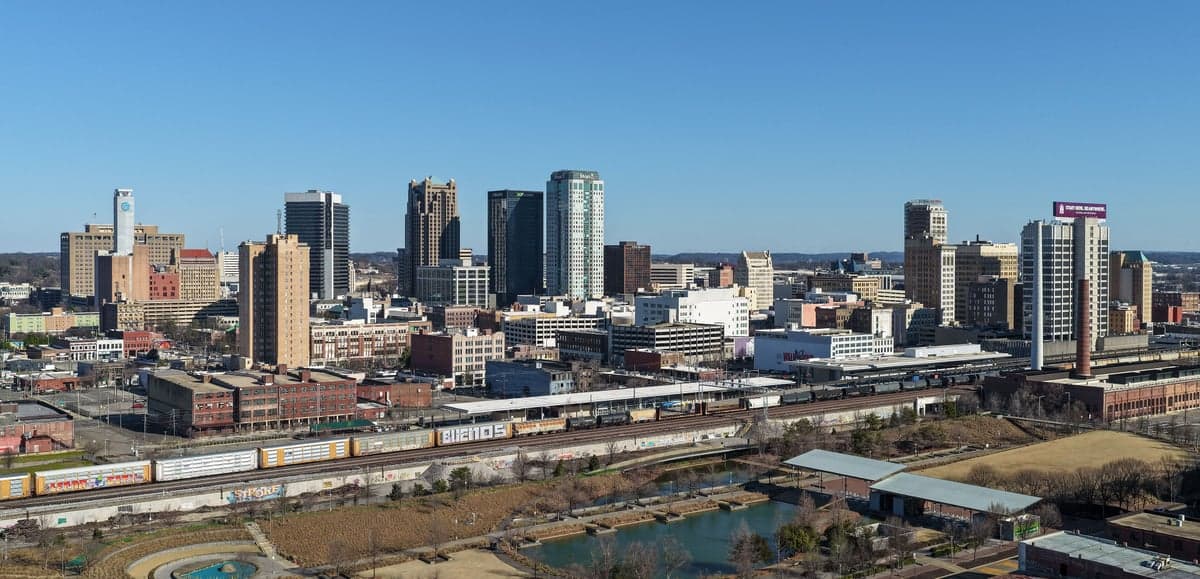
Photo: Wikipedia
Strategic Assessment of Birmingham, AL
Meaningful friction. Expect exposure to either population pressure, blast zones, or natural disaster risk. Consider buying a retreat property.
What does the Strategic Assessment tell us?
Our Strategic Assessment grades tactical survivability of an area. Major population centers, military targets, fallout zones, natural disasters, and border exposure all drive risk — lower exposure means a more defensible position in a crisis.
This is heavily inspired by Joel Skousen's Strategic Relocation book. Highly recommended you checkout the book ($)What does this tell us?
Our Strategic Assessment grades tactical survivability of an area. Major population centers, military targets, fallout zones, natural disasters, and border exposure all drive risk — lower exposure means a more defensible position in a crisis.
This is heavily inspired by Joel Skousen's Strategic Relocation book. Highly recommended you checkout the book ($)Strategic Pillars

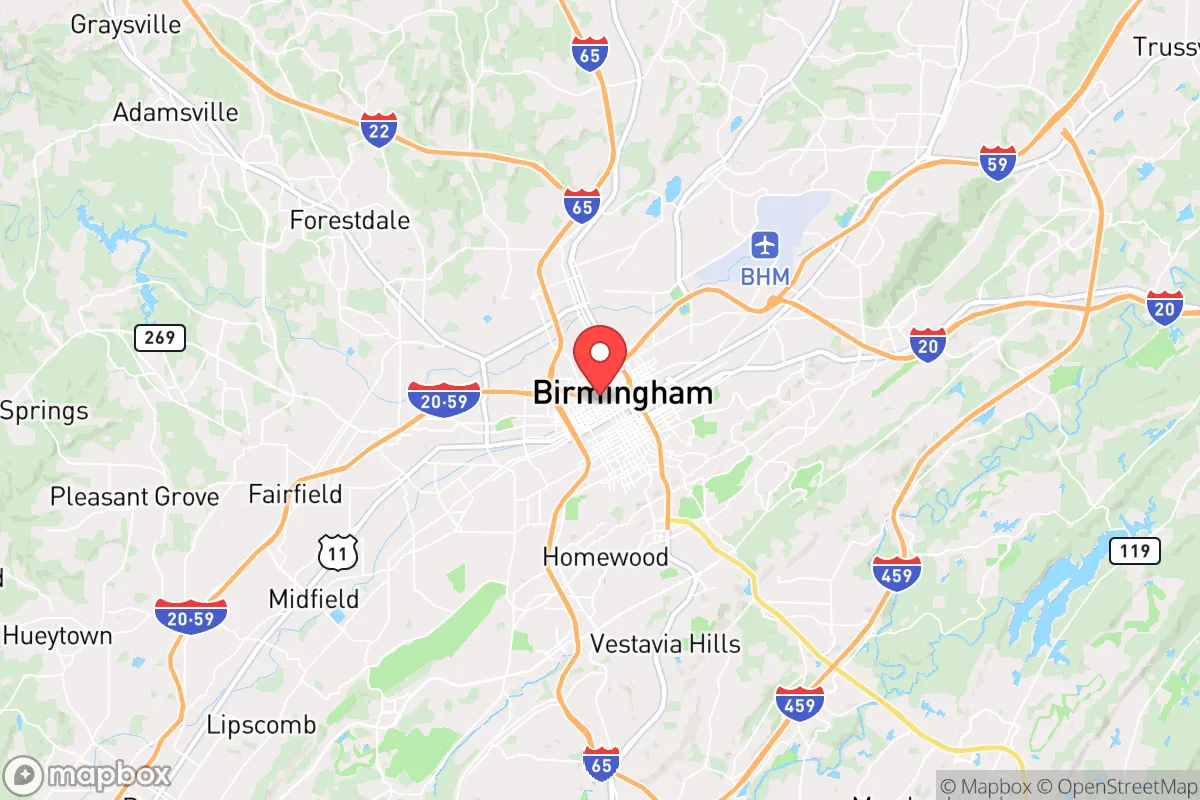
Key Distances
Regional Safe Places
Below is our recommended "safe zones" in Alabama and the surrounding area based on our strategic heuristics. For most people, it's unrealistic to live in a “safe zone” full-time due to work, family or other personal reasons. They tend to be more rural. However, many of these areas are perfect for second homes and retreat properties that double as a vacation home or even a short-term rental.
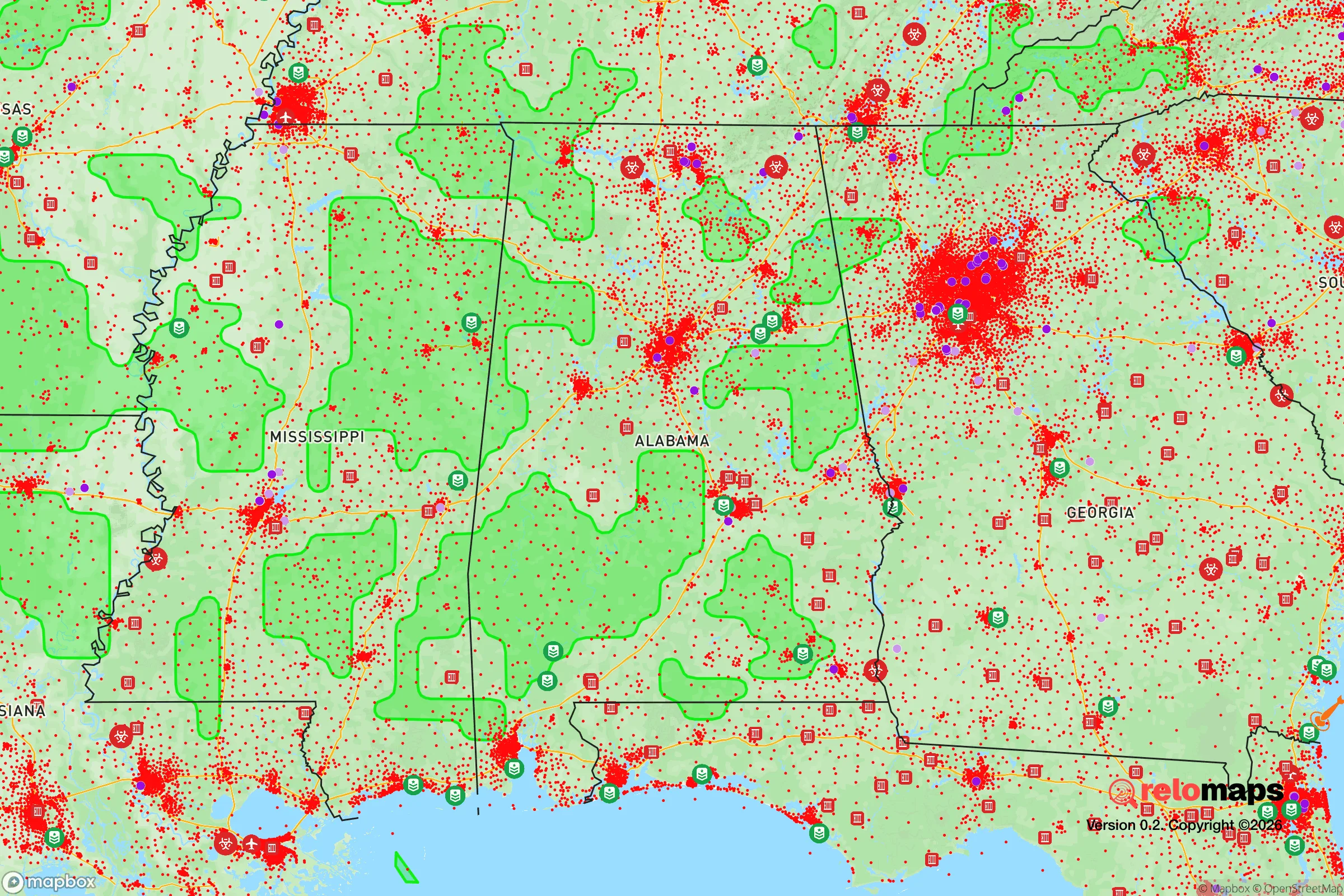
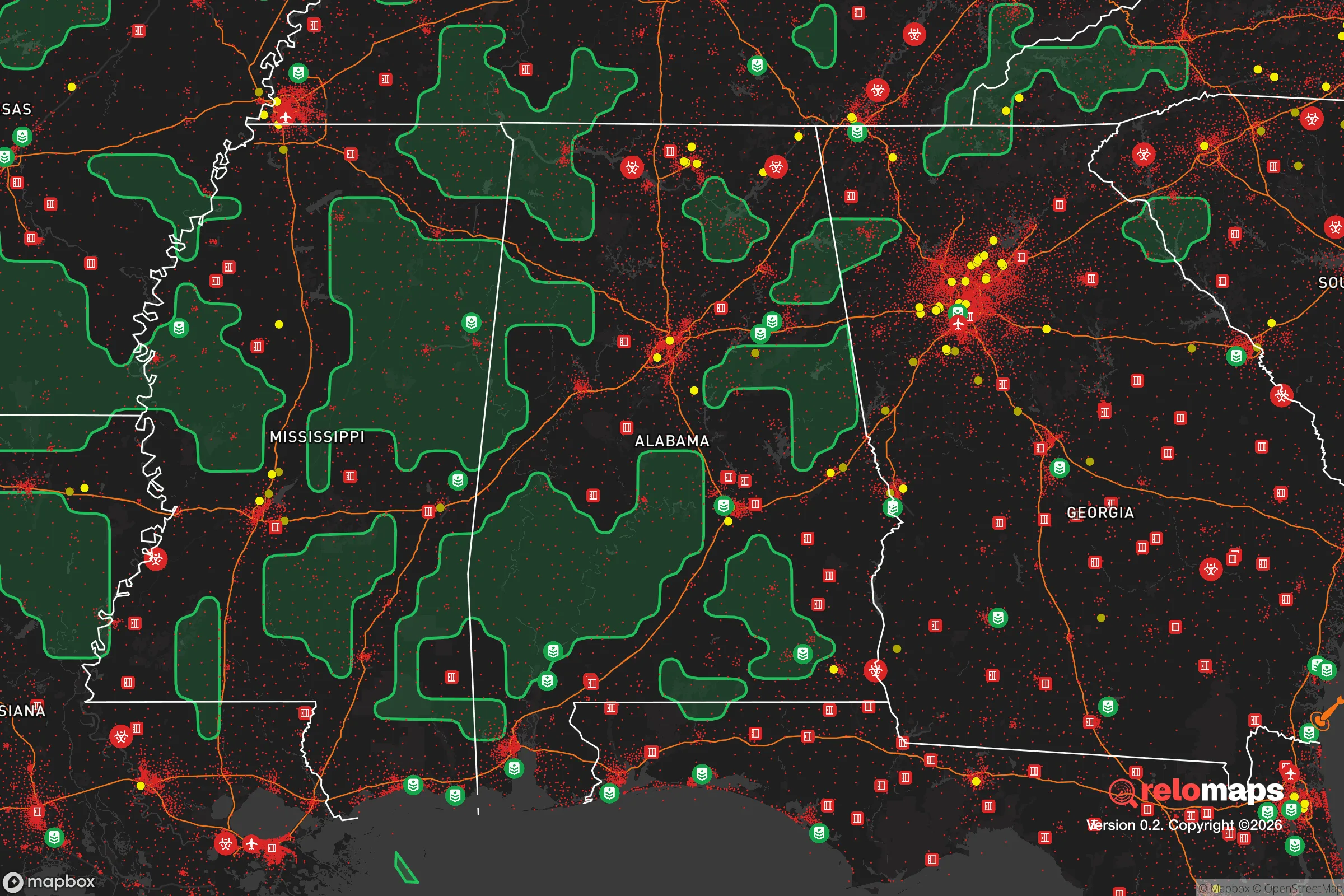


Important Note: For informational purposes only. This does not mean nothing bad ever happens in the green zones. Please use common sense. This is based on public data and modeled with AI. We tried to take a conservative approach but mistakes happen. We update this regularly as new information becomes available.
Solar Generator Recommendations
Backup power matters more here than in safer locations. We've picked three solar generators across budgets and capacity tiers — start with the budget unit if you only need a few essentials, or step up if you want to run a fridge and HVAC for days at a time.

Jackery Portable Power Station Explorer 300
Budget OptionPower on the Go: Weighing only 11 lbs, it's convenient to set up and store with book-sized foldable solar panels

BLUETTI Portable Power Station AC180
Designed for both indoor and outdoor scenarios, AC180 is highly capable as it has a robost capacity and continuous output power.

EF ECOFLOW DELTA Pro Ultra Power Station
Upgraded PickEcoFlow DELTA Pro Ultra is a whole-home energy system designed to grow with your family. Integrated with the Smart Home Panel 2, it scales to meet your evolving energy needs — keeping your home powered, intelligent, and secure through every stage of life.
We earn a commission, at no additional cost to you.
Strategic Assessment Analysis
Birmingham, Alabama, presents a mixed bag for the strategic relocator who prioritizes resilience and self-sufficiency. While its central location in the Deep South offers some logistical advantages, the city itself is a major population and industrial hub that introduces significant vulnerabilities. For those with a prepper or survivalist mindset, the key is understanding that Birmingham is not a retreat—it is a potential danger zone that demands a clear-eyed assessment of its proximity to high-value targets, its dependence on fragile infrastructure, and the practical realities of living in a region that could become a focal point during widespread unrest.
Geographic position and natural advantages for long-term survival
Birmingham sits in the Jones Valley, flanked by the Ridge and Valley province of the Appalachian foothills, giving it a defensible terrain that is rare for a major Southern city. The surrounding hills, including Red Mountain and Shades Mountain, provide natural chokepoints and elevated positions that could be leveraged for observation or retreat. The area's water resources are substantial: the Cahaba River runs through the metro, and the Black Warrior River lies to the west, offering reliable surface water even during drought. The climate is humid subtropical, with a growing season of roughly 220 days—long enough to sustain serious gardening and small-scale agriculture. However, the region's heavy clay soils require amendment for productive food plots, and the summer heat and humidity can be punishing for those without adequate cooling or water storage. The real advantage here is that Birmingham is not coastal, so it avoids hurricane storm surge and the worst of sea-level rise, but it is squarely in Tornado Alley's southern extension, with a history of violent EF4 and EF5 tornadoes—a risk that demands a reinforced safe room or basement.
Risks, exposures, and proximity to fallout-relevant landmarks
This is where the analysis gets sobering. Birmingham is home to the University of Alabama at Birmingham (UAB), one of the nation's largest academic medical centers, and a major regional banking and insurance hub. That economic density makes it a likely target for civil unrest, cyberattacks, or even physical attacks aimed at disrupting the national grid or financial systems. The city also hosts the Birmingham-Shuttlesworth International Airport, a FedEx hub, and multiple rail yards—all potential choke points that could be seized or destroyed in a coordinated event. More critically, Birmingham is within 150 miles of the Anniston Army Depot, which stores chemical weapons and conventional munitions, and within 200 miles of the Savannah River Site (nuclear weapons production) and the Oak Ridge National Laboratory (nuclear research). A major incident at any of these facilities could produce fallout or contamination that affects the metro area, depending on wind patterns. The city's industrial corridor along the I-65 and I-20 corridors includes steel mills, chemical plants, and a coal-fired power plant, all of which are potential secondary hazards during a grid-down scenario. For the prepper, Birmingham's proximity to these high-value targets is a clear negative—it is not a place to hunker down for the long haul.
Practical resilience for a relocator: food, water, energy, and defensibility
If you are considering a move to the Birmingham area, the practical question is whether you can build a resilient lifestyle within commuting distance of the city's jobs while staying clear of its worst risks. The suburbs to the south and east—places like Hoover, Vestavia Hills, and Chelsea—offer newer housing stock with basements and larger lots, but they are also bedroom communities with little local food production and heavy reliance on the grid. Water is generally reliable from Birmingham Water Works, but the system is aging and vulnerable to both cyberattack and physical sabotage; a well on your own property is a must for serious preparedness. The region's energy mix is heavily dependent on coal and natural gas, with some nuclear from the Browns Ferry plant (about 90 miles northwest). Solar potential is decent, but the frequent cloud cover from Gulf moisture reduces output compared to the Southwest. Defensibility is a mixed picture: the hills and hollows provide natural cover, but the suburban sprawl means your neighbors are close, and a grid-down scenario could quickly turn into a competition for resources. The best strategy for a relocator is to buy land at least 20 miles outside the urban core, preferably in a rural county like St. Clair or Blount, where you can have a well, septic, and enough acreage for a garden and livestock. Even then, you are within a two-hour drive of Birmingham's hospitals and supply chains, which is useful for pre-crisis stocking but a liability during a collapse.
The overall strategic picture for Birmingham is one of calculated risk. It is not a survivalist paradise, nor is it a doomed city. For the conservative-minded relocator who wants to stay connected to a regional economy while maintaining a low-profile, self-sufficient homestead, the exurbs of Birmingham offer a workable middle ground. But you must go in with eyes open: the city itself is a target, the infrastructure is fragile, and the natural risks are real. The smart play is to treat Birmingham as a resource hub for pre-crisis preparation—buy your tools, seeds, and medical supplies there—but have your retreat property already set up and stocked before you need it. If you are looking for a place to ride out a long-term disruption, look further into the Appalachian foothills, where the population density drops and the defensibility rises. Birmingham is a staging ground, not a sanctuary.

* Values derived from national, state, county, city and local statistics and may differ in a specific area. Last updated: 2026-04-19T18:45:00.000Z
Narrative content on this page is AI-generated and may contain mistakes. Verify any details that matter before acting on them.
ReloMaps may earn a commission from affiliate links at no extra cost to you.

