Photo: Wikipedia
Demographics of Blanco, TX
Affluence Level in Blanco, TX
A middle-class area roughly in line with national averages across income, home values, education, and employment.
People of Blanco, TX
The people of Blanco, Texas today number 2,336, forming a predominantly White (79.3%) and family-oriented community with a strong ranching and small-town identity. The Hispanic share stands at 14.2%, while foreign-born residents make up just 2.4% of the population, reflecting the city's limited immigration history. With 31.1% of adults holding a college degree, Blanco attracts a mix of working ranchers, retirees, and remote professionals seeking a conservative, rural lifestyle along the Blanco River.
How the city was settled and grew
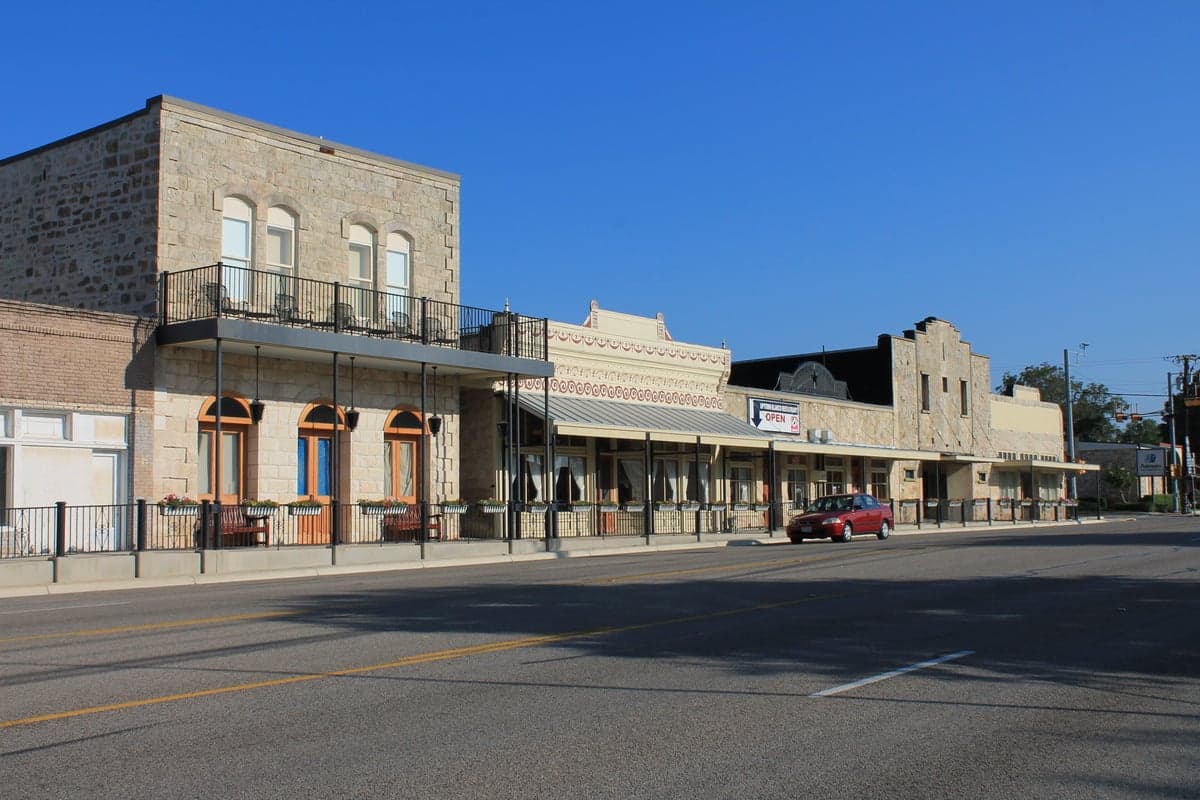
Blanco was founded in the 1850s when German and Anglo settlers arrived via land grants from the Texas Emigration and Land Company, drawn by the fertile valley of the Blanco River. The original town site, now the historic downtown district around the courthouse square, was platted in 1853. German immigrants built limestone homes and churches on the rise north of the square, an area still known as German Hill, where many of their descendants remain today. The River District, along the Blanco River, became the commercial and milling center, supporting a ranching economy that persisted through the early 20th century. Later domestic migrants from the South and Midwest arrived during the 1920s and 1930s, settling on rural homesteads along FM 165, but the population remained under 1,000 until the 1970s.
Modern era (post-1965)
After the 1965 Hart-Cellar Act, Blanco saw negligible international immigration; the foreign-born share remains just 2.4%, and East/Southeast Asian and Indian-subcontinent populations are statistically zero. Instead, domestic in-migration from the Austin-San Antonio corridor accelerated after 1990, bringing retirees and families seeking lower taxes and a slower pace. Newer subdivisions such as Blanco River Ranch and The Meadows, east of US 281, absorbed most of this growth. The Hispanic population, historically present but small, grew to 14.2% by 2020, concentrated in the River Road corridor and older rental stock near the downtown district. The Black population remains at 0.2%, and the college-educated share rose to 31.1% as remote workers and professionals moved in.
The

* Values derived from national, state, county, city and local statistics and may differ in a specific area. Last updated: 2026-05-14T18:31:56.000Z
Narrative content on this page is AI-generated and may contain mistakes. Verify any details that matter before acting on them.
ReloMaps may earn a commission from affiliate links at no extra cost to you.

